Middle East Shitshow - MESS

Middle East Shitshow - MESS

by Daniella Alpher
Season 1
Sixteen Tons of Concrete: What a Quiet August Actually Means
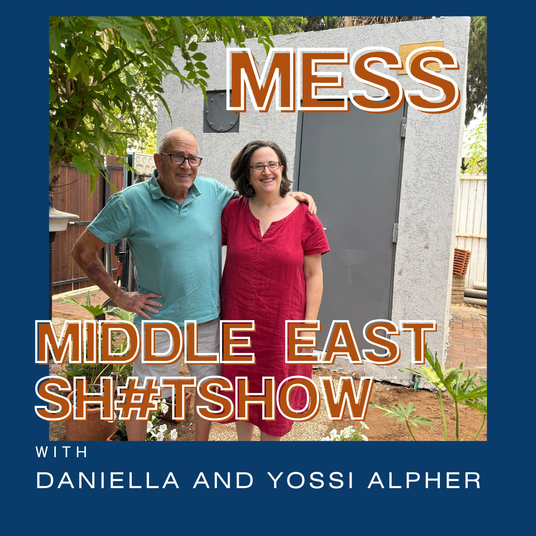
August is quiet, and Yossi doesn't trust it. He and Daniella map the fronts: Syria's new president signaling accommodation over the Golan Heights, settler violence turning the West Bank into the region's real flashpoint, encouraged by a government that needs those votes before elections, and why Iran, Hezbollah, and the Houthis each have reason to break the calm while Trump keeps Netanyahu on a leash until the American midterms. Underneath it all, the strange history binding Israel to the Houthis' ancestors, and a new shelter in the garden that Yossi expects will not stay a white elephant.
Every Front Is Quiet but One
Gaza is quiet. Lebanon is quiet. Even Iran, from Israel's standpoint, is quiet. So why does the West Bank look like it's being set alight on purpose? Daniella and Yossi examine the fear that Netanyahu wants conflict brewing before the end-of-October elections, violent enough to feed messianic-nationalist fervor, quiet enough to stay off international screens. Plus, the framework agreement with Lebanon and Iran's long arm over it, the funeral that got Bibi into the White House by a side entrance, the technocrat plan for Gaza, and why, since the assassination of Khamenei, nobody has a picture of who runs Iran.
The Iran Regime Change Fantasy
Reports that the Mossad explored working with former Iranian president Mahmoud Ahmadinejad as part of an effort to change Iran’s leadership sound almost too extraordinary to be true. Daniella and Yossi examine the reported plan and ask whether Israel confused its ability to penetrate Iran with an ability to understand and reshape it. Yossi also recalls being asked in 1979 whether the Mossad should kill Ayatollah Khomeini before his return to Tehran.
Hezbollah, Trump, and the Deal Israel Didn’t Get
From Switzerland to southern Lebanon, this episode follows the chain linking the Iran deal, Hezbollah, Trump, Netanyahu, and Israel’s strategic isolation. Daniella and Yossi revisit the history of US-Israel ties, debate whether Iran’s nuclear ambitions remain the central threat, and consider how Israel should think about survival in a less predictable Middle East.
Who Gets Left Out of the Conversation?
What happens when everyone talks about a conflict, but not with the people at the center of it? Daniella and Yossi Alpher discuss Israel’s exclusion from negotiations over a war it fought, think tanks that debate Israel without Israelis, and an Israeli political system that keeps avoiding both Palestinians and Arab citizens of Israel. The conversation ends with a more practical question: when Netanyahu and Trump lie on TV, do you mute them, or keep listening because they still matter?
The Gofman Case: What Makes a Head of Mossad
What does it take to lead the Mossad? In this episode, Daniella and Yossi Alpher trace the history of Israel’s intelligence leadership through stories of controversial appointments, unexpected successes, operational failures, and political entanglements. Along the way, they discuss Meir Dagan’s impact on the Mossad, Tzvi Zamir’s role before the 1973 war, the limits of Israeli involvement in Lebanon, and why the head of an intelligence service must know when to stay out of politics.
Israel-Abu Dhabi: Iron Dome, lasers and IDF boots on the ground
This week, Yossi and Daniella assess the real state of Iran's military capabilities after recent strikes, and what Israel's overblown assessments reveal about its chronic inability to define achievable war aims. They also explore the historic depth of Israel-UAE security cooperation, including cutting-edge missile interception technology and boots on the ground in Abu Dhabi, the UAE's departure from OPEC, and the ethical gray zones of Israeli arms exports from Iron Dome to the spyware used to track Jamal Khashoggi. The episode closes on the psychological toll of living under a sub-50% probability of Iranian attack.
Israel’s Strategic Dead Ends
In this episode of MESS, Daniella and Yossi Alpher step back from the headlines to examine a deeper problem: the repeated failure of Israeli strategy across multiple fronts. Going back to the idea of “mowing the lawn,” they examine why ceasefires and negotiations on three fronts do not necessarily produce security, why decapitation campaigns and proxy strategies so often fail to deliver lasting results, and how extremist movements can trap entire societies in recurring cycles of conflict. The conversation ranges across Gaza, Lebanon, Iran, and Israel itself, exploring the strategic limits of military power and the uncomfortable possibility that in much of the Middle East, the real challenge is not ending conflict, but learning how to live with it.
Mowing the Lawn, Not Winning the War
Is this ceasefire the end of the war, or just the end of this round? Daniella and Yossi Alpher argue that the campaign against Iran looks less like decisive victory and more like mowing the lawn: inflicting damage, buying a little time, and accepting that the threat will return. They break down the winners and losers so far: Iran, Israel, Trump, Netanyahu, Hezbollah, Saudi Arabia, and Lebanon, and ask what was actually achieved beyond tactical success. A hardheaded discussion of war aims, strategic illusions, and why the region may be heading not toward peace, but toward the next cycle.
A Heart Attack, Missile Alerts, and the Iran War
In this episode, Daniella and Yossi Alpher record remotely in the middle of the war with Iran after Yossi suffers a mild heart attack and undergoes emergency catheterization under missile alerts. From the hospital, the stairwell, and even the side of the road, they reflect on how Israel and Iran went from quiet partners to bitter enemies, the deeper Persian-Arab rivalry shaping the region, and why some of the war’s central assumptions are failing. They end with a grimly ordinary wartime question: how do you host Passover when your safe room has to fit 15 people?
1 of 2