JC Talks About Humanity

JC Talks About Humanity

by Jakub Chmielniak
Season 1

Why Are Humans Better Than Machines?

The "final word" on AI topic. Dr. Armada shows us why we, humans, are "indefinitely" better" than any machines or algorithms, including AI. This is not because of our emotions, but because of the way in which we are able to think.

Does the coming of AI mark the end of humanity? Conversation with Dr. P. Armada (part 2)

Continuation... What happens when a technology becomes powerful enough to make us question not only the future of work, politics or science — but the future of humanity itself? In this episode, I sit down with my former teacher, Paweł Armada — an independent scholar and author whose work explores political thought, civilization, humanism and the philosophical life. We begin with a simple but unsettling question: Does the coming of AI mark the end of humanity? Unlike previous technological revolutions, artificial intelligence has created a peculiar sense of existential anxiety. People speak not merely about disruption, but about humans becoming obsolete, subordinate to machines, or even replaced by them. Is that fear justified? Or does the apocalyptic narrative itself reveal something about the condition of modern man? Our conversation moves beyond the technical side of AI and into much deeper territory: human dignity, self-reliance, progress, science, power, civilization and what it actually means to live as a human being. If humanity is defined by more than intelligence alone, perhaps the most important question is not what AI will become — but what we choose to become in response to it.
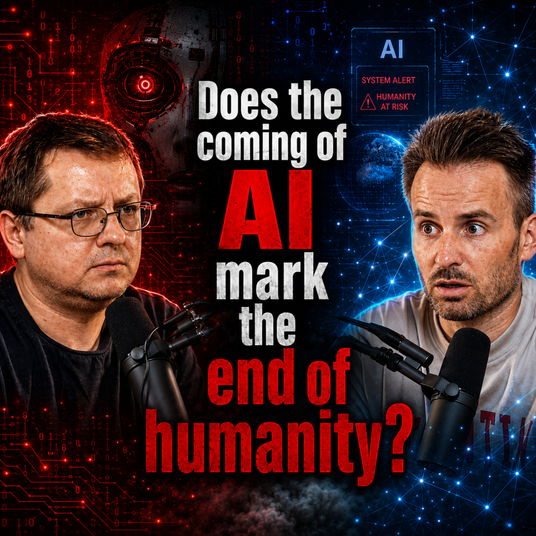
Does the coming of AI mark the end of humanity? Conversation with Dr. P. Armada

What happens when a technology becomes powerful enough to make us question not only the future of work, politics or science — but the future of humanity itself? In this episode, I sit down with my former teacher, Paweł Armada — an independent scholar and author whose work explores political thought, civilization, humanism and the philosophical life. We begin with a simple but unsettling question: Does the coming of AI mark the end of humanity? Unlike previous technological revolutions, artificial intelligence has created a peculiar sense of existential anxiety. People speak not merely about disruption, but about humans becoming obsolete, subordinate to machines, or even replaced by them. Is that fear justified? Or does the apocalyptic narrative itself reveal something about the condition of modern man? Our conversation moves beyond the technical side of AI and into much deeper territory: human dignity, self-reliance, progress, science, power, civilization and what it actually means to live as a human being. If humanity is defined by more than intelligence alone, perhaps the most important question is not what AI will become — but what we choose to become in response to it.