
Episode notes
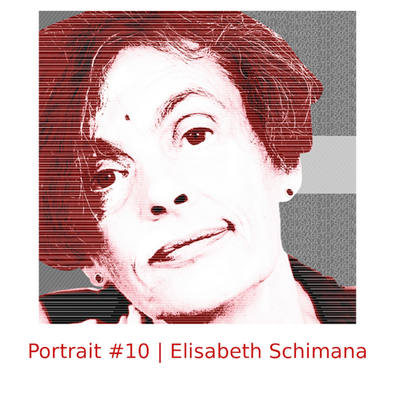
A portrait by Seppo Gründler & Johanna Moder (2018). Language: Deutsch
Text by Solar Winds, Milena Meller, 2018
At the end of a railway line lies a station called Seestadt. From there, you reach Sonnenallee, which leads to the place where Elisabeth Schimana will perform her piece "In die Sonne". It's hot at the end of Sonnenallee, which opens into a large construction site. At the edge of this site stands a simple hall where the electronic music festival is taking place, and Schimana is opening it. People are lying on the ground, surrendering to the music. The piece "In die Sonne" begins very quietly. Clouds have gathered into a dark front; something is banging loudly against the wall outside. Later, Elisabeth Schimana will rave about how beautifully these disturbances blended with her composition. The sun's vibrations fill the dark space, making it vibrate more as Schimana layers in more low frequencies.
Soils, Roots, Paths: In the context of her Virus series, Schimana speaks of the fertile ground on which the project was able to grow. For Virus, the listening experience of a performance of Iannis Xenakis's Terretektorh (1965/66) was a trigger. Schimana also cites her ongoing collaboration with Ö1 Kunstradio. The ideas of musique concrète, developed by Pierre Schaeffer, are also "one of the roots" of her work.
Her background is reflected in her educational path: she took singing lessons and attended the course in fundamental harmonic research at the Vienna University of Music and Performing Arts, where she studied electroacoustic and experimental music. She completed studies in ethnology and musicology at the University of Vienna, as well as composition and computer music at the IEM in Graz. Important periods were her experiences in Moscow, where she immersed herself in the theremin at the Theremin Center. Her research-oriented approach is manifested in the founding of the IMA Institute for Media Archaeology in 2005, which she heads.
Bodies, spaces, notations. Elisabeth Schimana is one of the pioneers of this field: with interdisciplinary projects, sound installations and radio works, projects in the techno context and live compositions, she has been exploring field after field since the 1980s.
Listening to Space: “Since the beginning of my work as a composer of electronic music, I have been concerned with the placement of sounds in space." In live electronic projects, Schimana explores real architectures. In on tesar (2006–08), she performs within the specific space designed by architect Heinz Tesar. She explores the space of radio within the framework of Ö1 Kunstradio. Early on, she experimented with constellations that combine radio and the internet, for example in Die Fuge (1996). In ein dorf tut nichts (2000-01), she and Markus Seidl designed an experimental setup for the social space of a small village community.
Hearing Bodies: In Obduktion (1996), Schimana works with recordings from the autopsy room. The theremin keeps its distance, forming an invisible aura around itself. The Max Brand synthesizer is a massive organism made of handcrafted connections. Elisabeth Schimana investigates its inner workings and brews organ-like masses of sound: Höllenmaschine (2009).
Listening to the Score: In the large score (2001-06), Schimana, together with Seppo Gründler, develops a score whose basic structure determines work steps in which musical material is generated. Rethinking it with Virus (from 2011 onwards), she develops the concept of an auditory score that generates a non-written live composition.
Edges, surfaces, stars: Elisabeth Schimana's music moves along the edges, in extremes. Working within the tension between concept and experiment, she translates scientific data into musical terms. Her work In die Sonne (2016) is inspired by research on solar vibrations. With a keen mind and persistence, Elisabeth Schimana creates music that implants itself in our ears.