Sign up free
Features
Resources
Pricing
Podcasts
Sign up free
Sign In
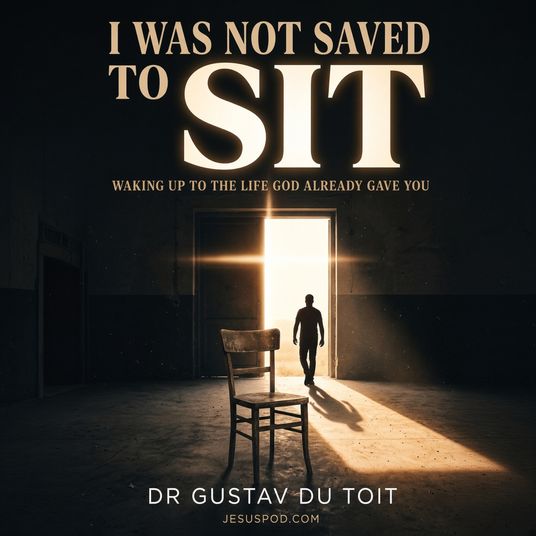
I was not saved to sit - Dr Gustav du Toit
by Gustav du Toit
Books
Christianity
RSS feed
Share
Episodes
About
Season 1
INTRODUCTION
AI
This introduction sets up the book’s central message: many believers are not rebellious or lacking in God’s grace, they are simply seated in a life that has become familiar and comfortable, even though they know God is calling them to more. The author identifies three things that can keep believers from moving forward: disorder, a lack of surrender, and delayed obedience. The book is designed to help readers examine what has taken first place, release what God is asking them to surrender, step into their assignment, and move beyond the limits they have accepted. The challenge is simple and direct: God has already provided what we need; the question is whether we will get up and act on what He has already told us to do.
CHAPTER ONE: First Things First
AI
The chapter identifies three things that push God out of first place: ignorance, idolatry, and insecurity. It also highlights seven things we use against ourselves; shame, uncontrolled thoughts, unhealthy desires, fear, hopelessness, bitterness, and insecurity. The answer is not condemnation, but returning to Christ, surrendering control, and allowing God to govern every area of life. Practically, putting God first means giving Him the first word in our decisions, the first time in our day, the first trust in our finances, and the final authority over our lives. And if something has already “capsized,” the chapter reminds us that God can raise it, but we must rebuild it His way.
CHAPTER TWO: Arise, Shine!
AI
This chapter teaches that God has already given us the light we need; our responsibility is to arise and let that light shine. Using the story of the Fresnel lighthouse lens, the author explains that the flame itself did not become bigger, the lens simply gathered and directed the light that was already there. In the same way, believers do not need to become someone else before they can be useful to God. We need to position our lives so the light of Christ within us can reach others.
CHAPTER THREE: Believers, or Disciples?
AI
Comfortable bondage can become so familiar that we mistake it for our personality. We can hear God's Word without actually doing it, attend church without changing our priorities, and say we follow Jesus while keeping control of our time, money, habits, and choices. True discipleship requires discipline, obedience, and a willingness to let God's Word reshape our lives.
CHAPTER FOUR: Moving, but not Awake
AI
The story of Charles Mulli demonstrates what radical surrender can look like. He gave up a successful business empire to care for abandoned children, following a calling that required him to surrender comfort, reputation, wealth, and control. The chapter emphasizes that God doesn't need brilliant vessels as much as available ones. His mandate is reconciliation, but His strategy may look very different from ours. Ultimately, the chapter calls us to slow down, listen, and take our direction from God rather than our own calculations. In God's kingdom, greatness doesn't come through self-promotion but through surrender and service.
CHAPTER FIVE: From Surrender to Authority
AI
Charles Mulli’s story shows what surrender can look like in real life. He walked away from business success and comfort to care for abandoned children because he believed God was calling him. His story reminds us that God is not primarily looking for brilliant people, but available people, people willing to release control and follow His direction.
CHAPTER SIX: You are called for more
AI
This chapter uses the story of scientists who died protecting seeds during the Leningrad siege to illustrate a powerful truth: a seed is meant to be planted, not simply stored. In the same way, every sermon, Scripture, conviction, and instruction God gives us is spiritual seed. We are not called merely to hear God's Word, but to act on it. Jesus’ Great Commission makes this clear: we are called to go, make disciples, and teach people to obey what He commanded. The author uses the parable of the four soils to show that the same Word can produce completely different results depending on the condition of our hearts. Distraction, shallow commitment, anxiety, and the pursuit of wealth can choke the Word, while good soil receives it, understands it, and produces fruit.
CHAPTER SEVEN: Ten Doors into a life of Service
AI
We are saved not only from sin, but for a purpose. God has given every believer gifts, opportunities, and an assignment to serve Him and others. Jesus modeled this by washing His disciples’ feet, showing that true greatness comes through humility and service. We don’t need a title or perfect conditions to serve, we simply need to be willing and use what God has already placed in our hands.
CHAPTER EIGHT: Daring to be Generous
AI
The stories of Stanley Tam and Chuck Feeney show that true generosity requires trust and an open hand. God doesn’t bless us simply to have more; He gives so we can become channels of blessing to others.
CHAPTER NINE : Four Keys to Breaking Through Your Limits
AI
Many of the limits holding us back are not from God, but are created by fear, circumstances, pressure, and old ways of thinking. Using Peter walking on water and Dick Fosbury’s unconventional high-jump technique, the author shows that breakthrough often requires faith to do something new and trust God beyond what seems normal.
1 of 2