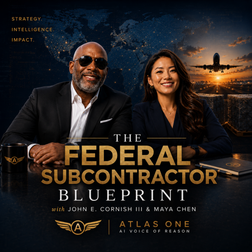
The Federal Subcontractor Blueprint

The Federal Subcontractor Blueprint

by John E. Cornish III
Season 1

Government Contracting Is Not Just for Big Companies

AI
Ep. 1 introduces small businesses to the federal contracting marketplace and challenges the belief that government opportunities are reserved for large corporations. John Cornish and Maya Chen explain how subcontracting, supplier relationships, strategic teaming, and focused mission alignment can provide practical entry points. The episode emphasizes disciplined qualification, honest capability positioning, and the importance of becoming a reliable part of a larger government mission.

You’re Leaving Federal Contract Money on the Table: Why Prime Contractors Need Small Businesses

AI
Explore the real reason prime contractors hire subcontractors—and it isn't simply to add labor. They reveal how prime contractors build teams to reduce operational, technical, geographic, compliance, and mission risk. Listeners will gain a new perspective on how to position their companies as trusted partners by solving critical problems, increasing confidence, and strengthening mission success. This episode reframes subcontracting as a strategic role at the heart of government contracting rather than a secondary position.

Prime Contractors Choose Who They Trust Before the Opportunity Arrives—Will They Choose You?

AI
John and Maya discuss why trust is the foundation of every successful government contracting relationship. They explain how meaningful partnerships are built long before opportunities are released and why credibility, consistency, and professionalism matter more than a sales pitch. Listeners will learn practical strategies for building executive relationships, positioning their capabilities, and becoming the kind of partner prime contractors remember when mission-critical opportunities arise.

The Federal Money Is Already Moving—Does Your Business Know Where to Find It?

AI
Federal contract dollars are being awarded every day—but many qualified business owners never see the opportunities until it is too late. In this episode of The Federal Subcontractors Blueprint, John E. Cornish III explains how to follow the money, identify where federal agencies are spending, and uncover the prime contractors receiving major government awards. You will discover why finding the right opportunity requires more than searching for open solicitations. The real advantage comes from understanding which agencies have funding, which companies are winning the work, and where your business can provide valuable subcontracting support. If you have ever wondered where federal contract opportunities are hiding—or whether your competitors are finding them before you—this episode will help you begin searching with greater focus and confidence. The federal money is already moving. The question is: does your business know where to find it? Listen now and learn how to position your company closer to the money, the decision-makers, and the opportunities. Follow The Federal Subcontractors Blueprint for practical strategies designed to help small businesses understand federal contracting, connect with prime contractors, and compete for meaningful subcontracting opportunities.

Prime Contractors Are Leaving Clues to Federal Contract Money—Are You Missing Them?

AI
Most business owners wait until a federal opportunity is announced before taking action. By then, the companies paying attention may already be positioned to win. Prime contractors regularly leave clues about where federal money, future work, and subcontracting demand may be headed. The problem is that most small businesses do not recognize the signals—or know what to do after finding them. In this episode of The Federal Subcontractors Blueprint, John E. Cornish III explains how to follow the breadcrumbs prime contractors leave behind and use those signals to identify potential opportunities before the market becomes crowded. You will learn why successful federal subcontracting is not only about responding to open bids. It is also about studying prime-contractor activity, recognizing where momentum is building, and positioning your business before the opportunity reaches everyone else. Your competitors may be watching the same companies, awards, programs, and market signals. The difference is whether they understand what those clues mean before you do. The breadcrumbs are already there. The question is: are you following them—or allowing your competitors to reach the opportunity first? Listen now and discover how to position your business closer to prime contractors, federal contract dollars, and the opportunities developing beneath the surface.

Prime Contractors Are Searching for Subcontractors—Why Aren’t They Finding You?

AI
Prime contractors are actively searching for qualified subcontractors—but they cannot select a business they cannot find. Many business owners assume that registering in SAM.gov, building a website, or waiting for a solicitation is enough to generate federal opportunities. Meanwhile, better-positioned competitors are placing their companies directly inside the databases, supplier networks, relationships, and visibility channels that prime contractors use to identify potential partners. In this episode, John E. Cornish III explores where prime contractors actually look for subcontractors—and why some capable small businesses remain invisible despite having valuable services to offer. You will discover why federal subcontracting is not simply about being qualified. Your business must also be visible, credible, correctly positioned, and present in the places where procurement teams and prime contractors search for support. Because when a major contract is awarded, primes may need responsive partners quickly. The question is not only whether your company can perform the work. The real question is: will they know your business exists when the opportunity arrives? Your competitors may already be appearing in the searches, supplier portals, databases, and professional networks where teaming decisions begin. Listen now to learn how to improve your visibility, position your company for discovery, and increase the likelihood that prime contractors find you before they find someone else.

Your Competitors See Federal Contracts Coming—Do You Know How to Read the Signals?

AI
Most business owners begin searching for federal opportunities after everyone else can already see them. But major contracts rarely appear without warning. Prime-contractor activity, agency priorities, recent awards, program expansions, supplier outreach and other market signals can reveal where federal work may be heading. Business owners who learn how to recognize those signals can begin preparing, positioning and building relationships before the competition becomes crowded. In this episode of The Federal Subcontractors Blueprint, John E. Cornish III explains why successful federal subcontractors must learn to read the radar—not simply wait for an opportunity to appear. You will discover how to separate meaningful signals from background noise, recognize where momentum is developing and identify the companies and programs that deserve your attention. Because by the time an opportunity becomes obvious, your competitors may have already researched the customer, contacted the prime contractor and positioned their capabilities. The signals may already be visible. The question is: are you reading them—or will you discover the opportunity after someone else has already moved? Listen now and learn how to spot federal contracting momentum earlier, focus your business-development efforts and position your company before the market catches up.

The Businesses Winning Federal Contracts Think Differently—Does Yours?

AI
Two businesses can see the same federal opportunity, possess similar capabilities and enter the same market—yet only one positions itself to win. What creates the difference? It is not always company size, experience or access to inside information. Frequently, the advantage begins with how business owners think about preparation, visibility, relationships, rejection and long-term opportunity. In this episode of The Federal Subcontractors Blueprint, John E. Cornish III examines the mindset separating businesses that merely want federal contracts from those that deliberately position themselves to capture them. You will discover why winning companies do not wait for perfect conditions, immediate results or guaranteed opportunities before taking action. They study the market, build relationships early, remain visible and continue positioning while less disciplined competitors become discouraged or disappear. Federal contracting rewards more than capability. It rewards preparation, consistency, strategic patience and the willingness to move before success is guaranteed. Your competitors may have access to the same registrations, supplier portals and public information that you do. The difference may be how they interpret the opportunity—and what they decide to do next. The question is: is your business thinking like a federal contracting winner, or waiting for an opportunity that better-positioned companies are already preparing to capture? Listen now and discover the mindset shift that can move your company from watching federal opportunities to positioning itself to win them.

The 90-Day Trap...

AI
BONUS EPISODE - Most business owners do not fail in federal contracting because they lack capability. They fail because they expect the market to move on their timeline. They register their company, send a few emails, complete several supplier portals and give the process 90 days. When a contract does not immediately appear, they assume federal subcontracting does not work—and walk away while their positioning is only beginning to gain momentum. In this episode of The Federal Subcontractor Blueprint, John E. Cornish III exposes the 90-day trap: the dangerous expectation that a long-term government market should produce instant results. You will discover why federal opportunities are often created through sustained visibility, repeated positioning, strategic relationships and consistent follow-up—not one registration, one introduction or one promising conversation. Meanwhile, your competitors may still be researching agencies, tracking prime contractors, strengthening their credibility and staying visible after everyone else becomes discouraged. The most expensive mistake may not be choosing the wrong strategy. It may be abandoning the right strategy too early. Are you truly failing—or are you closer to the opportunity than you realize? Listen now before impatience causes your business to leave a market your competitors are preparing to capture.
Season 2

THE EXECUTIVE FEDERAL MARKET ENTRY OPERATING SYSTEM

AI
In the Season Two premiere of The Federal Subcontractor Blueprint™, Maya Chen sits down with John E. Cornish III, founder of Marshall Davis Medical Logistics, LLC, to introduce a new approach to entering the federal marketplace: The Executive Federal Market Entry Operating System™. This episode explores a problem many established businesses face when pursuing government work: strong capabilities, experience, and leadership can still be undermined by disconnected branding, weak positioning, unclear federal messaging, or fragmented market-entry tools. John explains why federal readiness requires more than registration, a capability statement, or simply searching for solicitations. The real challenge is creating a coherent system that connects how a company presents itself, how its capabilities are positioned, how buyers and prime contractors understand its value, and how opportunities are identified and pursued. Throughout the conversation, Maya challenges the assumptions behind traditional government-contracting advice and helps uncover the larger strategy behind the system. This is not a promise of guaranteed contracts. It is the beginning of a 30-day introduction to a framework designed to help serious business owners become more visible, credible, positioned, and prepared to compete in the federal marketplace. Season Two starts here. The system is being revealed one piece at a time.
1 of 2