Farm To Stable: An Equine Nutrition Podcast (TM)

Farm To Stable: An Equine Nutrition Podcast (TM)

by Dr. Nettie Liburt
Season 1

Episode 3: Importance of weight your horse, and his feed

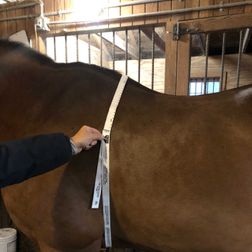
In this episode I'll talk about why it is very important to weigh your horse, and give you some tools on how to do so. Some helpful links are here too:Body Condition Scoring System, from Texas A&M University (where it originated!): https://vetmed.tamu.edu/files/vetmed/vmth/laminitis/Equine_Body_Condition_Scoring.pdfExcellent video by TheHorse.com and Dr. Bob Coleman from the U. of Kentucky about how to body condition score your horse: https://youtu.be/bq0ZXnSlsNQ?feature=sharedThe "Healthy Horse" app is available where you get your apps at a nominal cost, and guides you through measuring your horse to estimate body weight. Equation used to estimate horse's body weight:For an adult horse : (Heart Girth x Heart Girth x Body Length) / 330Measure heart girth behind the shoulders in inches. Body length is point-of-shoulder to point-of-rump (should be a smaller measurement compared to a blanket size).

Ration Balancers - What are they, does my horse need one, and what's with all that protein?

In this episode I'll define ration balancers, and give examples of when they may or may not be appropriate for a horse's diet. Additional references are promised, including links with information on how to read a hay analysis:Equi-Analytical Laboratories: https://equi-analytical.com/resources/glossary-of-nutrient-terms/From U. of MN: https://extension.umn.edu/horse-nutrition/understanding-your-hay-analysisFrom Penn State U.: https://extension.psu.edu/understanding-a-hay-analysisAnd more information about ration balancers, with my colleagues over at Tack Box Talk: https://podcasts.apple.com/us/podcast/tack-box-talk/id1492355719?i=1000604138859
Episode 1: Finding an Equine Nutritionist

Horse owners are often not sure where to turn for real information about equine nutrition. The internet is full of both good and bad information, and I'll give you tips about how to find the right consultant. In this first episode, I'll talk about how to find a qualified equine nutritionist, questions to ask and resources available to you right now.

All About Protein: Busting Myths and Talking Truths!

There are many misconceptions about the role of protein in the horse's diet. Protein gets the blame for things it shouldn't (for example, bad behavior, growth problems, weight gain). This week I'm busting protein myths and clarifying facts about what protein is, what it does, and why it shouldn't be blamed for certain things. You'll love this one!

Pre-, Pro- and Post-biotics: An explainer

Pre-, pro- and post-bitoics get a lot of attention in the world of equine nutrition. There is lots we do know, but even more that we don't (but we're working on it!) This week, I'll explain what each actually is and why we need more research in horses. Some of the references used for this podcast are listed below. Adams, A.A., et.al. 2015. The effect of n-3 polyunsaturated fatty acids (DHA) and prebiotic supplementation on inflammatory cytokine production and immune responses to vaccination in old horses. Journal of Equine Veterinary Science. 35(5):407-408. Auwerda, P. Undated. Digestive anatomy and physiology of the horse. Iowa State Extension and Outreach, Equine Science. Accessed online at: https://www.extension.iastate.edu/equine/blog/dr-peggy-m-auwerda/digestive-anatomy-and-physiology-horse Coverdale, J.A. 2016. Can the microbiome of the horse be altered to improve digestion? Journal of Animal Science. 94(6):2275-2281. Heaton, C.P., et al. 2019. Are prebiotics beneficial for digestion in mature and senior horses? Journal of Equine Veterinary Science. 76: 87-88. National Research Council. 2007. Nutrient Requirements of Horses, 6th Ed. National Academies Press. Washington, DC. Ray, L. 2018. Understanding a horse’s digestive system. University of Georgia Extension. Accessed online at: https://site.extension.uga.edu/forageteam/2018/09/understanding-a-horses-digestive-system/ Respondek, F., et al. 2011. Dietary supplementation with short-chain fructooligosaccharides improves insulin sensitivity in obese horses. Journal of Animal Science. 89(1):77-83. Weese, J.S. 2002. Probiotics, prebiotics and synbiotics. Journal of Equine Veterinary Science. 22(8):357-360.
5 of 5