Dr. Z's Podcasts

Dr. Z's Podcasts

by Dr. Z
Season 123

AI, LLMs, & Agents

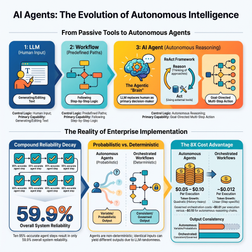
Category: AI (S123) This podcast explains the evolution of artificial intelligence from simple chatbots and structured workflows into autonomous AI agents. While traditional tools remain passive and prompt-dependent, agentic systems use large language models to independently reason, select tools, and iterate to achieve complex goals. The materials describe how these agents function through cognitive architectures and software frameworks like the Model Context Protocol to interact with the real world. Real-world applications are emerging in government services, software development, and task automation, though many are still in experimental stages. Despite their potential to boost productivity, the texts highlight significant security risks, ethical concerns, and economic impacts, including job displacement and systemic financial vulnerabilities. Ultimately, the transition to agents represents a shift where AI becomes a decision-maker rather than a mere tool for human-led processes.
Season 115

Also Sprach Zarathustra (Thus Spoke Zoroaster)

Category: Social Science (S115) Friedrich Nietzsche’s seminal work, Thus Spoke Zarathustra, serves as a complex fusion of philosophical fiction and poetic narrative. The podcast explores transformative concepts such as the Übermensch, the will to power, and the eternal recurrence, moving beyond traditional religious moralities to advocate for personal self-mastery. In the late 19th century, composer Richard Strauss adapted these themes into a famous symphonic poem, musically illustrating the evolution of humanity toward a "super-person." Both the literature and the music reflect a period of existential crisis following the cultural decline of Christian authority. Ultimately, these sources highlight the importance of life-affirmation and the individual's role in creating their own unique meaning and values. -Dr. Z

How Zoroaster (Zarathustra) Shaped Heaven & Hell

Category: Social Science (S115) This podcast provides a comprehensive look at the history, theology, and social structure of Zoroastrianism, with a particular focus on the evolving status of women. The initial teachings of the Prophet Zoroaster established a monotheistic framework that emphasized spiritual equality and moral agency for all people. Over time, however, later texts introduced rigid ritual purity laws regarding menstruation and childbirth, which historically limited women's roles within the all-male priesthood. Modern perspectives now highlight a shift toward reform and inclusion, exemplified by the recent appointment of female assistant priests in Iran and North America. The podcast illustrates how a faith centered on the struggle between good and evil has influenced global religious concepts like the afterlife, angels, and demons. -Dr. Z
Season 111

XML, JSON, YAML, CSV, SAML

Category: Security (S111) This podcast offers a comprehensive guide to modern data serialization formats and their practical applications in network automation and secure authentication. The podcast contrasts the syntax and use cases of JSON, XML, and YAML, highlighting how these structured languages allow different systems to exchange information. Special focus is given to SAML, an XML-based framework used by enterprises to implement Single Sign-On (SSO) for improved user security and experience. Additionally, the materials explain simpler formats like CSV for tabular data and efficient binary formats like Protocol Buffers. Readers can also learn how to parse and manipulate these data models using programming languages like Python and JavaScript. Together, these resources serve as an educational toolkit for understanding how data is structured, transmitted, and secured across the web. -Dr. Z
Season 121

Network+ - Domain 05 - Network Troubleshooting

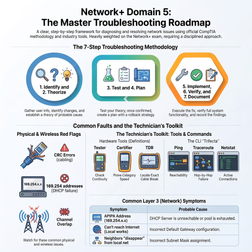
Category: Network+ (S121) This podcast provides a comprehensive framework for diagnosing and resolving network connectivity issues, emphasizing a structured seven-step troubleshooting methodology. The materials highlight how physical layer failures, such as damaged cables, faulty network interface cards, and electromagnetic interference, often present as misleading software errors. To address these problems, the podcast advocates for a systematic approach that includes identifying symptoms, testing theories, and verifying solutions through established workflows. Furthermore, the podcast details essential command-line utilities like ping, traceroute, and nslookup to isolate faults within the OSI model. By combining preventative maintenance with logical isolation techniques, IT professionals can efficiently restore services and improve long-term system stability. Specific focus is also given to critical network services, such as DNS and DHCP, explaining how to recognize and fix configuration exhaustion or resolution failures. -Dr. Z

Network+ - Domain 04 - Network Security

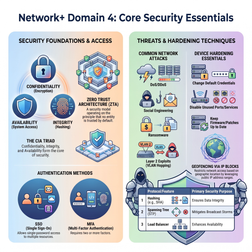
Category: Network+ (S121) This podcast focuses on safeguarding network infrastructure, traffic, and data assets. The Network+ Domain 4 is anchored by the CIA Triad: Confidentiality (keeping data private using encryption and multi-factor authentication), Integrity (ensuring accuracy using hashing and digital signatures), and Availability (maintaining system uptime via redundancies). Modern networks also incorporate Zero Trust Architecture, which assumes no default trust and mandates policy-based authentication and least-privilege access. Administrators must defend against diverse network attacks. These include social engineering (such as phishing), malware (such as human-activated viruses and self-replicating worms), and technology-based exploits (such as SYN floods, Smurf attacks, rogue access points, evil twins, and VLAN hopping). To mitigate these threats, robust hardening techniques must be implemented. Essential controls include deploying stateful firewalls that track connection states, disabling unused switch ports, implementing port security by binding authorized MAC addresses, and leveraging DHCP snooping to block rogue servers. -Dr. Z

Network+ - Domain 03 - Network Operations

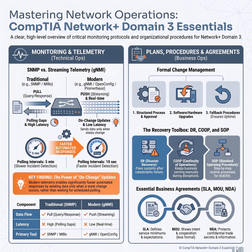
Category: Network+ (S121) This podcast focuses on Network+ Domain 3, Network Operations. The focus is on managing, monitoring, and securing infrastructure to maintain uptime and availability. Key concepts include implementing a formal change management process with strict policies and procedures to fall back if upgrades fail. It also involves establishing Standard Operating Procedures (SOPs) and incident response plans to handle security events like malware or DDoS attacks. Organizations must prepare disaster recovery and continuity of operations plans (COOP) to keep businesses running. Finally, operations require managing vendor agreements (SLAs, MOUs, NDAs), supervising system lifecycles, and utilizing modern streaming telemetry or traditional SNMP to constantly observe critical device health. -Dr. Z

Network+ - Domain 02 - Network Implementation

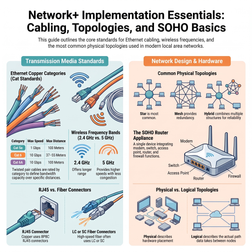
Category: Network+ (S121) This podcast traces network implementation from hardware foundations to cloud-scale virtualization. It begins at the physical layer with structured copper (Cat5e to Cat8) and fiber cabling terminating at distribution panels. Locally, Layer 2 Ethernet switches forward frames using MAC addresses, segmented logically into Virtual LANs (VLANs) and trunked via 802.1Q to isolate broadcast domains. Subnet communications are enabled by Layer 3 routers using static and dynamic routing. In virtualized environments, virtual switches connect virtual machines, while Virtual Extensible LANs (VXLAN) perform Layer 2 encapsulation inside Layer 3 UDP packets to stretch networks across boundaries. Finally, Software-Defined Networking (SDN) and SD-WAN leverage controllers and APIs to orchestrate dynamic, transport-agnostic logical overlays. -Dr. Z

Network+ - Domain 01 - Networking Concepts

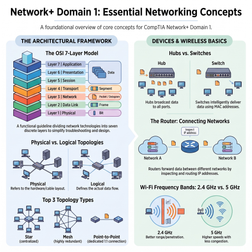
Category: Network+ (S121) This podcast offers a comprehensive look at network infrastructure, beginning with a detailed objective map for the CompTIA Network+ (N10-009) certification. This curriculum guide outlines essential topics such as OSI model concepts, cloud connectivity, network security, and troubleshooting methodologies. Complementing these educational goals, a technical guide explores the physical components of data transmission, focusing specifically on Ethernet cables, SFP transceivers, and fiber optic technology. This technical section distinguishes between various twisted-pair copper categories and highlights the performance differences between single-mode and multimode fiber. Together, the sources establish both the theoretical knowledge and the physical hardware requirements necessary for modern network operations. While one source mentions IPv4 and IPv6 differences, it serves primarily as a placeholder for security verification. These materials ultimately serve as a resource for mastering both the professional standards and the hardware specifications of the telecommunications industry. -Dr. Z
Season 119

Security+ - Domain 11 - Governance, Risk, & Compliance

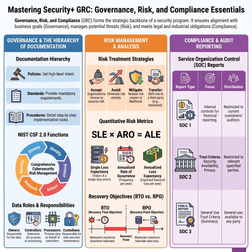
Category: Security+ (S119) Security+ GRC outlines key knowledge required to assess enterprise security posture. Security governance establishes management’s intent and operational structure through a strict hierarchy of policies (high-level direction), standards (mandatory requirements), and procedures (step-by-step actions). The risk management lifecycle involves identifying, assessing, and treating risks through avoidance, acceptance, mitigation, or transference. Quantitative risk analysis uses metrics like Single Loss Expectancy (SLE) and Annualized Rate of Occurrence (ARO) to calculate Annualized Loss Expectancy (ALE=SLE×ARO). Even after applying these controls, some residual risk always remains. Lastly, compliance ensures organizations adhere to regulatory frameworks like GDPR and HIPAA. This extends to managing third-party risk via thorough vendor assessments and structured agreements such as Service-Level Agreements (SLAs) or Memorandums of Understanding (MOUs). -Dr. Z
2 of 11