It's the End of the Week!

It's the End of the Week!

by LIDD Consultants
Season 2

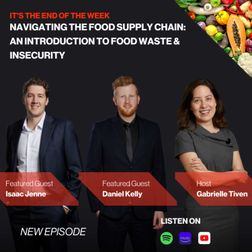
Navigating the Food Supply Chain: An Introduction to Food Waste & Insecurity

It's the end of the week and on this episode, Gabrielle Tiven takes over the show to sit down with Daniel Kelly and Isaac Jenne to talk about food waste and insecurity in Canada and the United States. Tune in for a brief spotlight on LIDD's work with Food Banks Canada and the World Wildlife Fund, and get answers to some key questions about the global issue: 1️⃣ How do food banks operate and what role do they play in combatting food insecurity? 2️⃣ How does food waste occur across every stage of the supply chain? 3️⃣ What solutions are organizations deploying to combat these challenges?

Extensions in Microsoft Business Central

What are extensions? How do they work? When should I build my own? Get answers to all these questions and more in the latest edition of It's the End of the Week! This week, Charles is joined by Mathieu to discuss all things extensions in the Microsoft Business Central platform.

When, How, and Why to Automate According to Industry Leaders | ProMat 2025 Special Edition

This year at #ProMat2025, Stephan Lauzon had the pleasure of speaking to five industry leaders to get their thoughts on how, when, and why businesses should be looking to automate their operations. The LIDD team would like to extend a special thank you to our friends who took the time to share their knowledge: ⭐ Ross Halket at SSI SCHÄFER ⭐ Christoph Buchmann at iAutomate ⭐ Ryan Chesterfield at Auto-FC ⭐ Nick Klein at Dematic ⭐ Marcel van Schijndel at WSR Solutions

What's The Deal With Integrations? FTP, SOAP & REST APIs w/ Sabina Sasu

#ItsTheEndOfTheWeek and in this episode our hosts Charles Fallon and David Beaudet are joined by Sabina Sasu to dive into integrations. From the social media apps on your phone to the intricate workings of your company's operations, application programming interfaces (APIs) are a central factor in ensuring the transfer of data and communication between computer programs. In the world of supply chain, APIs are used at every step to enable visibility and facilitate smooth operation.Join Charles, David & Sabina for an insightful discussion into APIs and walk away with a more acute understanding of some key topics: The History of APIs: First published in 1971, File Transfer Protocol (FTP) was the preferred method for integration for years. However, as time has gone on and needs have evolved, FTP has become largely obsolete. In particular, the post-2000s boom in web-based stores, media, and more necessitated a seamless and quick transfer of data that FTP could no longer keep up with. APIs emerged to fill that gap, as they offered a simpler means of connecting a database to a website's front-end that enabled end-users to more quickly gain access to the information they needed. Nowadays, the development of APIs such as Simple Object Access Protocol (SOAP) and Representational State Transfer (REST) have revolutionized the way businesses can deploy integrations in their information systems. SOAP vs REST: While the two protocols share similarities in their HTML-like appearance, they are ultimately used for very different purposes. REST APIs are speedy at transferring data, and can invoke the four fundamental functions of CRUD: create, read, update and delete. SOAP APIs on the other hand are adept at conducting real-world operations, such as facilitating the shipment of a company's sales orders.

Understanding the Signs: How To Know It's Time For Digital Transformation

Should your business take on digital transformation? It's the end of the week, and on this episode Charles & David are joined by Mathieu Galipeau to answer that question. Tune in to learn more about what digital transformation is, what it could mean for your business, and how to determine when it's the right time to switch. Here are just some of the many indicators they explain in this episode: 1️⃣ Functional limitations: Spreadsheets can only take you so far. At a certain scale, your business needs the depth of functionality that a specialized software can offer for optimal performance. 2️⃣ Frankenstein solutions: Dealing with a monster? A digital transformation roadmap can help identify and streamline your suite of software solutions to ensure every part of your business works together seamlessly. 3️⃣ Outdated Technology: Software needs support. As new technologies emerge, existing technologies fall into obscurity with minimal or no support, making it difficult for your business to operate at peak efficiency.

Logistics Automation Readiness w/ Patricia Laureys & Jennifer Hall

Logistics automation is transforming supply chain operations and improving employee satisfaction. But it's not just about picking your automation equipment and sending it off to the vendor. There's a crucial phase between solution selection and implementation that can't be overlooked: getting your organization ready for automation. How prepared is your company? Tune in for an insightful discussion on some key topics: 1️⃣ The push towards automation: Labor shortages, escalating logistics costs, and the need for rapid eCommerce fulfillment are driving companies to embrace warehouse automation. 2️⃣ Technological advancements: Automated Guided Vehicles (AGVs) and Autonomous Mobile Robots (AMRs) are transforming the logistics landscape. They offer scalable solutions that can adapt to changing business needs and volume fluctuations. 3️⃣ Preparing for automation: The transition to automation requires careful planning and preparation. This is where LIDD's logistics automation readiness tool comes in handy. It helps you asses your current state, identifying potential areas for improvement and eliminating risks before implementation.🔗 Fill out the assessment to ensure your business is properly prepared for automation. http://bit.ly/3sHaT0N

Supply Chain Engineering in the Fur Trade w/ Gabrielle Tiven - It's the End of the Week! Unplugged

Ever wondered how the adventurers of the 17th century established a complex trade network in pursuit of beaver furs? Delve into the riveting world of the fur trade supply chain and discover how these pioneers tackled logistics challenges long before the age of modern technology. LIDD founder, Charles Fallon, and guest speaker Gabrielle Tiven, discuss the history of the fur trade in Canada and the similarities of supply chain engineering then and now.: 1. Learn about Canada's 17th century fur trade and the competition between the Hudson Bay Company and Northwest Trading Company. 2. The striking similarities between the supply chain management of the past compared to now. 3. Gabrielle's upcoming book that delves deeper into Canada's fur trade to examine the engineering principles and supply chain network design at play.

How to Think and Talk about Business Technology with Ben V.

Charles sits down with LIDD partner and NetSuite practice lead Ben V. to discuss all things business technology.

A Tale of Two Firms: Supply Chain Optimization Insights from Rocky Mountain Chocolate and Funko

Charles and David sit down to discuss Rock Mountain Chocolate's plans to streamline their operations, while Funko remains stuck in the aftermath of the delayed implementation of their new warehousing processes. Rocky Mountain Chocolate: https://www.heraldnet.com/news/lawsuit-funko-misled-investors-about-arizona-move/ Funko: https://www.heraldnet.com/news/lawsuit-funko-misled-investors-about-arizona-move/

Data Analytics Through Time: How It's Changed and Where It's Going

Charles and David sit down with Jeff Hamilton to discuss how supply chain consulting and data analytics have evolved over the years and where it could possibly go in the future.
5 of 6