

Edge Igniter

Edge Igniter

by Alex Rivers
Season 1
Episode 1: Introducing the Mission of Edge Igniter – Fact-Based Pathways to Personal Advancement
This is Episode 1 of Edge Igniter, titled “Introducing the Mission of Edge Igniter – Fact-Based Pathways to Personal Advancement.” I am Alex Rivers, and today, we will establish the foundational principles of this series, emphasising its commitment to delivering evidence-informed assistance for individuals seeking incremental improvements in their lives. To commence, let us define the name “Edge Igniter.” The term “Edge” denotes a competitive or personal advantage—an enhanced capacity to navigate challenges with greater efficacy and resilience. “Igniter” refers to the act of initiating or sparking a transformative process, much like kindling a flame that sustains ongoing progress. Together, “Edge Igniter” encapsulates the podcast’s ethos: to activate and cultivate that advantage through targeted, knowledge-driven interventions, enabling listeners to elevate their circumstances methodically.
Episode 2: Evidence-Informed Strategies for Building Daily Resilience
This is Episode 2 of Edge Igniter, titled “Evidence-Informed Strategies for Building Daily Resilience.” I am Alex Rivers, and today we will explore practical, research-supported methods to cultivate resilience in everyday routines, targeting individuals aiming to stabilise and advance their personal or professional circumstances. Building on Episode 1’s introduction to our mission of providing fact-based guidance for incremental life improvements, this episode focuses on resilience as a foundational skill, defined in psychological literature as the adaptive capacity to withstand and recover from stressors through emotional regulation and problem-solving efficacy.
Episode 3: How to work….without becoming work

This is episode three of Edge Igniter
Episode 4: Why shame pays you rent- and how to evict it

This is episode 4 of Edge Igniter
Episode 5: Strategies for Reducing Self-Deception

This is Episode 5 of Edge Igniter, titled “How to lie Less to Yourself”
Episode 6: Maintaining Momentum During Transitions
This is Episode 6 of Edge Igniter, titled “Maintaining Momentum During Transitions.” In this episode, we will explore the challenges associated with periods of significant change, such as career shifts, relocations, or personal milestones, and outline evidence-based strategies to sustain progress and well-being throughout these phases.
Episode 7: Techniques for Enhancing Decision-Making Under Pressure
This is Episode 7 of Edge Igniter, titled “Techniques for Enhancing Decision-Making Under Pressure.” In this concise session, we will explore evidence-based methods to improve decision-making during high-stress scenarios, such as crises or tight deadlines. These periods often trigger impulsive responses due to heightened stress hormones, which can impair executive functions and shift behaviour toward habitual rather than goal-directed actions. By adopting structured techniques, individuals can foster clarity and resilience. We will cover three key approaches with elaborated details and vivid practical examples.
Episode 8: Strategies for Cultivating Long-Term Resilience
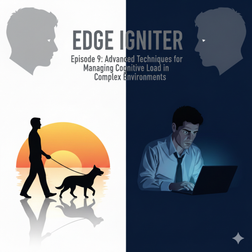
This is Episode 8 of Edge Igniter, titled “Strategies for Cultivating Long-Term Resilience.” I am Alex Rivers, and today we will examine evidence-based approaches to sustain adaptive capacity over extended periods, enabling individuals to withstand cumulative stressors and achieve enduring personal and professional stability. Long-term resilience extends beyond immediate coping mechanisms, incorporating proactive habits and systemic adjustments informed by longitudinal psychological and neuroscientific research.
Episode 9: Advanced Techniques for Managing Cognitive Load in Complex Environments
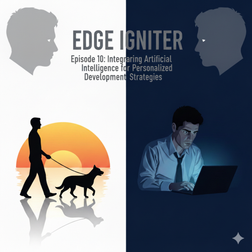
This is Episode 9 of Edge Igniter, titled “Advanced Techniques for Managing Cognitive Load in Complex Environments.” I am Alex Rivers, and today we will investigate sophisticated, research-supported methods to regulate the mental effort required for processing information in demanding settings, such as high-stakes professional roles, dynamic learning scenarios, or multifaceted decision-making contexts. Cognitive load refers to the total amount of working memory resources utilized during tasks, categorized into intrinsic (inherent complexity), extraneous (unnecessary demands), and germane (productive schema-building) types, as outlined in Cognitive Load Theory (CLT). In complex environments, unmanaged load can lead to reduced performance and burnout, but advanced interventions, informed by empirical studies, enable optimisation for sustained efficacy.
Episode 10: Integrating Artificial Intelligence for Personalized Development Strategies
This is Episode 10 of Edge Igniter, titled “Integrating Artificial Intelligence for Personalized Development Strategies.” I am Alex Rivers, and today we will examine the evidence-supported application of Artificial Intelligence (AI) systems to tailor personal and professional growth trajectories, leveraging adaptive algorithms to optimise learning, behavior change, and performance in real-world contexts. AI-driven personalisation transcends generic advice by analysing individual data patterns—such as behavioral logs, biometric inputs, and self-reported metrics—to generate precise, evolving recommendations, grounded in machine-learning models validated across educational, health, and organisational domains.
1 of 2