The Reading Instruction Show

The Reading Instruction Show
by Dr. Andy Johnson

Ropes, Humpty Dumpty, and Systems Theory
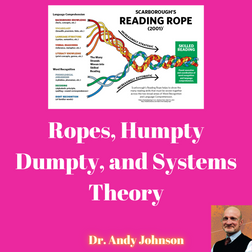
The SoR is based on the simple view of reading (Cervettie, et. al, 2020; Duke & Cartwright, 2021; Hoffman, 2017). According to this theory, skilled reading is a result of decoding and language comprehension (Gough & Tunmer, 1986) (see Figure 9.1). In other words, you decode each word (sound it out) and then listen to the decoding occurring in your head. What could be simpler than this? Yes? Later iterations of this theory would change it slightly. Scarborough (2001) created his now famous reading rope based on this (see Figure 9.2). According to this theoretical model, skilled reading is like a rope comprised of two sets of strands. Word recognition strands. The word recognition strands represent three low level skills related to: (a) phonological awareness (syllables, phonemes, etc.), (b) decoding (alphabetic principle and spelling-sound correspondence), and (c) sight word recognition (orthographic mapping). These skills are to be learned and practiced until they become increasingly automatic. That means that students do it without thinking. Language comprehension strands. The language comprehension strands represent five higher level skills related to: (a) background knowledge, (b) vocabulary, (c) language structures (syntax and semantics), (d) verbal reasoning (inferring, predicting, and (e) literacy knowledge (print concepts, genres, etc.). These elements are to be learned in ways that enable students to consciously apply them as needed. (They become increasingly strategic.) As the smaller strands within each set become increasingly intertwined, two sets of strands eventually become intertwined. And as the intertwining becomes increasingly tighter, one becomes more skilled as a reader.

Ropes, Humpty Dumpty, and Systems Theory

The SoR is based on the simple view of reading (Cervettie, et. al, 2020; Duke & Cartwright, 2021; Hoffman, 2017). According to this theory, skilled reading is a result of decoding and language comprehension (Gough & Tunmer, 1986) (see Figure 9.1). In other words, you decode each word (sound it out) and then listen to the decoding occurring in your head. What could be simpler than this? Yes? Later iterations of this theory would change it slightly. Scarborough (2001) created his now famous reading rope based on this (see Figure 9.2). According to this theoretical model, skilled reading is like a rope comprised of two sets of strands.
Season 23

Little Timmy Learns to Read: A True Story
Phonics is important, but if that’s all you’re teaching, you limit students’ ability to recognize words and create meaning with print. And that is the end goal – to create meaning, not to fill out phonics worksheets, or pass end-of-unit tests, or sound out words in isolation

Chilren of the Code: Hard-Wired to Learn Reading
I was having a discussion with a fellow online who insisted that early reading instruction should consist primarily of direct instruction of phonics. His argument was that unlike learning to use oral language, learning to use written language is not a natural process for humans. “We’re not wired to learn these skills” he insisted. “Reading is a uniquely human invention,” he said. According to him, children, starting around age 5 or 6, need lots of direct instruction of letter-sound relationships in order to learn “the code”. When they learn the code, then they can read (or decode). This is a commonly held idea that seems to make good sense to many. But we want reading instruction to be based on good science, not good sense. So, let’s do a bit of unpack-o-rating:

Defining the Science of Reading and SoR Research Standards
If you threw a rock into the middle of a pond but that rock was not a rock, can you still be said to have thrown a rock? Likewise, can a standard be said to be a standard if it is not standardized? We know that science is a good thing, and using science in reading instruction is a good thing. But what exactly is meant by the “science of reading”? What exactly is the Science of Reading? Is it a noun? Is it a verb? Or has it become an adjective or perhaps a metaphor used to indicate something else?

Understanding Science, Research, and Research Methods
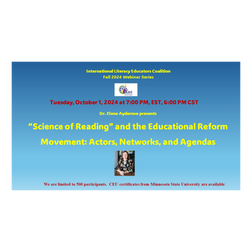
Basic terms are often misunderstood or misapplied by SoR advocates. My goal in this podcast is to bring a little more clarity to three important and often misunderstood terms: science, research, and research methods. In doing so, I hope to move the needle a little bit in helping you become more critical consumers of educational research Science is both a noun and a verb. It’s a noun when it refers to a field or a system of knowledge within a particular area such as physics, chemistry, or zoology. It is a verb when it references the processes used to develop that system of knowledge (research).

Dr. Elana Aydarova. Science of Reading Mythologies
Dr. Elena Aydarova is an Assistant Professor in the Department of Educational Policy Studies at the University of Wisconsin-Madison and a fellow with the National Education Policy Center. Dr. Aydarova’s research examines the interaction between educational policies, education reforms, and policy advocacy. She is an award-winning author of over 40 publications. Dr. Aydarova received postdoctoral fellowships from the National Academy of Education/Spencer Foundation and the American Association of University Women.

It’s Easier to Blame Teachers than to Fix Problems
If you can blame students, teachers, and colleges of education, we won’t see the social problems that impact learning. It’s much easier to blame teachers than to fix the actual cause of social problems. However, there is one thing of which we can be certain: If Cengage Learning, Houghton Mifflin Harcourt, McGraw-Hill Education, Pearson Education, and Scholastic could sell products to fix one of these social problems, that problem would be the cause of the next educational crisis.

The Ample Testimony of Reading

To fully understand this current reading “crisis” (which really isn’t a crisis at all), it must be seen in the context of similar “crises” occurring in the past (which weren’t really crises either). This current “crisis” is not the first reading crisis to come along (Aydarova, 2024; Berliner & Biddle, 1995; McQuillan, 1998; Thomas, 2024), and it certainly won’t be the last. And when this crisis runs its course, there will be a lull followed by another crisis, and then another, and then another. That’s because there will always be those willing to create the illusion of crises for political and economic gain (Altwerger, 2008; Aydarove, 2023). And sadly, it’s an effective tactic … for a time anyway.

Understanding the Limitations of Data and Research in Educational Research

The thing about research is that it doesn’t prove anything, at least not in the social sciences. There is no single research that conclusively proves anything once and for all about reading instruction. Research may support a hypothesis. It may provide evidence for something, show something, indicate something, or demonstrate something, but in the social sciences, research doesn’t prove things. The results may indicate, implicate, or illustrate, but educational research doesn’t prove things. SoR advocates often claim that there is a “proven science” of reading. But when working with variable human beings interacting in variable social situations there are simply too many variables to say that something proves something else conclusively. Instead, research provides evidence for things. A lot of research provides strong evidence. A little research provides weak evidence. There are evidence-based practices (see Chapter *) but there is no “proven science” of reading. But even saying something is evidence-based says nothing about the quality of the evidence or the validity of the evidence.
8 of 34