
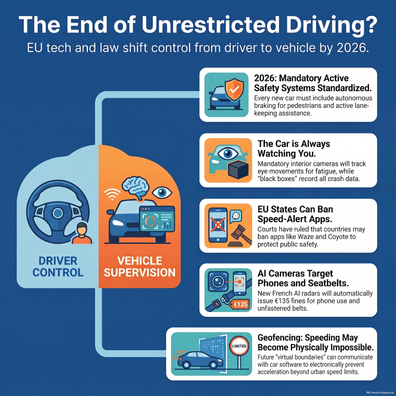
Hands off the wheel: How AI is phasing out the human driver in Europe
Episode notes
Will humans still be allowed to drive their own cars in Europe by the mid-2030s? According to this deep dive, yes—but not in the way we do today.
Over the next decade, driving will shift from an act of personal freedom to a hyper-regulated, machine-supervised operation.
1. In-Vehicle Mandates: The Shift to Active Safety
Under the EU’s General Safety Regulation (GSR Phase 2, taking full effect in mid-2026), automotive safety is pivoting from passive protection (airbags, crash zones) to active intervention:
- System Overrides: Features like Autonomous Emergency Braking (AEB) and active lane-keeping will physically override human input to prevent collisions.
- Drive-by-Wire & Black Boxes: Traditional mechanical/hydraulic systems are being replaced by electronic steering racks. Vehicles must also include an Event Data Recorder (EDR "black box") and standardized alcohol interlock interfaces.
- Forced Premiumization: Adding thousands of euros in sensors, radar, and Lidar drastically squeezes profit margins, threatening to eliminate cheap, entry-level city cars entirely.
2. Driver Surveillance & The Psychological Paradox
- Inward Monitoring: Infrared cabin cameras track pupil dilation, blink rates, and head movement to detect fatigue or distraction.
- Automation Complacency: A major human-factors paradox emerges: as the AI handles throttle and steering, human drivers experience a "vigilance decrement" (zoning out). Yet, drivers remain legally liable for any errors, creating immense cognitive fatigue.
3. External Infrastructure & Legal Crackdowns
- AI Speed Cameras (e.g., Mesta Fusion 2): Utilizing 3D Lidar and 36MP cameras, these devices scan dozens of vehicles across multiple lanes simultaneously—reading speed, tailgating distances, seatbelt usage, and phone activity inside the cabin to stack instant fines.
- Continuous Enforcement: Systems like section control (average speed checks over several kilometers) force sustained compliance rather than brief braking.
- App Restrictions: The EU Court of Justice ruled that warning platforms (e.g., Waze, Coyote) actively curate traffic data through algorithms, giving states legal grounds to ban them (leading to fines up to €1,500 in countries like France).
4. Speed Control & Geofencing
- Intelligent Speed Assistance (ISA): Mandatory since July 2024, ISA uses camera/GPS data to actively push back against the driver's foot via haptic accelerator pedal resistance when exceeding limits.
- Geofencing: The ultimate evolution of speed control involves digital municipal perimeters (e.g., "Zone 30" city centers). Once crossed, engine software mechanically limits vehicle speed to 30 km/h, regardless of how hard the driver presses the pedal.
Conclusion: The Rise of "Analog Freedom"
By 2035, drivers will act more like monitored managers of autonomous systems than active operators. This hyper-regulated environment may trigger an unintended side effect: a booming secondary market for pre-2024 "dumb" cars, where simple mechanical steering and un-monitored cabins become the ultimate status symbol of human autonomy.