Product Mastery in the Age of AI and ChatGPT

Product Mastery in the Age of AI and ChatGPT

by Madhumita Mantri
Season 2026
The Technical PM Playbook: Mastering the Problem Space with AI
Explicit
AI
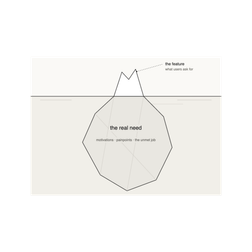
The best product managers are not the ones who build the most. They are the ones who can resist building for the longest. That single idea anchors the newest episode of Product Mastery in the Age of AI and ChatGPT, and it lands harder than ever in a world where a working prototype takes an afternoon. When building has never been cheaper, building the wrong thing has never been faster. The episode, The Technical PM Playbook, breaks down five techniques for using AI to understand the problem space so deeply that the right product becomes obvious: Problem laddering to find the need hiding underneath the feature The steelman and the gravestone for pressure-testing any idea Segmenting users by motivation and jobs to be done, never by demographics Mapping the journey that starts long before a user finds the product A negative space map for finding the segment every competitor ignores The most useful takeaway may be the simplest one. AI is a brilliant partner for generating hypotheses, and a terrible substitute for talking to a real person. The whole playbook is the loop between the two.
Broken. Still building
Explicit
AI
A practice I had maintained for over 13 years — gone overnight. I couldn't walk. Surgery. Months of physical therapy. Six months later, I'm still in rehabilitation, still working from home, still rebuilding. And yet — my work as a Staff PM at Walmart Marketplace continued. Full ownership. Full accountability. High-stakes deliverables in seller risk and data infrastructure. Even when showing up was the hardest thing I did that day. This season has been one of the most difficult of my life. It has also been one of the most clarifying. In this episode I talk about what I've learned — as a leader, and as a human.
GenAI Tools That Actually Help Product managers Save Hours a Week
Explicit
AI
The product managers who are quietly outperforming their peers are not working harder. They have changed the question they ask AI. Most people use ChatGPT the same way they used Google five years ago. Ask a question. Get an answer. Move on. The PMs building better roadmaps, finding underserved user segments their competitors have missed, and walking into executive reviews with arguments that actually hold up under scrutiny — they are using it differently. They are using AI not to produce content, but to pressure-test thinking. There is a meaningful difference between asking AI to write a PRD and asking AI: "What is the strongest argument that my core product hypothesis is wrong?" One saves thirty minutes. The other changes the product. The latest episode of Product Mastery in the Age of AI and ChatGPT makes the case for that shift with something rare in AI content: specific, tested, immediately usable techniques. Not theory. Actual prompts. With an explanation of why they work and what they surface that solo thinking tends to miss.
The Unlearning: What the AI Boom Forced Me to Let Go
Explicit
AI
There is a version of seniority in product management that looks like confidence. You have the answers. You know the domain. You've seen this pattern before. And then AI shows up and the confidence starts to feel like a trap. In this episode, I will share the personal pivot I didn't see coming — and the three beliefs I had to actively unlearn after two decades building products across consulting, media, data, fintech, and AI-powered marketplace risk. What You'll Hear Why a junior team member's overnight AI prototype exposed flaws in a requirements doc that two decades of experience had missed The shift from answer retrieval to question design — and why it changes every part of the PM job Why data fluency is no longer enough, and what actually replaces it The hardest belief to let go: that domain expertise is your most valuable asset
Why Most Agentic AI Products Fail
Explicit
AI
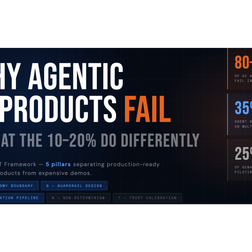
Hot take: most companies building AI agents right now are setting themselves up to fail — and it's not the technology's fault. Deloitte says 25% of enterprises are piloting AI agents in 2025. Salesforce data shows agents succeed on multi-step tasks only 35% of the time. Sendbird's analysis puts the overall project failure rate at 80–90%. We're watching billions flow into systems that fail nearly half the time. The culprit? Applying deterministic product thinking to non-deterministic systems. In Episode 2 of Product Mastery in the Age of AI and ChatGPT, I pull back the curtain on: → Why the CrewAI vs. LangGraph debate is the THIRD most important decision you'll make → The 5-pillar AGENT Framework I built from real fraud detection systems at Walmart → The whitespace opportunity almost no PM is talking about → 3 things you can do THIS week to build agents that actually work This one's spicy. I want to hear where you disagree.
What is AI Product Sense and Why Traditional Product Intuition Isn’t Enough

Explicit
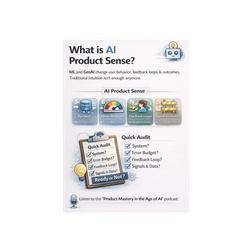
AI isn’t “just another feature.” It changes how users behave, how feedback loops form, and what success even means. That’s why traditional product intuition isn’t enough anymore. Here’s the mental model I share in the episode — the SENSE Framework: S — System over feature: map the full system, not just the UI E — Error budgets: define what failure is acceptable (and where it’s not) N — Novel feedback loops: your launch will change user behavior and future data S — Signals + scaffolding: instrument learning signals + guardrails, don’t “pray for accuracy” E — Evaluation in reality: offline + online + human audits + risk checks This episode covers this topic with some interesting examples based on my experience.
What are the AI agents running our life?
Explicit
Your alarm, coffee maker, commute app, email filter, credit card fraud protection—all AI agents making decisions about YOUR life. Most product leaders think AI agents are ChatGPT and virtual assistants. But after building fraud detection systems that prevented $50M+ in losses across e-commerce platforms, I discovered something completely different: The most powerful AI agents are invisible. Last week at 3:47 AM, an AI agent detected something extraordinary—a $12M coordinated fraud attack involving 847 fake seller accounts. The agent spotted patterns that would take human analysts 6-8 weeks to find. It stopped the attack in 4 minutes. This taught me that we're not just building AI tools—we're creating an invisible layer of digital governance that's fundamentally changing how decisions are made. In my latest episode, I reveal: The AIDE Framework—4 types of AI agents secretly running your life. Three $23B+ whitespace opportunities nobody's discussing Why 78% of people can't identify AI agent interactions The company that will become "the next Microsoft" by 2027 Most importantly: 3 actions you can take THIS WEEK to audit and optimize your AI agent strategy.
Season 2025
Designing with Models: Product-First Thinking for GenAI
Explicit
Which AI model should we use?" ← This question just cost a startup $200K While teams debate GPT-4 vs Claude, smart product managers are asking completely different questions. I just dropped a 30-minute deep dive on the framework that's helping AI products win by focusing on users first, models second. Key insight: The most successful AI products (Notion, Linear, Grammarly) don't feel like AI products at all. They feel like magic. What you'll learn: The 3-layer framework for user-first AI development Real examples from companies shipping beloved AI features 30-day action plan you can start Monday The one question that validates any AI feature idea This isn't theory – it's battle-tested insights from shipping AI products that users actually love.
The Future of Work with AI Agents: Stop Prompting, Start Managing
Explicit
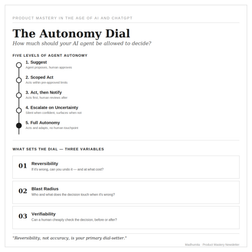
Stop writing prompts. Start hiring agents. The biggest shift in AI isn't about better prompting—it's about thinking like a CEO. What if instead of asking ChatGPT for help, you could hire a specialized team that works 24/7? This episode includes The 4-step process to "hire" your first AI agent Real case study of 5x productivity increase How to build agent teams that work together The One-Week AI Agent Challenge (with actionable steps) This isn't theory—it's a practical system you can implement today.
From Pilot to Production: A CEO’s Journey with AI
Explicit
This episode dives into the CEO's journey of deploying AI, revealing five essential gates to move from pilot to production. It covers real-world artifacts, reliability tactics, UX and pricing that boost trust, and proven go-to-market strategies. Listeners get actionable templates, practical metrics, and exclusive founder insights to avoid pitfalls and build AI products that perform, scale, and win enterprise deals.
1 of 6