In The Arena

In The Arena

by Cameron Schwab
Season 1
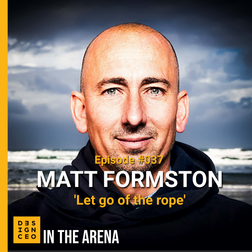
Matt Formston AM - 'Let go of the rope'
Matt Formston AM is legally blind and has surfed a 51-foot wave at Nazaré. Four-time surfing world champion. Paralympic cyclist. World record holder. Fifteen years at Optus exceeding enterprise sales targets by 140 per cent. But before any of that, Christmas Eve, 3am, blood on his clothes that wasn't his own. This is a conversation about rock bottom, the question "why not?", and what it actually takes to let go of the rope when you can't see the five-story wave you're riding down. We go deep on the trust formula, on standards and consequences, on the difference between unlocking performance and extracting it, and on why high standards are the foundation of psychological safety, not the enemy of it. This is a conversation for any leader who needs to know how trust is actually built when the stakes are life and death.
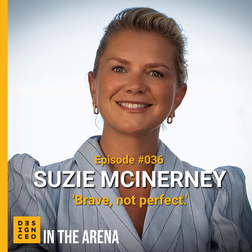
Suzie McInerney - 'Brave, not perfect'
Suzie McInerney is the CEO of Six Degrees Executive, leading a team of 90 across three states in one of Australia's most human-centred recruitment firms. She took the scenic route to CEO. From toy brand manager to running a hatted restaurant, to first employee CEO stepping into a founder-led business at Six Degrees Executive. Then COVID hit 12 months in. Then breast cancer. And through it all, the same lesson kept showing up, pretending to be fine doesn't make you strong. We go deep on psychological safety, on the cost of martyring yourself, on what it means to let off steam before the cracks become craters, and on why the work that feels unproductive, conversations, relationships and knowing your people, is often the work that truly matters. This is a conversation for any leader who's ever been scared shitless but put the big boots on anyway. Notebook ready. Play on!
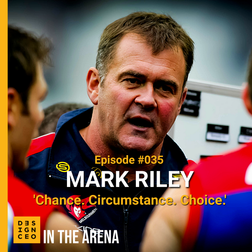
Mark Riley - 'Chance. Circumstance. Choice.'
Mark Riley has spent a career where few would know his name, but his fingerprints are everywhere. Assistant coach across the Fremantle, Melbourne, Carlton and Gold Coast Football Clubs. Nine games as Melbourne's caretaker senior coach. 450 AFL games in the box. But the real story starts in a shearing shed in Hyden and ends up at the Clontarf Foundation — 12,500 Indigenous boys, 170 sites, generational change. Two mentors shaped him: Gerard Neesham, the radical who taught him football could be art, and Neale Daniher, who taught him leadership is about others, not yourself. We go deep on knowing your people, unlocking performance rather than extracting it, and why the best question any leader can ask is simply — are you thinking about what you're doing? This is a conversation for anyone who understands that the size of a life isn't measured by headlines, but by the quiet work of seeing good in people and helping them see it in themselves. Notebook ready. Play on!
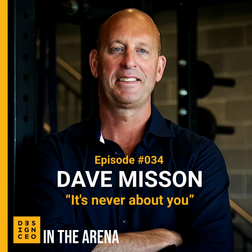
Dave Misson - "It's never about you"
Dave Misson has spent a career where most people would never know his name, and that's exactly the point. High performance manager across Tennis Australia, Australian Cricket, the Sydney Swans, St Kilda and Melbourne Football Clubs, Dave has been in the room for premierships, World Cups and some of the most powerful cultural moments in Australian sport. He steps into the arena with a mantra given to him over dinner in Mount Gambier by his mentor Ken Richardson: it's never about you. We go deep on the Bloods culture at the Swans, on mechanics and dynamics, on what it means to unlock performance rather than extract it, and on why the most powerful words in any team are simply — you belong here. This is a conversation for any leader who wants to understand what high performance actually looks like when ego leaves the room.
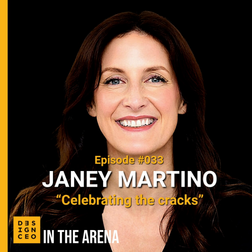
Janey Martino - 'Celebrating the cracks'
Janey Martino built Smiling Mind, one of Australia's most impactful not-for-profits, led businesses, coached founders, and is now back in the CEO chair at KIC. But this conversation isn't about what she's built — it's about what broke, and what she found inside the cracks. Janey steps into the arena with a willingness to go there, sharing openly the moments that reshaped how she leads and lives. We go deep on the Japanese philosophy of Kintsugi, on learning to feel before you think, and on the tension every leader carries between coaching and operating. This is a conversation for any leader who has ever tried to hold it all together and wondered whether letting go might actually be the work.
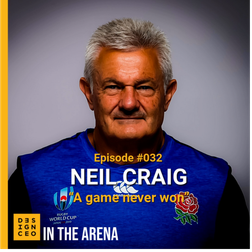
Neil Craig - 'A game never won'
Neil Craig is the first guest we've brought back into the arena — and for good reason. He's 70, coaching leaders at the Australian Institute of Sport, and still the most curious person in any room he walks into. Former AFL senior coach at Adelaide, performance coach with England Rugby and the Wallabies, and a wonderful mentor of mine. We go deep on expectations — the most dangerous word in high performance — and what happens when your behaviour drifts under pressure. Neil tells the story of a CEO brave enough to say, "You're not the coach we appointed." We talk about coaching effort, the critical friend every leader needs, and why the best coaches never stop being coached themselves. A game never won. Notebook ready. Play on.
Gabrielle Dolan - 'Leading with story'
I can’t remember exactly when I first heard the statement: “If it’s too obvious, it can’t be trusted.” This thought comes to mind when I am speaking with Gabrielle Dolan, a leader I have come to know over the past decade and feel so fortunate to have done so. The fact that we immediately connected is no surprise. Her leadership builds on the power of story, its nuance, and relatability. Our capacity to draw on personal lessons and learnings to understand self and what’s important to us, whilst developing the confidence to draw on these insights and tell our story to build a deeper connection with others and a commitment to a shared purpose and plan. Mostly, however, a story’s capacity to express what truly matters, your values and principles, that once told holds you accountable, as your credibility will now be judged by your capacity to live them, especially when it gets hard, as it will. I doubt, therefore, whether there is a more important skill for leaders than storytelling, including our capacity to tell our own. I understand this statement would be very challenging, if not confronting, for many leaders. For more than two decades, Gabrielle has worked with leaders across business, sport, and government, helping them move beyond jargon that can’t be trusted and into meaning that can. Notebook ready. Play on.
Dr. Damien Taylor - 'The second mountain'
Explicit
There comes a time when every leader must pause and take stock. For Dr Taylor, it’s the passage between age 40 and 55, a stretch of life that exposes both the weight and the cost of relentless striving. It’s a season that asks harder questions, such as: Is this still who I want to be? What truly matters now? It’s a crossroad that humbles even the most accomplished. The first mountain’s confidence gives way to doubt, yet it’s here, in the quiet and discomfort, that purpose begins to form. In turning inward, leaders learn to lead from a place that is a true reflection of who they are, and from the lessons learned, what we describe as their ‘leader’s limp’. “I don’t teach anything I haven’t fucked up”, I explain to Dr Taylor in support of his hypothesis. Success becomes less about climbing higher and more about deepening connection, to self, to others, and to purpose. It’s leadership as practice, not performance. In this space, “good enough” is not resignation but wisdom, the recognition that steadiness, kindness, and self-awareness are the new measures of mastery. When leaders learn to value calm over control, and meaning over momentum, they discover that the summit was never the goal; it was about growth, even though you never realised it at the time. Notebook ready… Play on!
Jenny George - 'A different way of hearing things'
Explicit
Jenny George runs Melbourne Business School - #1 in Australia. "A CEO is a symbol of what matters," she says. "Every choice you make — what you wear, where you sit, how you spend your time — tells the organisation who it's becoming." A mathematician turned CEO who learned leadership at thirteen, voting on where the family's charity money went. Her parents chose impact over income - dad building electricity systems for nations, mum counselling prisoners. Both asking: where can I make the difference only I can make? "Cut off my information flow and we're done," she tells me. We both know people who wake up thinking about power over rather than power with. Now she asks every leader the same question: "What are you doing that only you can do?" Everything else is noise. We explore how small choices become systematic change, why she sings eight-part Renaissance music (if you don't show up, your note doesn't exist), and what breaks trust between leaders. For CEOs who understand that leadership isn't about control - it's about creating conditions for others to thrive.
Maggie Roberts - 'The pain of standing still'
Explicit
At sixteen, Maggie Roberts broke her back three weeks before the Olympic diving trials. Eight months later, at three in the morning, she made a decision that would define her life: she went for a run. "The pain of my injury was less than the pain of standing still." From that moment of choosing movement over stillness came a scholarship to the University of Hawaii, three degrees, three years as the WAC Athlete of the Year, and, ultimately, becoming CEO of Creative Factory at just twenty-five. Eighteen years later, she's never stopped moving forward. In this conversation, Maggie shares her five-point daily framework for maintaining momentum, how visualisation took her from world champion at nine to boardroom success, and why harmony resides on expectations. A powerful exploration of what truly matters versus what seems to matter, and the decision to keep moving forward, one step at a time. Notebook ready, Play on!
1 of 4