
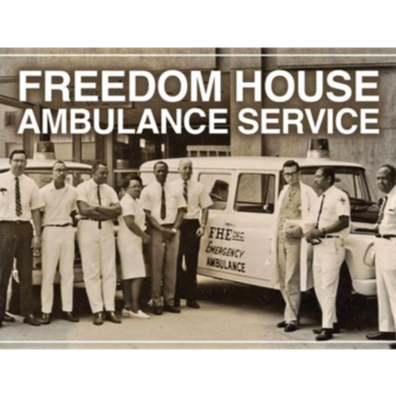
BLACKS Started Ambulance EMS
Episode notes
Order my book at: www.weusoursluckybooks.com
Lesson Plan: Freedom House Ambulance Service — The Birthplace of Modern EMS
Thesis Statement
The Freedom House Ambulance Service revolutionized emergency medical care in the United States by proving that marginalized Black citizens—once labeled “unemployable”—could become the nation’s first professionally trained paramedics and set the national standard for modern EMS.
Learning Objectives
- Students will identify the historical significance of the Freedom House Ambulance Service and its role in shaping modern emergency medical systems.
- Students will analyze how racial inequality influenced both the rise and dismantling of Freedom House, and how its legacy continues to impact EMS today.
Learning Outcomes (with Examples)
Outcome 1:
Students will be able to explain how Freedom House pioneered modern paramedic training and prehospital care.
- Example: A student might describe how Freedom House paramedics learned advanced airway management, CPR, and on‑scene medical decision‑making long before these skills were standard nationwide.
Outcome 2:
Students will be able to connect the story of Freedom House to present‑day EMS practices and equity issues.
- Example: A student might compare Freedom House’s community‑based model to today’s EMS systems and discuss how racial bias still affects healthcare access and emergency response.
Short 5E Learning Model
Engage
Show a photo of a modern ambulance and ask: “Who do you think invented the paramedic profession?” Most students will guess incorrectly—this opens the door.
Explore
Students read a short overview or watch a brief clip about Freedom House’s founding, training, and impact.
Explain
Teacher clarifies how Freedom House paramedics—Black men from Pittsburgh’s Hill District—became the first highly trained EMS professionals in the nation.
Elaborate
Students compare Freedom House protocols to today’s EMS procedures (e.g., cardiac care, trauma response, airway management).
Evaluate
Students complete a short-written reflection or exit ticket: “How does knowing this history change the way you view paramedics today?”
Challenge to Think
Each time you see paramedics racing through the city—lights flashing, sirens cutting through traffic—remember that the very system they use was built by Black pioneers whose brilliance was nearly erased from history. Ask yourself: How do we honor their legacy today, and what inequities still need to be confronted in emergency care?
Help with my audience research by calling 773-809-8594 leaving your name and where you are listening form. THANKS