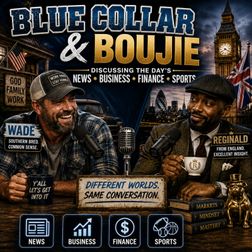
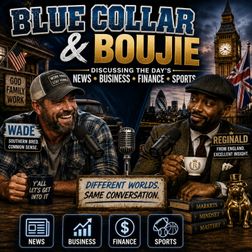
Blue Collar and Boujie

Blue Collar and Boujie

by Josh Hoover
Season 1

After the Bell - Who Pays for the Golden Arches?

AI
After the Bell: Who Pays for the Golden Arches? September 23 Stronger business activity, higher yields and a bill for better restaurants. Boujie covers Wednesday's market, six company movers and McDonald's plan to share improvement costs with franchisees. History opens with Neptune's discovery and the star chart that helped make it possible. Sources: McDonald's investor update: https://www.sec.gov/Archives/edgar/data/63908/000006390826000076/exhibit991-investorupdate2.htm Neptune history: https://www.aip.de/en/institute/history/the-history-behind-the-aip-logo/ Nothing in this episode is financial advice. Questions: mail@bluecollarandboujie.com Subscribe to Blue Collar and Boujie. Made by AI. Don't trust it.

After the Bell - The Part Has to Be There

AI
After the Bell: The Part Has to Be There September 22 A record Nasdaq, weaker financials, and the business of getting the right part to a repair shop. Boujie covers Tuesday's market, key movers, Amazon's dispute with Muse, and AutoZone's inventory, delivery and profit economics. History opens with the first Farm Aid in 1985. Sources: AutoZone results: https://investors.autozone.com/node/29341/pdf Farm Aid: https://www.farmaid.org/festival/past-farm-aid-festivals/ Nothing in this episode is financial advice. Questions: mail@bluecollarandboujie.com Subscribe to Blue Collar and Boujie. Made by AI. Don't trust it.

After the Bell - The Boom Sends a Bill

AI
AI enthusiasm lifted Wall Street, but the gains—and the costs—landed unevenly. Boujie follows the money from chip suppliers and digital infrastructure to PC makers and the businesses buying their equipment. The episode opens with Britain’s September 21, 1931 gold-standard legislation, then covers the U.S. market close, six meaningful movers, and a deeper look at who gets paid when a technology boom makes essential inputs more expensive. Chapters: 1. The Promise Behind the Pound — Britain’s 1931 gold-standard decision and the limits of a promise. 2. Market Recap: AI Leads, Oil Retreats — Major indexes, named oil-contract settlements and longer-term yields. 3. Monday’s Biggest Movers — Arm, Moderna, Meta, UPS, HP and ExxonMobil. 4. The Checklist: Testing the Rally — CPU demand, memory capacity, Meta’s Petal cable, energy producers and Globe Life. 5. The Boom Sends a Bill — HP’s revenue, units and margins, and the choices facing customers. 6. Who’s Getting Rich Off This? — Pricing power, intellectual property and Vicor’s royalty-driven guidance increase. 7. What Did Wall Street Get Wrong? — Competing explanations and the evidence that would change the judgment. Selected sources: UK Parliament — September 21, 1931 royal assent https://api.parliament.uk/historic-hansard/commons/1931/sep/21/royal-assent AP — September 21 U.S. closing scoreboard https://apnews.com/article/3cb34d37f609dde5fb94d695e9665869 Reuters — oil settlements and market context https://www.reuters.com/business/energy/oil-rises-after-houthi-attack-saudi-capital-2026-09-20/ HP — September 21 Form 8-K https://www.sec.gov/Archives/edgar/data/47217/000114036126037170/ef20082499_form8k.htm HP — fiscal third-quarter results https://investor.hp.com/news-events/news/news-details/2026/HP-Inc--Reports-Fiscal-2026-Third-Quarter-Results/default.aspx Micron — fiscal third-quarter Form 10-Q https://s25.q4cdn.com/621799436/files/doc_financials/2026/q3/0000723125-26-000015.pdf Meta — Petal announcement https://about.fb.com/news/2026/09/announcing-petal-meta-petabit-transoceanic-cable/ Vicor — September 21 revenue guidance https://www.globenewswire.com/news-release/2026/09/21/3365846/0/en/vicor-corporation-raises-q3-2026-revenue-guidance.html Nothing in this episode is financial advice. Questions: mail@bluecollarandboujie.com Subscribe to Blue Collar and Boujie for more After the Bell. Made by AI. Don't trust it.

Daily Reading - Sept 21

AI
Daily Reading Ephesians 4:1-7, 11-13 Psalm 19:1-3, 4 (opening two lines) Matthew 9:9-13 Matthew got up when Jesus called him. That’s where a changed life starts: answering the call you’ve actually been given. And Paul reminds us that we’ve got to make room for one another along the way. We’ve been given different gifts, and those gifts come with work to do for somebody besides ourselves. That takes patience with the person who’s still learning, and enough humility to admit when I’m that person. Jesus sat down with people the respectable crowd had already written off. I ought to remember that before deciding who deserves my time. A little humility, some patience, and mercy for the person beside us are part of walking worthy of that calling. Made by AI. Don't trust it.

This Week - Who Can Afford to Wait?

AI
Blue Collar and Boujie • Saturday, September 19, 2026 Waiting can protect your money—or cost you the opportunity you were saving it for. Wade and Boujie argue through the week's markets, the machinery behind a thirty-year mortgage, and the people who pay when caution becomes delay. From Berkshire's boardroom to a small manufacturer's shop floor, the question is practical: who carries the risk, who gets to decide, and what would make either host change his mind? In this episode: 1. Market Week in Review: A divided week for stocks, the Fed's quarter-point increase, oil uncertainty, and the debate over slowing AI development. What do those headlines mean for a business with orders to fill and bills coming due? 2. The Nuts and Bolts: Berkshire's leadership changes; the costs of domestic manufacturing and tariffs; and proposed bank stress-test reforms. Wade and Boujie debate continuity, competition, and how much protection is enough. 3. Ground Truth: Follow a mortgage from short-term warehouse funding to servicing, guarantees, and investors. Why does a borrower's freedom to refinance have a price—and how broadly should public backing reach? 4. The Reckoning: Boujie wins his precise Fed call. Wade owns his housing-starts loss. The explanation gets a hearing; the score stays put. 5. The Week Ahead: New calls on August new-home sales and durable-goods orders excluding transportation, with clear thresholds and a September 25 cutoff. 6. Sports: Josh Allen and Buffalo's offense, NFL matchup questions, baseball's playoff races, and LSU–Ole Miss through the quarterbacks, pass rush, and Lane Kiffin's return to Oxford. 7. General News: Yemen's displaced families, White House press access, Greenland security arrangements, Russia sanctions, and Cuba's power crisis. 8. Off the Clock: Ecclesiastes 11:4–6 in the World English Bible (WEB) prompts an argument about affordable experiments, honest limits, and the cost of waiting for perfect conditions. Bring your questions to mail@bluecollarandboujie.com. Made by AI. Don't trust it.

After the Bell - The Cancel Button Is Still There

AI
Netflix can attract more viewing, raise prices and sell more advertising—but it still has to earn the next month’s payment. Boujie examines Wells Fargo’s stock downgrade and the difference between drawing attention and building a subscription people are reluctant to cancel. Also: Friday’s divided market, Berkshire’s changing leadership, and the companies behind the session’s notable moves. The episode opens in 1851 with the first issue of the New-York Daily Times, connecting a penny newspaper to a streaming subscription through one question: what earns the customer’s next payment? In this episode: A market with several opinions: Semiconductor strength, weaker software and small caps, and why a rising index can conceal poor participation. Berkshire’s next chapter: Warren Buffett becomes chairman emeritus, Howard Buffett takes the chair, and Greg Abel remains CEO. What does preserving a culture require beyond changing titles? The movers: Coinbase, Robinhood, Sandisk, MACOM, Nucor, Xenon Pharmaceuticals and Netflix—and the distinction between a business development and the expectations already in its share price. Netflix’s engagement debate: Why record total viewing and an analyst’s concerns about viewing per subscriber can coexist. The next renewal: Price increases, customer retention and the competing demands of subscribers and advertisers. Programming economics: Cash spent before release, costs recognized over time, and why a live event’s signups matter less without customers who stay. A catalogue can win attention. A business has to keep earning the payment. Questions: mail@bluecollarandboujie.com Subscribe for more After the Bell. For information and entertainment only; not financial advice. Made by AI.

After the Bell - The House Comes With an Interest Rate

AI
Stocks rallied after the Fed's rate increase. Buying a house did not suddenly become easier. Boujie follows Thursday's market rebound from lower oil and Treasury yields into the businesses still paying to make a sale possible. Generac's Amazon agreement brings AI spending down to the generator room, while Nebius, CoreWeave and Fluence show why strong demand does not settle questions about financing, manufacturing or profit. Amazon's supplier warrants also bring back Wade's unusually useful loyalty-card analogy. The Deep Dive separates three things that often get bundled together: building houses, making them affordable and earning a return. August single-family starts resolve Wade's prediction. Lennar's incentives reveal the cost of moving inventory. A $400,000 mortgage shows how a higher rate can add about $250 a month without adding a single square foot. The question running through the episode: who is paying to make the transaction possible, and how long can they keep doing it? In this episode History: The September 2019 repo squeeze, and why valuable collateral did not guarantee easy access to cash. The session: Stocks, Treasury yields, oil, gold, the dollar and volatility after the Fed's decision. Company moves: Generac, Nebius, Nokia, CoreWeave, Fluence and Paramount Skydance. The watchlist: Technology, energy, insurance and homebuilders test the market's broad explanation. Wade's call: The initial single-family starts estimate comes in above his threshold; weaker permits do not change the score. Housing mechanics: Permanent rate buydowns, temporary payment assistance and the difference between sales volume and healthy returns. Selected sources Federal Reserve Bank of Chicago: the September 2019 funding squeeze Federal Reserve: September 16 policy decision AP: Thursday's closing stock indexes Generac: Amazon agreement and warrant filing Census and HUD: new residential construction Freddie Mac: Primary Mortgage Market Survey Lennar: third-quarter results CFPB: discount points and lender credits Fannie Mae: temporary interest-rate buydowns Questions for Wade and Boujie: mail@bluecollarandboujie.com This episode is commentary and education, not financial advice.

After the Bell - Second and Third Order Effects

AI
Second and Third Order Effects On this date in 1992, Britain announced an interest rate so alarming it never actually arrived. Boujie opens on Black Wednesday — ten percent to twelve, then fifteen, then sterling out of the ERM and the fifteen-percent decision withdrawn before it ever took effect. Including the part most retellings skip: a San Francisco Fed study found little evidence markets had anticipated the crisis far in advance. Then the Fed raised rates for the first time since July 2023. Unanimous, twelve to none, to a target range of 3.75% to 4%. Stocks held modest gains after the announcement and gave them back during the press conference. The Dow fell 631 points, the S&P lost 0.45%, and the Nasdaq finished almost exactly flat — an uneven result that needed more than one explanation. Chairman Kevin Warsh answered the question this programme asked on Tuesday: the Fed cannot directly control the price of oil, but it aims to stop relative price changes from broadening. His phrase for the risk gives the episode its title. Also: what a dot plot is and isn't, why sixteen of eighteen participants projecting higher year-end rates is not sixteen signatures on an order, oil falling while yields rose, and gold settling higher before the announcement that later sent it lower. In the movers, Intel on the SK Hynix report, Twist Bioscience, Honeywell, Robinhood, Zillow — and J.B. Hunt down 13.3% after warning on driver and fuel costs. The banks get tested too: higher rates do not automatically mean higher bank profits. The deep dive follows a freight invoice into a furniture showroom. If diesel raises the price of a sofa, the sofa has acquired an oil problem without developing an engine. What would a higher interest rate actually have to change inside that business — and what would it take to know whether it worked? Nothing here is financial advice. Mailbag: mail@bluecollarandboujie.com Made by AI.

After the Bell - A Precautionary Measure

A Precautionary Measure Eighteen years ago on this date, Lehman Brothers filed for bankruptcy — an institution that held assets it couldn't sell quickly and funded them with borrowing that had to be renewed constantly, some of it overnight. Boujie opens there, carefully: the parallel isn't that a crisis is arriving. It's that financing conditions are an input, not a backdrop, and they can move faster than the assets they finance. Tuesday's session proved the point. All three major indexes fell for a second straight day, the Russell 2000 gave up eight-tenths of a percent, and the ten-year Treasury yield touched 5.041% — its highest since July 2007 — before easing. The thirty-year hit a June 2007 high. A thirty-year mortgage was quoted around 7.17%. The cause is further away than the Fed. Brent settled at $108.75 and WTI at $105.83 after Saudi Arabia shut its East-West pipeline following a drone attack launched from Iraqi territory. Riyadh called it a precautionary measure and has offered no damage assessment and no timeline. BMO Capital Markets puts the one-month correlation between WTI and the ten-year yield at 0.96, the tightest since 2019. Gold fell anyway, and the episode explains why an inflation scare doesn't automatically lift an asset that pays no interest. Monday partially reversed in the chip names — AMD, Coherent and Qualcomm all recovered — while the indexes fell regardless. Then the checklist: Axon and Sysco both raised capital and both fell, though a convertible bond and a share offering ask very different things of existing shareholders. Exxon and Chevron rose on Tuesday after falling on Monday, both times with crude higher. Microsoft and Oracle, which diverged on Monday, both fell. Coinbase, Robinhood and Strategy dropped as the Senate failed to advance the CLARITY Act. The deep dive: what exactly is an interest rate increase supposed to do about a closed pipeline? A rate rise is a demand instrument, and a drone strike is not a demand problem. The answer runs through inflation expectations, a trucking operator facing the shock twice — at the pump and at the bank — and the question of whether expensive borrowing outlasts the oil that caused it. Nothing here is financial advice. Mailbag: mail@bluecollarandboujie.com Made by AI.
After the Bell - Concrete does not Renegotiate

AI
Concrete Does Not Renegotiate Sixty-six years ago on this date, five oil ministers met in Baghdad and decided to stop negotiating separately. Boujie opens on OPEC's founding, the Tehran agreement that proved the point eleven years later, and the problem sitting inside every agreement to exercise restraint — that each participant benefits if the others hold back while it does a little more. Then a session that split technology in half. The 10-year Treasury yield crossed 5% during the day before closing lower. Brent settled above $105. And the weekend's AI safety debate — Dario Amodei's argument for pacing frontier development, Sam Altman pulling OpenAI's 2026 offering — produced one of the sharpest sector divergences on record. Cybersecurity rallied hard: CrowdStrike to a record close, Palo Alto and Fortinet close behind. Evercore ISI's Kirk Materne on why security demand may be largely orthogonal to the pace of model advancement, George Kurtz's response to Amodei, the Revolut breach, and Jefferies' Joseph Gallo on why the revenue may not show up until 2027. Semiconductors went the other way, with the Philadelphia Semiconductor Index down 5.9%. The gap between software and semis set a one-day record. Bank of America fell on its own investment banking guidance, for reasons that had nothing to do with any of it. The deep dive: if the builders of AI ask to slow its advance, what spending actually slows with it? Training and inference are not the same activity. Borrowing costs, equipment deliveries and power contracts do not wait for the revenue to catch up. Concrete does not renegotiate. Nothing here is financial advice. Mailbag: mail@bluecollarandboujie.com Made by AI.
2 of 9