Biomedical Frontiers: Stories with Innovators in Healthcare

Biomedical Frontiers: Stories with Innovators in Healthcare

by Dasha Tyshlek
Season 3
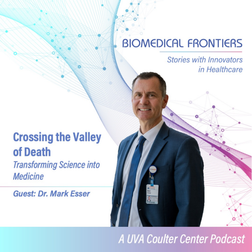
Crossing the Valley of Death: How the Manning Institute Will Transform Science into Medicines
Why do so many promising scientific discoveries never become real medicines? In this episode of Biomedical Frontiers Dr. Mark Esser, Chief Scientific Officer of the Paul and Diane Manning Institute of Biotechnology at the University of Virginia, describes one of the biggest challenges in healthcare innovation: the translational valley of death. Dr. Esser explains how the Manning Institute is being built to bridge the gap between academic discovery and patient-ready therapies. Drawing on decades of experience in industry, he shares how infrastructure, cross-disciplinary teams, regulatory expertise, and new funding models are essential to turning science into medicine. The conversation explores: Why promising biomedical research often stalls before reaching patients How the Manning Institute’s Accelerate, Create, Educate (ACE) model is designed to overcome these barriers A real-world case study of a novel sepsis therapy entering clinical trials What this effort means for the future of drug discovery and Virginia’s growing biotech ecosystem Follow Dr. Mark Esser on Social Media LinkedIn: https://www.linkedin.com/in/mark-esser-0b152b2/ Email: mark.esser@virginia.edu Paul and Diane Manning Institute of Biotechnology (University of Virginia) https://manninginstitute.virginia.edu UVA Licensing & Ventures https://lvg.virginia.edu/ Resources: Recommended Book: “A Practical Guide to Drug Development in Academia” https://catalog.nlm.nih.gov/permalink/01NLM_INST/vdtut1/alma9916234173406676 SPARK Drug Discovery Model (Stanford) https://sparkmed.stanford.edu Love this episode? Follow and write to us: 📸 Instagram: @biomedicalfrontiers 🔗 LinkedIn: https://www.linkedin.com/company/uvacoulter 📧 Reach us: biomedicalfrontiers@virginia.edu Director & Host: Dasha Tyshlek, StratCraft, Inc. www.strat-craft.com Executive Producer: David Chen, Managing Director & Instructor of Engineering Design, UVA Senior Producer: Hannah Moore, Associate Director, UVA Coulter Design Director: Carolyn Wagner, Inc. & Link: carolynwagnerinc.com Produced on behalf of Wallace H. Coulter Center for Translational Research at University of Virginia https://engineering.virginia.edu/centers-institutes/coulter-center-translational-research
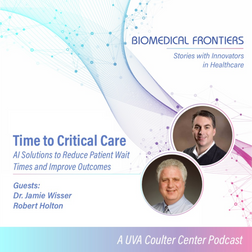
Time to Critical Care: How AI Can Cut Patient Wait Times | Dr. Jamie Wisser & Robert Holton
When every minute counts, inefficiencies in communication and data flow can cost lives. In this episode of Biomedical Frontiers, trauma surgeon Dr. Jamie Wisser and entrepreneur Robert Holton share how they’re using AI and interoperability to accelerate time to critical care. Dr. Wisser, founder of Actual Healthcare Solutions, describes how his experience performing 26-hour reconstructive surgeries exposed the limits of today’s electronic medical records. Together with Holton, he’s building a platform that connects hospital systems, specialists, and radiologists in real time—using AI to automate referrals, interpret imaging in seconds, and bridge the silos that slow patient care. 💡 What you’ll learn: ✅ Why healthcare still runs on disconnected “data islands” ✅ How AI-driven radiology can deliver results in under 30 seconds ✅ How interoperability can improve patient outcomes and physician efficiency ✅ Lessons from a trauma surgeon turned health tech founder 📚 Resources: Actual HealthCare Solutions: https://www.actualhealthcaresolutions.com HIT Lab: https://www.hitlab.org New York Innovation Week: https://www.nyinnovationweek.com Follow Biomedical Frontiers for more: 📸 Instagram: @biomedicalfrontiers 🔗 LinkedIn: https://www.linkedin.com/company/uvacoulter 📧 Reach us: biomedicalfrontiers@virginia.edu Love this podcast? Write to us with feedback or guest recommendations! Production Team: Director & Host: Dasha Tyshlek, StratCraft, Inc. www.strat-craft.com Executive Producer: David Chen, Managing Director & Instructor of Engineering Design Senior Producer: Hannah Moore, Associate Director, UVA Coulter Design Director: Carolyn Wagner, Inc. & Link: carolynwagnerinc.com Produced on behalf of: Wallace H. Coulter Center for Translational Research at University of Virginia
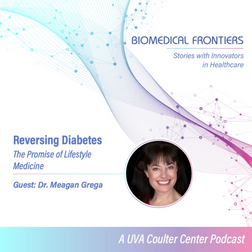
Reversing Diabetes: The Promise of Lifestyle Medicine With Dr. Meagan Grega
Type 2 diabetes affects over 37 million Americans — but what if our standard treatment paradigm is all wrong? In this episode, Dr. Meagan Grega shares the science and strategy behind lifestyle medicine, a fast-growing movement that uses food, sleep, movement, stress reduction, and social connection to treat and even reverse chronic disease. Dr. Grega is the co-author of the first-ever Clinical Practice Guideline on Lifestyle Interventions for Type 2 Diabetes and a lead author of ACLM’s Expert Consensus Statement on lifestyle medicine in primary care. She co-founded the Kellyn Foundation, where she helps families across Pennsylvania access fresh food, grow gardens, change lifestyle and improve their health together. You’ll learn: How fat in your muscles causes insulin resistance — and how to reverse it What makes behavior change stick Why doctors don’t prescribe lifestyle medicine — and how that’s changing How community-based programs and school gardens are transforming lives New Clinical Guidelines and Expert Consensus on treating diabetes with lifestyle interventions 📚 Resources: Free CME course: https://lifestylemedicine.org/education-certification/course-catalog/ Kellyn Foundation: https://www.kellyn.org/ Dr. Grega’s TED Talk: https://www.youtube.com/watch?v=efGa8QD8pU4 ACLM Clinical Practice Guideline: https://journals.sagepub.com/toc/ajla/19/2_suppl ACLM Expert Consensus Statement: Lifestyle Medicine for Optimal Outcomes in Primary Care: https://journals.sagepub.com/doi/full/10.1177/15598276231202970 Follow Biomedical Frontiers for more: 📸 Instagram: @biomedicalfrontiers 🔗LinkedIn: https://www.linkedin.com/company/uvacoulter 📧 Reach us: biomedicalfrontiers@virginia.edu Love this podcast? Write to us with feedback or guest recommendations! Production Team: Director & Host: Dasha Tyshlek, StratCraft www.strat-craft.com Executive Producer: David Chen, Managing Director & Instructor of Engineering Design Senior Producer: Hannah Moore, Associate Director, UVA Coulter Design Director Produced on behalf of: Wallace H. Coulter Center for Translational Research at University of Virginia
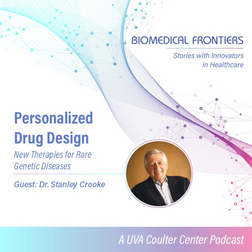
Personalized Drug Design: New Therapies for Rare Genetic Diseases with Dr. Stanley Crooke
Dr. Stanley Crooke pioneered a new class of medicine—antisense oligonucleotides—and built a $5B biotech company, Ionis Pharmaceuticals, to prove it could work. Then he walked away to found a nonprofit, n-Lorem, to treat patients with one-in-a-billion genetic mutations—people no one else would help. In this episode, we explore: What nano-rare diseases are, and why they represent medicine’s next great frontier. The promise of antisense therapy for individualized, mutation-specific treatment. The 30-year scientific journey behind genetic medicine—and what it takes to lead through failure. Why n-Lorem offers a new nonprofit model for treating diseases too rare to commercialize. The privilege, heartbreak, and hope of doing science not just for success, but for purpose. Mentioned Resources: Antisense Technology: A Review (PubMed) n-Lorem Foundation Hope Lies in Dreams – Nature’s 10-part series on Dr. Crooke The National Economic Burden of Rare Disease Study (EveryLife Foundation) Follow Biomedical Frontiers for more: 📸 Instagram: @biomedicalfrontiers 🔗 LinkedIn: https://www.linkedin.com/company/uvacoulter 📧 Reach us: biomedicalfrontiers@virginia.edu Love this podcast? Write to us with feedback or guest recommendations! Production Team: Director & Host: Dasha Tyshlek, StratCraft, Inc. www.strat-craft.com Executive Producer: David Chen, Managing Director & Instructor of Engineering Design Senior Producer: Hannah Moore, Associate Director, UVA Coulter Design Director: Carolyn Wagner, Inc. & Link: carolynwagnerinc.com Produced on behalf of: Wallace H. Coulter Center for Translational Research at University of Virginia
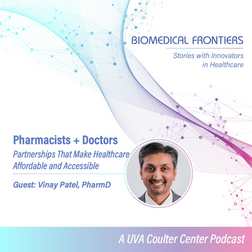
Pharmacists + Doctors: Partnerships That Make Healthcare Affordable and Accessible
Why Is Your Prescription So Expensive? How Pharmacists Can Help Fix Healthcare 💊 Featuring: Vinay Patel, Pharmacist & Founder of MakoRx Did you know that prescription drugs now account for 40% of healthcare spending on many employer plans? Or that pharmacists were once forbidden from telling you about cheaper alternatives to the medications you take? In this eye-opening episode, pharmacist and healthcare entrepreneur Vinay Patel joins host Dasha Tyshlek to expose the tangled web of middlemen, opaque pricing, and policy loopholes that drive up the cost of care—and to offer real, actionable solutions. Drawing from his experience serving over 15,000 patients through home delivery and launching the cost-plus pharmacy platform MakoRx, Vinay shares: Why drug prices vary wildly—and who really profits from your prescriptions What “gag clauses” were and why they harmed patients How subscription-based pharmacy models are changing the game The forgotten role of pharmacists in patient-centered care How employers can save 30–40% on their pharmacy costs Whether you’re a patient, a provider, or a policymaker, this episode is packed with insights on how to untangle the “complification” of our system—and why independent pharmacies could be the future of accessible, affordable care. 📚 Mentioned on the podcast: Unlocking the Value of AI in Healthcare by Dasha Tyshlek: https://www.strat-craft.com/learnwithstratcraft/ai-healthcare-report-info/report Bottle of Lies by Katherine Eban: https://www.harpercollins.com/products/bottle-of-lies-katherine-eban Books by Marty Makary: https://www.martymd.com/ 🔗 Learn more about Vinay Patel: LinkedIn: https://www.linkedin.com/in/vinaypharmd/ Company: https://www.makorx.com/ Director & Host: Dasha Tyshlek, StratCraft, Inc. www.strat-craft.com Executive Producer: David Chen, Managing Director & Instructor of Engineering Design, UVA Senior Producer: Hannah Moore, Associate Director, UVA Coulter Design Director: Carolyn Wagner, Inc. & Link: carolynwagnerinc.com 🎧 Produced on behalf of Wallace H. Coulter Center for Translational Research at University of Virginia https://engineering.virginia.edu/centers-institutes/coulter-center-translational-research 📩 Send feedback or guest ideas: biomedicalfrontiers@virginia.edu
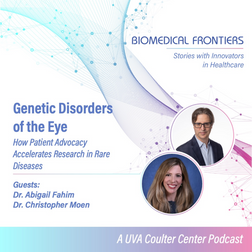
Genetic Disorders of the Eye: Living with Vision Loss, Patient Advocacy, and Rare Disease Research with Dr. Fahim and Dr. Moen
What is it like to live with a rare genetic eye disorder? Join Dr. Abigail Fahim and Dr. Chris Moen as they discuss choroideremia—a progressive retinal disease—and how research, advocacy, and patient experience intersect to push for treatments and improve quality of life. Dr. Fahim shares her cutting-edge research into the cellular mechanisms driving this progressive condition, while Dr. Moen—a physician, patient, and advocate—shares his personal experience with vision loss and the systemic gaps that impact those with rare diseases. Together, they explore: What choroideremia is and how it affects vision How inherited retinal diseases are diagnosed and why genetic testing matters The challenges of developing gene therapies for rare conditions Why clinical trials often fail despite promising science How patient advocacy groups like the Choroideremia Research Foundation are driving progress Assistive technology, mobility, mental health, and accessibility for the blind and visually impaired 🔬 Dr. Fahim is an Assistant Professor of Ophthalmology at the University of Michigan 🩺 Dr. Moen is formerly the Chief Medical Officer of the Choroideremia Research Foundation and a retired emergency physician Love this podcast? Write to us with ideas, feedback, and guest recommendations at biomedicalfrontiers@virginia.edu. Follow Dr. Abigail Fahim on Social Media Bio & Research Page: https://medicine.umich.edu/dept/ophthalmology/abigail-t-fahim-md-phd Fahim Lab: https://medresearch.umich.edu/labs-departments/labs/fahim-lab Follow Dr. Chris Moen on Social Media LinkedIn: https://www.linkedin.com/in/christopher-moen-2aabb1/ Choroideremia Foundation: https://www.curechm.org/ Mentioned on the Podcast - HYBRD: Website Link : https://www.hybrd.app/ iOS App Store Link: https://apps.apple.com/us/app/hybrd-hybrid-athlete-tracker/id6670271875 Director & Host: Dasha Tyshlek, StratCraft, Inc. www.strat-craft.com Executive Producer: David Chen, Managing Director & Instructor of Engineering Design, UVA Senior Producer: Hannah Moore, Associate Director, UVA Coulter Design Director: Carolyn Wagner, Inc. & Link: carolynwagnerinc.com Produced on behalf of Wallace H. Coulter Center for Translational Research at University of Virginia https://engineering.virginia.edu/centers-institutes/coulter-center-translational-research
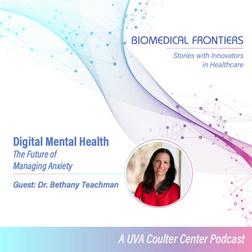
Digital Mental Health - the Future of Managing Anxiety and Depression with Dr. Bethany Teachman
How do we tackle the rising epidemic of anxiety with tools that actually scale? Why aren’t traditional therapy models enough? And how can digital technologies like mobile sensing and cognitive bias modification help close the treatment gap in mental health? In this episode of Biomedical Frontiers, host Dasha Tyshlek sits down with Dr. Bethany Teachman, Professor of Psychology and Director of Clinical Training at the University of Virginia, to explore how digital mental health tools are being designed and tested to meet people where they are. Dr. Teachman is the founder of MindTrails, a suite of app-based tools to help individuals reduce anxious thinking, and co-leads the UVA TYDE initiative (Thriving Youth in a Digital Environment). She brings a unique perspective as both a clinician and innovator developing tools rooted in science but built for the real world. Topics Discussed: Why anxiety and depression are rising—and why therapy alone isn’t enough How mobile sensing and AI can detect anxiety through physiological, social, and environmental cues How MindTrails helps people shift negative thinking patterns What it takes to co-develop ethical and effective tech with engineers Challenges of building digital interventions people actually use The unique value a clinician brings to tech innovation Resources Mentioned: 🔹 MindTrails: https://mindtrails.virginia.edu/science.html 🔹 UVA TYDE: https://tyde.virginia.edu/ 🔹 Research Paper: Mobile Sensing and Anxiety Detection 🔹 Research Paper: CBM-I Digital Intervention Preprint Follow Dr. Bethany Teachman: Lab Website: https://teachman.org Email: bat5x@virginia.edu LinkedIn: https://www.linkedin.com/in/bethany-teachman-b78558236/ Follow Biomedical Frontiers for more: 📸 Instagram: @biomedicalfrontiers 🔗 LinkedIn: https://www.linkedin.com/company/uvacoulter 📧 Reach us: biomedicalfrontiers@virginia.edu Love this podcast? Write to us with feedback or guest recommendations! Production Team: Director & Host: Dasha Tyshlek, StratCraft, Inc. www.strat-craft.com Executive Producer: David Chen, Managing Director & Instructor of Engineering Design Senior Producer: Hannah Moore, Associate Director, UVA Coulter Design Director: Carolyn Wagner, Inc. & Link: carolynwagnerinc.com Produced on behalf of: Wallace H. Coulter Center for Translational Research at University of Virginia
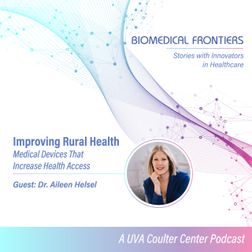
Improving Rural Health: Medical Devices That Increase Health Access With Dr. Aileen Helsel
Can medical devices improve patient care in rural healthcare systems? In this episode, Dr. Aileen Helsel, Director of Innovation at Carilion Clinic, shares how her team of engineers works with Carilion’s clinical teams to develop new medical devices that solve unique challenges in rural settings. Rural patients often travel long distances for care - making management of time sensitive emergencies and recurring visits for chronic conditions particularly challenging. Dr. Helsel highlights three projects: a wearable lymphedema therapy device, an early detection system for ventriculoperitoneal shunt failures, and a cardiac surgery arm positioning device. Each of these devices was conceptualized at the bedside (or in the operating room) and brought to life with the expertise and passion of a physician. Dr. Helsel began her career as a research scientist at Washington State University before transitioning to technology transfer in the licensing and ventures team at WSU. She was always looking for a greater impact. Now, as Director of Innovation at Carilion Clinic, she partners with physicians, nurses, and therapists on the front lines to help solve their most pressing challenges. Aileen shares how her team collaborates with a human factors group and a simulation center to test prototypes in realistic settings. Dr. Helsel believes that solving targeted problems in rural healthcare can yield scalable solutions that benefit the broader medical community. Love this podcast? Write to us with ideas, feedback, and guest recommendations at biomedicalfrontiers@virginia.edu. Follow Dr. Aileen Helsel on Social Media LinkedIn: https://www.linkedin.com/in/aileenhelsel/ Carilion Clinic: https://www.carilionclinic.org/ Roanoke Blacksburg Innovation Alliance: https://rbia.tech/ Director & Host: Dasha Tyshlek, StratCraft, Inc. www.strat-craft.com Executive Producer: David Chen, Managing Director & Instructor of Engineering Design, UVA Senior Producer: Hannah Moore, Associate Director, UVA Coulter Design Director: Carolyn Wagner, Inc. & Link: carolynwagnerinc.com Produced on behalf of Wallace H. Coulter Center for Translational Research at University of Virginia https://engineering.virginia.edu/centers-institutes/coulter-center-translational-research
Season 2
Tech Transfer, navigating the healthcare system and taking risks, from academia to industry with David Chen and Lisa Bowers
How do groundbreaking biomedical innovations move from research labs to real-world applications? What challenges make healthcare such a complex industry for startups? What risks are worth taking when translating science into impactful solutions? In this episode host Dasha Tyshlek sits down with David Chen, Assistant Dean of Entrepreneurship and Innovation Partnerships, and Lisa Bowers, Director of UVA’s Enterprise Studio and former biotech executive, to explore tech transfer in healthcare. We discuss: Layers of complexity in solving healthcare challenges Economic realities that make healthcare innovation difficult How early-stage biotech companies navigate funding, regulations, and clinical trials Lisa and David share insights from their experiences in academia and industry, discussing how researchers can effectively bridge the gap between discovery and commercialization. Resources Mentioned CVille BioHub: https://cvillebiohub.org/ Manning Institute: https://manninginstitute.virginia.edu Building Better Medicine: https://buildingbettermedicine.com Follow David Chen LinkedIn: https://www.linkedin.com/in/david-c-3889753/ UVA’s Wallace H. Coulter Center: https://engineering.virginia.edu/centers-institutes/coulter-center-translational-research UVA’s School of Engineering and Applied Science: https://engineering.virginia.edu/ Follow Lisa Bowers LinkedIn: https://www.linkedin.com/in/lisavbowers/ Medium: https://medium.com/@lisavbowers UVA’s Enterprise Studio: https://lvg.virginia.edu/enterprise-studio-1 UVA’s Licensing and Ventures Group: https://lvg.virginia.edu/ Follow us Instagram: @biomedicalfrontiers LinkedIn: https://www.linkedin.com/company/uvacoulter Production Team: Director & Host: Dasha Tyshlek, StratCraft, Inc. www.strat-craft.com Executive Producer: David Chen, Managing Director & Instructor of Engineering Design Senior Producer: Hannah Moore, Associate Director, UVA Coulter Design Director: Carolyn Wagner, Inc. & Link: carolynwagnerinc.com Produced on behalf of Wallace H. Coulter Center for Translational Research at University of Virginia
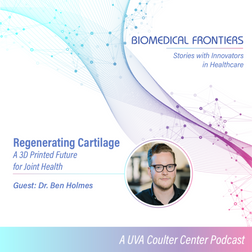
Dr. Ben Holmes on Regenerating Cartilage: A 3D Printed Future for Joint Health
Cartilage doesn’t heal easily—but what if it could? In this episode, we sit down with Ben Holmes Ph.D, CEO of Nanochon, to explore how his team is revolutionizing cartilage repair with 3D printing technology. Learn how Nanochon’s innovative material mimics natural cartilage and stimulates proper healing and repair. It may one day make knee replacements obsolete. Ben also shares his leadership journey, how he conducted over 100 physician interviews to help him understand the pain points in orthopedics, and insights on leading technological disruption in medical practices and procedures. Love this podcast? Write to us with ideas, feedback, and guest recommendations at biomedicalfrontiers@virginia.edu Ben Holmes is the CEO driving force behind Nanochon, a company innovating cartilage repair and regeneration. Holmes's expertise in biomedical engineering has positioned Nanochon as a frontrunner in developing next-generation orthopedic medical devices. Nanochon is creating durable, effective treatments for orthopedic patients, promising a future where advanced, reliable solutions are readily available to improve the quality of life for individuals with joint issues. Before founding Nanochon, Dr. Holmes was the CTO at SonoStik, another George Washington University medical device startup.He has a Bachelors of Science degree in mechanical engineering from UVA, and a PhD in Biomaterials and Nanomedicine from The George Washington University. Follow Dr. Ben Holmes on Social Media LinkedIn: https://www.linkedin.com/in/bbhceo/ Check out Nanochon: https://www.nanochon.com/ Read about CVille Biohub's Annual BioSpark Competition: https://cvillebiohub.org/bio-spark/ Learn about NSF's iCorp Program: https://new.nsf.gov/funding/initiatives/i-corps MedTech Innovator is recruiting their next class - apply here: https://medtechinnovator.org/ --------------------------------------------- Director & Host: Dasha Tyshlek, StratCraft, Inc. www.strat-craft.com Executive Producer: David Chen, Managing Director & Instructor of Engineering Design, UVA Senior Producer: Hannah Moore, Associate Director, UVA Coulter Design Director: Carolyn Wagner, Inc. & Link: carolynwagnerinc.com Produced on behalf of Wallace H. Coulter Center for Translational Research at University of Virginia https://engineering.virginia.edu/centers-institutes/coulter-center-translational-research
1 of 2