
Bible Q&A Uganda

Bible Q&A Uganda

by Afiq Africa
Season 11

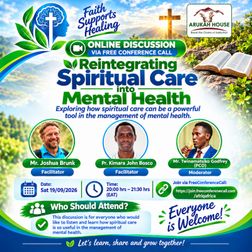
Spiritual Care and Mental Health, Episode 01

In this introductory episode, Mr. Twinamatsiko Godfrey discusses the general ideas of Mental Health as understood in the modern context and then interviews Mr. Joshua Brunk and P. Kimara John Bosco regarding the importance of having spiritual care within the realm of mental health treatment. Both Mr. Brunk and P. Kimara emphasize the importance of beginning with spiritual care and then bringing in the other aspects of working with mental health issues toward a holistic process rather than the other way around. Join us each Saturday at 2000 as we will continue to discuss important issues regarding mental health care within a biblical framework in the Ugandan context. One of our biggest goals is that we are able to share various means of help that people can have at their disposal in dealing these difficult issues in life. If anyone is in need of help for themselves or a loved one with overcoming serious addictive behavior in life please contact Mr. Twinamatsiko Godfrey on WhatsApp at +256 793 979647 If anyone desires to get general help with biblical counsel contact Mr. Joshua Brunk on WhatsApp at +27 69 373 2251 If anyone wants to join our Bible Q&A to ask any questions related to the Bible including anything regarding mental health and addictions to get a biblical understanding, please join our WhatsApp Group https://chat.whatsapp.com/Ja3rwl8waBeKyjlQ1eNE7v If anyone wants to have our team come to your church or school or other type of institution to present mental health and addictions from a biblical perspective please contact Mr. Joshua Brunk on WhatsApp at +27 69 373 2251
Season 1

In John 9 Jesus tells His disciples that the man was born blind so that the works of God might be displayed in him. Does God make some people to suffer just to use them as an object lesson?

We discuss this probing question as we consider the entire context of John 9. We conclude that God does not cause people to suffer for "just" one or another reason but that He does cause His people to suffer for a whole host of reasons. Then we consider other portions of Scripture: the book of Job, John 11, Romans 8, 2 Corinthians 4, and Colossians 1. We examine various reasons why God causes His own to suffer, and we conclude even that it is the norm for God's people to suffer. We develop a basic theology for suffering, something that is majorly lacking in proper understanding in this modern age, and we come back to Scripture in order to let Scripture inform our hearts. This is such an important part of theology that is more practical than most since all of us go through suffering, and we go through it quite often. How are we to view our suffering in light of our sonship in Christ? Join us as we discuss these things in this episode.

Why did God ask Adam "Where are you?" in Genesis 3:9 if God is all-knowing?

In this episode, we answer the question rather quickly and then spend our time examining from the rest of Scripture other instances in which God does this, and we spend time really reflecting on the character of God in how and why He asks His questions. Repeatedly, it is demonstrated the great grace and patience of God in how He asks His questions. Toward the end of this recording, I explain some ideas that we could consider to try to serve people better, and I ask the listeners to give feedback on ways that we could improve this service. Please respond to me on ideas that you have or feedback on what we are currently doing in order to help us improve. Thank you very much!

How can 1 Samuel 15:11 describe God as relenting from making Saul king when Numbers 23:19 says that God does not change His mind?

In dealing with this question, we examine several other texts: Genesis 6:6-7, Exodus 32:14, and Jonah 3:10 which all demonstrate similar activity of relenting from God. In contrast we examined Numbers 23:19, Malachi 3:6, and most especially within the same chapter as the question, 1 Samuel 15:29. It is clear that both the immediate context of 1 Samuel 15 as well as the greater teaching of all of Scripture is that God does not change His mind. We examined more carefully the difference between God changing His mind, which He does not do, and with Him feeling sorrow over the consequences of what had happened. Even in Genesis 6 with God feeling sorry for making man, He continued on with the process that was originally started. He did not wipe man out completely, but He preserved Noah and His family. He didn't make a new creation, He kept going with the original plan. We spend time fleshing out the emotional nature of God in relation to sin and disobedience in contrast to God's fixed and eternal plan which does not change. Please make sure to ask any follow-up questions if there are still areas of confusion in regard to this question.

What does Luke 11:24 mean in regard to the unclean spirit seeking rest?

We examine this parable of the Lord's in which He describes a demon being cast out of a person and goes about wandering. He determines to return to his original home, and when he arrives, he finds it swept and clean. He invites seven other spirits more evil than himself to join him in taking up occupation in the house, leaving the person worse off than before. We compare this section with Matthew 12:43:-45 as well. This is in the immediate context to a question we answered previously regarding "The Blasphemy of the Holy Spirit," so we are already a little familiar with this context. We discuss the idea that this is a continued warning to the hypocrisy of the religious leaders that are accusing Jesus of casting out demons by Satan's power, and so He responds accordingly with this warning. It is not enough to put off sin; in fact, it is damning to do so by itself. We must put on Christ and the new man that is dependent upon the Holy Spirit or else putting off evil will make us more susceptible to Satanic control. We wrap up our application to this question by briefly examining Ephesians 4 and Colossian 3 to see the process of putting off and putting on that the believer is called to. I referenced an interesting podcast in this episode called "Haunted Cosmos." It's not for everyone, but here is the link if you want to check it out: https://www.thehauntedcosmos.com/

In Matthew 22:44 who do the two different "Lords" refer to?

With this question we consider the parallel accounts from Matthew 22:41-46, Mark 12:35-37, and Luke 20:41-44. In addition we consider Peter's sermon from Acts 2:29-41 and see how Peter explained things. All of these passages make reference to Psalm 110:1, and the entire Psalm is about the character who is the second of the two Lords. In Psalm 110, it is clearly a Messianic Psalm considering the promised Messiah who would come to destroy Israel's enemies and rescue HIs people. What is intriguing is that another term for the Messiah from the Old Testament interpretation was "The Son of David," which was an accurate description for the Messiah would be a descendant of David. The question is then posed by Jesus in the Gospels and again by Peter in his arguing from logic, "How can this be David's Son, if He is David's Lord?" And so we not only spend time answering who this Lord is, but we also address the broader question of how this Son of David was also David's Lord before He became David's Son.

How was David such a huge sinner and yet called "a man after God's own heart"?

Another long answer here, but I spent so much time on the response because of its importance to our understanding. This question identifies a huge conflict between how the Bible seems to talk about what God looks for and how the institution of the church seems to talk about what God looks for. The problem is that how the Bible seems to most obviously talk is in contrast to how the institution describes things. Because of this, I wanted to really spend sufficient space and time dealing with this thoroughly. This is not a question that it is okay to not rightly understand. To fail to understand the answer that the Bible gives is damning. So, I wanted to thoroughly demonstrate what the Bible describes and says so that we can make sure to be right with God, even if the institution disagrees with us. We looked into a bit of the life of David in contrast to Saul as well as David's sin. David's sin was about as bad as one could imagine it. We dealt with God's view of sin and man's view of sin and demonstrated that man is only concerned with what is on the outside (the actual acts of sin) while God is concerned with the heart. David went after sin at the heart level and didn't care if he actually became more sinful in the efforts to deal with his heart. That is an alarming thing to say. In Psalm 139 David essentially asks God to bring out the buried sin into outward actions so that he could be purified of his sin. We closed by considering Psalm 51 and gave an overview of some of the characteristics of David's heart in relation to his own sin, in relation to God, in relation to restoration, and other things. Again, to miss how Scripture describes the heart of God in this is to miss salvation. We need to make sure we are clear on what God desires from us, and we need to begin by setting aside all our preconceived notions, because our preconceived notions are guaranteed to be wrong. Only God can describe his heart to us and what He desires in each of our hearts. We have no right to go before Him and say, "But even though you required this, look at what I brought? Accept my gift to you." This was established from the very beginning with Cain's sacrifice as false worship. We need to bring what God requires. Anything else is false worship, and, therefore, false salvation.

How can we trust the creation account in the Bible in relation to what Science teaches us?

This is a really long answer, because there is so much content in this particular topic to really consider. All that we do in this episode is do a thorough overview of the topic, and so I would encourage follow-up questions to any various part of this episode in order to dig deeper into a particular area. Please be patient through this answer because it covers a lot, and it covers a lot because it is important to understand that it is not really a fair assumption to make to consider the Bible and Science in opposition. The Bible has a lot to discuss in relation to this issue, and true Science stands in complete agreement with the Bible. False ideas or theories based on assumptions that Peter tells us in 2 Peter 3 are assumed in order to excuse sinful desires and avoid the topic of judgment are promoted to discredit God's Word and remove accountability. We discuss various views of creation and evolution by Christians that are held. We discuss the problems of trusting in Darwinian evolution and the advantages of trusting a more literal reading of Genesis 1-11. We deal with the literary structure of Genesis 1 and demonstrate some various ways in which is seems entirely impossible to have been written by a mortal man. The geometric and mathematical structure to the very lettering of each word in the chapter is incredible and demonstrates design that is akin to the DNA of a creature. It is not likely that there would be such demonstration of infinite wisdom inscribed in Genesis 1 and then the actual content of the message would be hap hazardous or vague or misleading. The more obvious explanation is that the same order and careful detail put into the literary structure is indicative of a Creator God who put the same level of order and careful detail into His creation and then gave us a order and careful detailed account of what exactly He did. Finally, by way of application, we consider 2 Peter 3, and we consider the implications of why men hold to other ideas than what the Bible suggests. We consider the judgment of the flood having been ordered even within that creation account, and then the second judgment also having its order within the creation account. Even the design of God's judgment on this earth was there in the creation. I hope this is helpful to peak your interest into digging deeper into various concepts within this topic. I hope that it is not something that just peaks the interest of our minds but that it helps us to know our God more deeply and understand what He has done, what He is doing, and what He is planning to do in better ways. Please feel free to ask any follow-up questions. Thank you!

What is the unforgiveable sin that Jesus spoke of?

"The unforgiveable sin" is also known as "the unpardonable sin" or "the blasphemy of the Holy Spirit. All three of these concepts refer to the exact same situation. In my experience in counseling, I do not believe I have come across a more commonly asked question. In this answer, we cover some historical contexts of the church in how we view warning passages in our modern context. We then consider application in regard to how we should really consider warning passages in Scripture, and we emphasize the importance of taking passages like this very seriously. We also consider Jesus' statements about this condition in the context of what was going on around Him as recorded in Scripture. We consider what Jesus was dealing with in regard to the people who seemed to be in jeopardy of committing this sin so that we can better understand what Jesus was warning against. Finally, we define what this sin is not as well as what it is, and we try to then consider various aspects of how that affects us. We should know what the sin is not so that we don't condemn ourselves or others wrongfully, but we should consider what it is, so that we can rightly apply it in the context of our own lives and ministries. In application, we bring out encouragement to not too quickly remove ourselves from a struggle with considering ourselves in relationship to this sin. More importantly, we encourage ourselves to not improperly "rescue" someone else as they struggle with considering this sin. We referenced the resource "The Pilgrim's Progress" by John Bunyan. Find an ebook and audiobook here at Monergism: https://www.monergism.com/pilgrims-progress-modern-english-ebook We also referenced the preaching of John Piper and specifically in regard to "The Perseverance of the Saints." You can find a good lecture-sermon on this topic by him here: https://www.desiringgod.org/messages/perseverance-of-the-saints-session-8

Will we be creatures of time in Heaven? What will Heaven look like in relation to time?

We've adjusted this question a bit in order to try to identify first if we will continue to be creatures of time in the next life. Secondly, in application to this question, we discuss a bit about what Heaven might be like. Because we do not have a lot of information on this topic, we are careful not to go beyond Scripture in addressing it, but we do use Scripture to give us a bit of insight into what Heaven will be like. We trust this will help us each to better anticipate Heaven on a daily basis. Resource: Randy Alcorn's "Heaven" is a fantastic book to help the believer know more about what we can know about Heaven: https://www.amazon.com/Heaven-Randy-Alcorn/dp/0842379428
1 of 2