
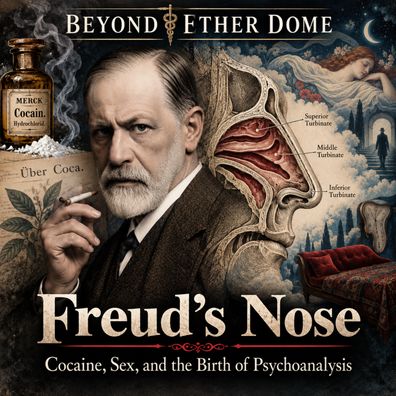
Freud’s Nose: Cocaine, Sex, and the Birth of Psychoanalysis
Episode notes
Sigmund Freud is remembered as the father of psychoanalysis, but before dreams, repression, and the unconscious, he was a young neurologist searching for biological explanations for nervous disease.
He was also fascinated by cocaine.
Freud experimented on himself, promoted cocaine as a treatment for fatigue and depression, and tried using it to treat morphine addiction. Then he became closely associated with Wilhelm Fliess, a Berlin ear, nose, and throat physician who believed that specific “genital spots” inside the nose were linked to menstruation, masturbation, sexuality, and neurosis.
Their collaboration eventually led to one of the strangest episodes in the history of medicine: the disastrous nasal surgery of Emma Eckstein. Fliess left a long strip of iodoform gauze inside her nose, causing infection, hemorrhage, and a near-fatal postoperative crisis. Freud was horrified. Months later, he had the dream that would become the centerpiece of The Interpretation of Dreams.
In this episode, we discuss:
- Freud’s early cocaine experiments and his 1884 publication Über Coca
- The disastrous attempt to treat Ernst von Fleischl-Marxow’s morphine addiction with cocaine
- Freud’s friendship with Wilhelm Fliess and their search for biological explanations of neurosis
- Fliess’s theory of nasal “genital spots” and the supposed connection between the nose, sexuality, menstruation, and nervous illness
- How cocaine, cautery, and turbinectomy became treatments within Fliess’s nasal-reflex theory
- Emma Eckstein’s nasal surgery, the retained gauze, and the hemorrhage that nearly killed her
- Freud’s continued cocaine use and his remarkable admission: “I need a lot of cocaine”
- The dream of Irma’s injection and Freud’s realization that the dream fulfilled his wish to escape responsibility
- How dream interpretation helped shift Freud from anatomy and reflexes toward unconscious wishes, memories, fantasy, and repression
Freud never stopped believing that the mind was ultimately biological. But by the end of the 1890s, he was increasingly looking for meaning rather than anatomy. The road from Über Coca to The Interpretation of Dreams passed through cocaine, sexual theory, nasal surgery, medical error, and one very guilty dream.