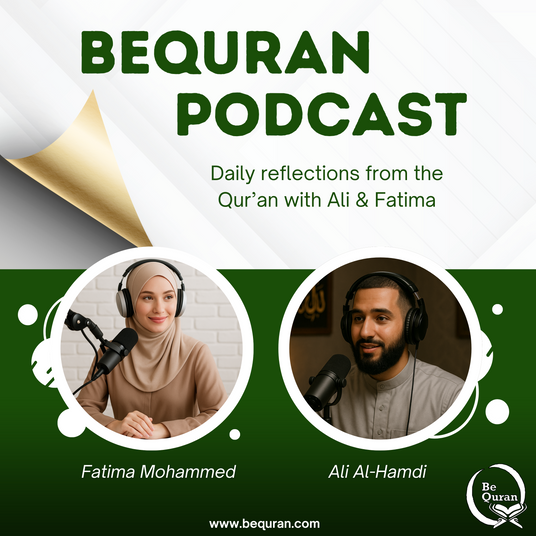
BeQuran Podcast

BeQuran Podcast

by Ali & Fatima
Season 1

The Successor After the Prophet? Unpacking Ghadir Khumm
In this powerful episode of the BeQuran Podcast, Ali and Fatima take a deep dive into one of the most defining and debated events in Islamic history Ghadir Khumm. Was leadership after the Prophet Muhammad ﷺ divinely appointed or left to community consensus? Drawing from Qur’anic verses, Hadith literature, and insights from Sayyid Ammar Nakshawani’s lecture, this episode explores the rational, theological, and historical arguments for the succession of Imam Ali (AS). We reflect on terms like Mawla, Wali, and the Prophet’s final message, and how this event continues to shape Muslim identity and belief today. Whether you're Sunni, Shia, or simply curious — you're invited to listen with an open heart.

Divine Appointment or Community Choice? – Understanding Eid al-Ghadir
In this episode of the BeQuran Podcast, Ali and Fatima take a deep dive into the historical and theological significance of Eid al-Ghadir, the day Prophet Muhammad (peace be upon him) publicly declared Imam Ali as his Mawla and successor at Ghadir Khumm. They explore whether this was a divinely appointed leadership or a matter left to the community’s decision. Drawing from powerful Qur’anic precedents like the appointments of Adam, Musa, Harun, and Talut they reveal a consistent pattern of divine or prophetic appointment over popular election. The discussion also highlights how the Prophet consistently appointed leaders during his lifetime, never leaving leadership to chance or vote, reinforcing that the announcement at Ghadir was a continuation of a divine model. This episode invites listeners to reflect on the nature of leadership in Islam, divine authority, and the implications of Ghadir on our understanding of faith and community today.

Why Do Shia Pray on a Stone? The Turbah Explained
In this episode of BeQuran, Ali and Fatima dive deep into one of the most visually distinctive practices in Islamic prayer: the use of a turbah a small piece of earth or clay commonly used by Shia Muslims during sujood (prostration). Drawing on Sunni hadith collections like Sahih Bukhari and Sahih Muslim, and guided by insights from Dr. Sayed Ammar Nakshawani, this episode explores the roots of this practice, its link to the Prophet Muhammad (PBUH), and the historical precedent set by his companions.

Divine Wisdom: Understanding the Qur’an
In Episode 17 of the BeQuran Podcast, Ali and Fatima explore the unique structure, profound themes, and spiritual depth of the Holy Qur’an. Drawing on insights from Dr. Sayed Ammar Nakshawani, unpacking how the Qur’an differs from other scriptures, why it isn’t organised chronologically, and what its true central message is. Whether you’re a lifelong reader of the Qur’an or just starting your journey, this episode will deepen your understanding of why this sacred text continues to guide and inspire.

The Story of the Quran: Compilation, Controversies & Clarity
In this deep and thought-provoking episode of the BeQuran Podcast, Ali and Fatima explore one of the most sensitive yet foundational topics in Islamic history—the compilation and preservation of the Holy Quran. For generations, the Shia community has faced accusations of believing in a different or altered Quran. But rather than defending against these claims, this episode flips the lens and examines Sunni hadith sources themselves—Sahih Bukhari, Sahih Muslim, and others—to uncover what they actually say about missing verses, variant readings, and Quranic transmission. This discussion is inspired by a lecture from Sayed Ammar Nakshawani, whose controversial statement about “holes in the narrative” stirred widespread debate. Ali and Fatima unpack what he likely meant—diving into the technical complexities of Ahruf, Qira’at, abrogated verses, and historical narrations involving Aisha, Umar, Ubayy ibn Ka'b, and Ibn Masud. This isn’t about sensationalism—it’s about historical awareness, scholarly nuance, and honest inquiry. In this episode: What do Sunni hadith sources really say about Quran preservation? Were verses lost, abrogated, or altered according to early narrations? How do different readings and recitations impact our understanding? This episode reminds us that unity is built not by ignoring the past, but by engaging with it—critically, respectfully, and truthfully.

God’s Essence & the Limits of Knowing: Divine Attributes and the Reality of Tawheed
In Episode 15, Ali and Fatima unpack a complex but powerful perspective on Tawheed—the absolute oneness of God. Drawing from classical sources and a statement by Imam Ali (a) in Nahjul Balagha, the episode explores the idea that God’s attributes—His knowledge, power, and life—aren’t just things He possesses, but are identical to His essence. What does it mean to say “God is knowledge” rather than “God has knowledge”? What are the dangers of thinking about God’s essence in human terms? And how does this view explain that true knowledge of God leads not to clarity—but to awe, to bewilderment, to Tahayyur? From discussions on anthropomorphism to the meaning of the name Allah, this episode will push you to reframe how you think about divine understanding. Can a finite mind ever grasp the infinite?

Understanding the Divine: Jamal, Jalal & the Essence of God's Attributes
In this deep dive, Ali and Fatima explore two major frameworks that Islamic scholars use to understand the attributes of Allah: the distinctions between Sifat al-Jamal (beauty) and Sifat al-Jalal (majesty), and between Sifat al-Dhat (essential attributes) and Sifat al-Fi’l (attributes of action). These frameworks aren't just theological classifications they help believers deepen their understanding of who Allah is, and how He interacts with creation. Join us as we break down these concepts and reflect on what they reveal about Allah’s perfection, transcendence, and will. What does it mean for God to be both timeless in essence and active in time? Let’s unpack this together.

What’s the difference between Al-Wahid and Al-Ahad?
In this episode of the BeQuran Podcast, Ali and Fatima explore a lecture by Sayed Mohammed Baqer al-Qazwini that dives deep into the core of Tawheed the oneness of God. What’s the real difference between Al-Wahid and Al-Ahad? Is it just semantics, or does it impact how we understand God's essence, His relationship to creation, and divine self-sufficiency? We break down complex theological concepts using practical analogies—like the table parts example and discuss the Quranic story of Prophet Isa (as) creating a bird from clay, plus a rare hadith during the minor occultation of Imam Mahdi (aj). If you’ve ever pondered the deeper meaning of “God is One,” this episode is for you.

The Problem of Evil: Dualism, Justice, and Divine Wisdom
In Episode 12 of the BeQuran Podcast, hosts Ali and Fatima confront one of the most difficult theological questions: If God is all-powerful and all-good, why is there evil in the world? This episode dives deep into: The concept of dualism and why Islam rejects the idea of two competing divine forces How the Qur’an frames suffering as part of divine wisdom, not chaos Analogies that help us understand pain: bitter medicine, testing in school, and the full story beyond one page Why trusting in Allah’s justice goes beyond what we can see in this life How trials and tests are opportunities for growth, not signs of divine absence Join us as we unpack the emotional and intellectual dimensions of this question and explore how belief in Tawhid offers clarity in times of hardship.

Arguments for the Oneness of God: 5 Proofs for Tawhid

In Episode 11 of the BeQuran Podcast, hosts Ali and Fatima explore the profound concept of Tawhid — the Oneness of God — through five powerful intellectual and philosophical arguments. Based on insights from the lecture by Sayed Mohammed Baqer al-Qazwini, this episode explains: Why the universe’s consistent order points to a single Creator The absence of any true rival to God — no prophets, scriptures, or signs from another deity Why God’s perfection rules out the need for another being The logical contradiction of having multiple, limited or dependent gods How divine unity affirms God’s eternal, independent, and indivisible nature Join us as we reflect on how the Qur’an, reason, and natural signs all point toward the clear truth: there is only One God.
2 of 3