
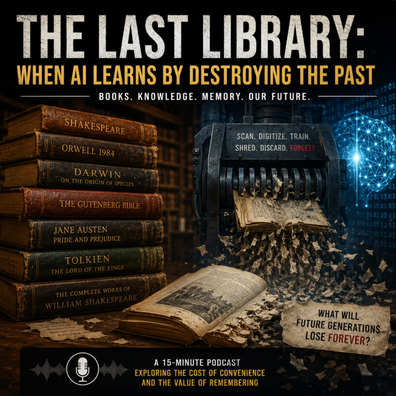
The Last Library - When AI Learns by Destroying the Past
Episode notes
Artificial intelligence companies are reportedly purchasing millions of physical books, scanning them at industrial scale and, in many cases, destroying the originals to create training data for frontier AI models. While much of the public discussion has focused on copyright, this episode explores a far deeper question: what happens when humanity destroys its physical knowledge to build digital intelligence?
From the Gutenberg Bible and Shakespeare to Darwin, Tolkien and Orwell, books have shaped civilisation for centuries. Yet books are more than collections of words—they are historical artefacts carrying the fingerprints, annotations and stories of generations. As AI models consume humanity's greatest works, are we preserving knowledge or losing something irreplaceable?
This episode presents both sides of the debate. We examine the remarkable benefits of digitisation, including global access to education, preservation of fragile texts, accessibility for people with disabilities and the acceleration of scientific discovery through searchable knowledge. At the same time, we confront the cultural, ethical and historical consequences of destructive scanning, the growing concentration of knowledge inside privately owned AI systems and the risk of reducing civilisation's memory to statistical patterns rather than physical heritage.
The discussion explores some of history's greatest books and asks whether AI should become humanity's greatest librarian or whether convenience is slowly replacing preservation. As authentic human-written books become increasingly valuable training data in an AI-driven world, an unexpected irony emerges: machines are reminding us just how important human creativity has always been.
Ultimately, this episode asks a timeless question. Civilisations are remembered not only for what they created, but for what they chose to preserve. As we build artificial intelligence capable of learning from every book ever written, will we ensure future generations inherit both the knowledge and the history that shaped it? Or will the last library become a memory itself?