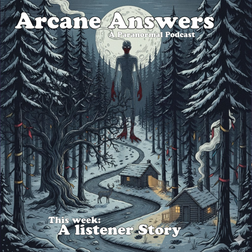
Arcane Answers
by Lare, Amanda, and SaraSeason 2

ESP experiments, and mysterious psychic claims.
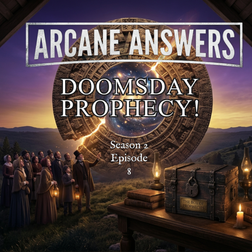
This episode of the Arcane Answers podcast features host Lare and co-hosts Amanda and Sara discussing famous end-of-the-world theories, doomsday predictions, and historical apocalyptic panics. Key Topics Discussed: The 2012 Mayan Calendar & Mandela Effect: Lare explores the 2012 Mayan calendar phenomenon, theories surrounding Nibiru (Planet X), and the idea that activating the Large Hadron Collider* split reality into parallel timelines, causing the Mandela Effect.*I now know it was turned on in 2008 William Miller and the Millerites: Amanda details 19th-century preacher William Miller's attempt to calculate the Second Coming using biblical timelines during the Second Great Awakening. His failed prediction in October 1844 became known as "The Great Disappointment" and led to the formation of the Adventist movement. Joanna Southcott: Sara shares the history of 18th-century English self-proclaimed prophetess Joanna Southcott, who sold "Seals of God" for protection, claimed to be pregnant with the Messiah late in life, and left behind a box of unread end-times prophecies for her followers. 
The Denver International Airport
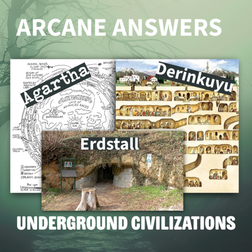
Underground Civilizations
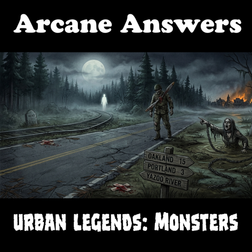
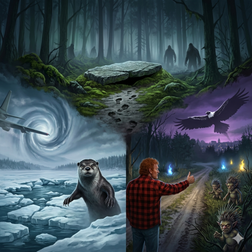
In this episode of Arcane Answers, Larry, Amanda, and Sara explore a variety of regional monsters and urban legends from across the United States. The discussion begins with the Black Eyed Kids, a 1990s phenomenon involving eerie, monotone-voiced children with solid black eyes who evoke a sense of overwhelming dread. The hosts then shift to Arkansas to discuss the Gurdon Light, a mysterious floating orb on railroad tracks attributed to either the ghost of a murdered worker or geological piezoelectricity. Amanda shares the local legend of the Prop Man from Washington, a ghostly B-24 crash victim said to wander Mission Ridge with a propeller blade embedded in his chest. Sara concludes with two chilling tales: the Bandaged Man of the Oregon coast, a foul-smelling, bloody figure who terrorizes parked vehicles , and the Witch of Yazoo from Mississippi, who allegedly fulfilled a deathbed curse to burn down the town twenty years after being left to die in quicksand Email Us at aarcanepodcast@gmail.com The mysterious triangles of the world
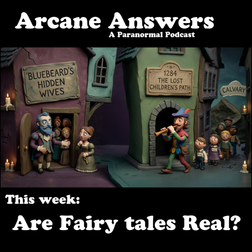
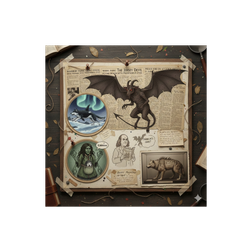
In this episode of the Arcane Answers podcast, We get into the grim historical realities that inspired famous folklore. They discuss how these stories often served as a way to process collective trauma or as dire warnings to keep children safe. Featured Fairy Tale Origins Bluebeard: Lare connects this tale to Gilles de Rais, a 15th-century French nobleman and companion to Joan of Arc. After turning to alchemy and allegedly seeking the Philosopher's Stone, he confessed to the ritualistic murder of 140 to 600 children. The Pied Piper of Hamelin: Amanda highlights historical evidence in Hamelin, Germany, including a plaque at the "Rattenfänger House" and town records from 1384 stating it had been 100 years since their children left. Theories include the failed Children's Crusade of 1212 or a mass migration led by a brightly dressed "recruiter". Beauty and the Beast: Sara discusses Petrus Gonsalvus, born in 1537 with hypertrichosis (werewolf syndrome). Though initially treated as a "wild man" in the French court, he was highly educated and eventually had a 40-year marriage with a woman named Catherine. Key Discussion Points German Werewolf Myths: The hosts touch upon the origin of werewolf legends in Germany, specifically mentioning a man who believed he could transform by rubbing fat on his body and wearing furs.For those interested in this specific historical case, you can read more about Peter Stumpp, often called the "Werewolf of Bedburg," here: https://en.wikipedia.org/wiki/Peter_Stumpp The "New Dark Ages": Sara and Amanda reflect on the modern era, suggesting that society has entered a "new middle" or "new dark ages" characterized by a lack of understanding and widespread fear. Museum Update: The episode wraps up with news that the International Cryptozoology Museum has relocated from Portland to Bangor, Maine. Lare, Amanda, and Sara discuss various legendary creatures, starting with the Jersey Devil. Larry explains the 1735 legend of "Mother Leeds," who allegedly gave birth to a child that transformed into a winged monster and flew into the New Jersey Pine Barrens. Amanda shares Inuit cryptids, including the Akhlut, a part-orca and part-wolf shapeshifter driven by vengeance, and the Qalupalik, a horrific creature used to scare children away from dangerous ice. Sara concludes with stories of the Flathead Lake Monster, described as a large creature with "undulating hips," and the Shunka Warakin (Rocky Mountain Hyena), a wolf-like beast shot by a Montana rancher in 1886, whose taxidermied remains are still on display today. a family gathering in the Haynesville Woods where members share local folklore, personal memories, and original poetry. The primary legend discussed is that of the Hoof Man, a "gangly" figure with a blood-stained face and hands who allegedly visited a hunting camp called The Raven during a snowstorm, leaving only cloven hoof prints in his wake. The speakers also recount other local myths like the hitchhiker and the "Neon Lady," alongside personal anecdotes of getting a flat tire near the bridge and the camaraderie of hunting camp life. The session concludes with a reading of an original poem titled "Rutting Season," which captures the rowdy yet sentimental atmosphere of northern Maine hunting camps and the deep bonds formed among the men who gather there. Bonus episode 1: Clowns, Dolls, and bears, oh my!