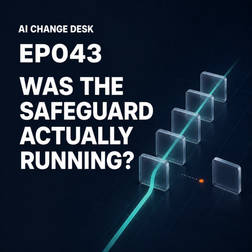
AI Change Desk | EP043: Was the Safeguard Actually Running?
Most organizations can name their safeguards. The harder question is whether those safeguards covered the run that mattered. In episode forty-three, Michael follows new official disclosures from OpenAI and Anthropic about separate high-risk cyber evaluation or training incidents. The mechanisms and organizations differ, and the episode does not generalize those accounts to ordinary customer deployments. The shared operating lesson is narrower and more useful: a documented control is not a runtime control until the organization can prove it covered the specific model, environment, configuration, partner handoff, and alert path in use. The episode introduces a six-part Runtime Safeguard Coverage Receipt and a focused 45-minute synthetic test for checking the difference between an intended control set and the controls that were actually active. Why control availability and runtime coverage are different facts. What new OpenAI and Anthropic disclosures signal for operators. Four common coverage gaps: policy to runtime, environment to assumption, event to incident, and provider to partner. Why functional success does not prove control success. The six receipts required before a high-risk AI workflow scales or resumes. A 45-minute exercise for testing a real workflow with a harmless synthetic event. The intended control set is what should protect the workflow. The effective control set is what actually protected one specific run. Run scope. Safeguard state. Environment state. Enforcement and alert. Partner handoff. Outcome and disposition. Anthropic: Improving our alignment and security efforts OpenAI: The Hugging Face incident and the road ahead METR and Redwood Research: Brief independent investigation Hugging Face: Anatomy of a Frontier Lab Agent Intrusion AI-assisted tools were used in parts of the research and production workflow. Final editorial judgment, risk posture, and release approval stayed human-led. This is operational guidance, not legal advice. These are Michael's personal views and do not represent the State of Oregon or any other organization. Michael's current role includes privacy work; no nonpublic work is discussed.