African Stream

African Stream

by African Stream
Season 1
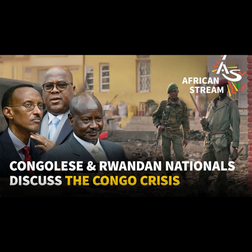
Pan African Attitude Ep 10 | Congolese & Rwandan Nationals Discuss the Congo Crisis
Conflict has been simmering in eastern Congo since the mid-1990s in the aftermath of the Rwandan genocide, exploding into two wars that left millions of people dead. The fighting, which intensified in late 2021 and involved dozens of armed groups, long-running ethnic tensions and at least five national armies, has now reached a peak not seen in at least a decade. African Stream is hosting two guests; Kambale Musavuli from the Center for Research on the Congo-Kinshasa and Claude Gatebuke, a Rwandan genocide survivor and human rights activist to discuss the long-standing crisis.

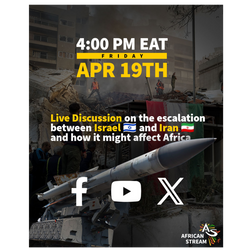
Iran/Israel Escalation Ladder. World War 3 Risk & What it means for Africa-Pan-African Attitude EP 9
The world is on the brink of war, following an uneasy, punctuated peace 79 years ago with the end of WW2. Decades of indirect confrontation between Middle Eastern bitter foes Israel and Iran culminated in a 14th April Iranian retaliation to Israel's bombing of its consulate in Syria on April 1st that killed 16 people. Israel is mulling over a response but had initially stated that Iran crossed a red line and must be responded to in kind. In a rejoinder Iran warned Israel of a harsher response. The West has rallied behind Israel, unwilling to criticize the countless international law violations it has committed not just against Iran, but against the ongoing bombardments in Gaza. However, Iran does not stand alone, it has powerful allies in Russia and China. Africa is caught in the middle once again. We are joined by an Iranian-American couple, Dr. Setareh Sadeqi and Christopher Weaver, to help make sense of just how dire the situation is and what it means for Africa. We hope you are as excited as we are and learn something by the end of our discussion. As always, let us know what you think.

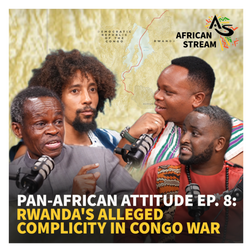
PLO Lumumba and Chakabars Debate Congo Crisis | Pan African Attitude - Ep.8
Brutal armed conflict has ravaged the eastern region of the Democratic of Congo since the late 1990s. Millions have been killed and displaced, with some blaming the West’s desire to get its hands on the country’s resources. It’s argued they work with neighbouring Rwanda and Uganda, to support rebels in DRC who extract minerals then sold on international markets. Despite mounting evidence, Rwanda denies involvement. It says it’s being scapegoated by Kinshasa for its own failure to secure the volatile region. The debate on Kigali's alleged complicity has also spilt to the public arena. In this episode of Pan-African Attitude, African Stream gets the views of Pan-African scholar PLO Lumumba, and activist and artist Chakabars.

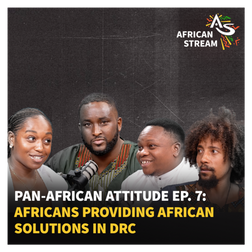
Pan-African Attitude Ep. 7: African Providing African Solutions to DRC 🇨🇩
It's been more than three decades of unrelenting violence in the Democratic Republic of the Congo's mineral-rich east. So much so that the UN recently raised the alarm about 'grave violations' against children in the conflict-ravaged country. Since January, paramilitary attacks have not only left many dozens dead and hundreds of thousands internally displaced. Reports are also mounting of armed groups maiming, recruiting or murdering children, suggesting that the youngest Congolese are paying the highest price of the long-running conflict. Since 1996, almost 7 million Congolese have been internally displaced—the second-highest figure in the world after Sudan—while 6 million people have been killed. About 1 million Congolese have fled the country. However, in the face of this, an African-run project, 'I Heart Africa,' provides a sanctuary for some of those children. The group, which puts African concerns first, has built a small community called Lumumba Village. African Stream recently hosted Pan-African activist and I Heart Africa Co-Founder Chakabars and I Heart Africa's General Manager and Congo Director Olivia Mundabi. The project's directors visited our Nairobi studio to discuss the Congo crisis and how Africans should provide African solutions to crises on the continent.

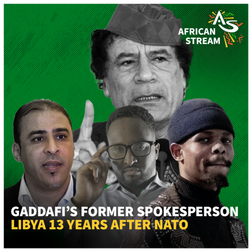
Pan-African Attitude Ep. 6: Interview with Gaddafi's 2011 Spokesperson
Muammar Gaddafi's spokesperson during NATO's bombardment of Libya, Moussa Ibrahim, joined us for a special podcast to discuss the 13th anniversary of the Western-backed Libya War. This is a story of how a former playground for imperial powers took back its sovereignty, the process of nation building, and betrayal of the revolution in an event that saw the West turn what was once Africa's highest ranking country in HDI terms into a country of open slave markets.

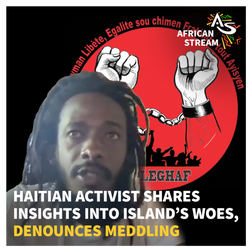
Interview | Ep. 1 | Haiti: History Of Sabotage, Actors Involved And The Island’s Enduring Spirit
African Stream sat down with Ezayi Jules, a Haitian from the organisation MOLEGHAF (National Movement for Liberty and Equality of Haitians for Fraternity) - to discuss the recent events surrounding the Caribbean island. In particular, we talked about the Kenyan government's push to deploy police officers on a US-funded (and US-proposed) security mission to Port-au-Prince. Analysing the geopolitical dynamics behind that push, Ezayi connected Haiti’s present woes to the aftermath of its liberation from slavery - arguing that the nation is still being punished for taking freedom into its own hands. He urges Africans interested in contributing towards Haiti's liberation to act today. We learned a lot. Let us know your reaction to what he has to say.

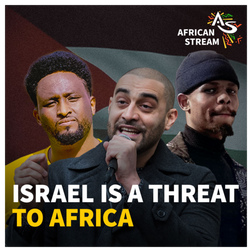
Pan-African Attitude with Lowkey | Ep.5 | Israel's Threat to Africa
British-Iraqi rapper, and journalist Lowkey joined us for a special episode of Pan African Attitude Ep. 5. We will be discussing the Israel lobby, South Africa's case at the ICJ, Israel's threat to Africa and of course Galloway's stunning victory in Rochdale and what lessons we can learn as Africans and anti-imperialists.

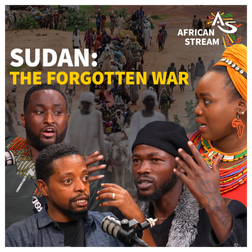
Pan African Attitude Ep. 3: Sudan, The Forogotten War
In 2018-2019, the people of Sudan took to the streets to fight for their democratic rights and demand that longtime Sudanese dictator Omar al-Bashir step down from power. He was then removed in a coup orchestrated by the joint efforts of the Sudanese Armed Forces (SAF) and the Rapid Support Forces (RSF) paramilitary. But what initially looked like a victory for the people soon spiralled into a power struggle between the SAF and RSF that turned into a devastating civil war and a proxy war between regional powers in the region. The Sudanese Army, led by Abdel Fattah al-Burhan, controls most of the industries in Sudan, while the Rapid Support Forces, led by Mohammed Hamdan Dagalo, aka Hemdeti, control the goldmines, but both sides want total supremacy over Sudan - and especially over the capital, Khartoum. The fighting has displaced more than 7.8 million people internally, while 2 million have fled the country. Some 20.3 million face acute food insecurity. Critical infrastructure has been destroyed, and on top of the humanitarian emergency, there are reports of mass rapes and genocidal violence. In the Darfur region, the RSF and allied Arab militia are accused of committing atrocities against the Masalit people. The war has also overshadowed a pre-existing conflict in the Nuba mountains. Despite the enormity of the tragedy unfolding in Sudan, the conflict and its consequences have largely been ignored by global news outlets. We invited two Sudanese guests to discuss the pressing emergencies in their country. Kamal Ramadan (aka ‘General KD’) is an artist from the Nuba mountains who highlights the challenges in this region and the role of art and music during this war, especially in reaching out to young people, who form the majority of the combatants. Mosaab Baba, meanwhile, is a researcher and consultant from Ayin Network. He has been working with Sudanese civil society since the 2000s, even during the conflict, to try and find an amicable solution and peaceful transition of power. They gave us their take on the war, its genesis and what steps need to be taken to put a permanent end to hostilities. They bring some great insights to the table.

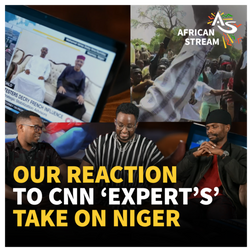
We React Ep 2. People In Niamey Are Elites, CNN 'Expert' Says
African Stream has reacted to videos of Donald Trump, King Charles, Elon Musk, among others, but the one that took the cake was our reaction to CNN's expert on the coup in Niger. Shortly after July 26 it was evident that the overthrow of Western-aligned president Mohamed Bazoum by the military had popular support. For Nigeriens, here at last was a chance to kick out the exploitative French - and their influence - from their motherland. CNN brought on Washington DC think-tanker and former State Department employee Aneliese Bernard to explain France's (and the West's) dwindling fortunes in Niger. Trying to make sense of it all, she said that the capital Niamey was populated by the elite, whose differences with the president may have contributed to his downfall. No mention of how France has greatly benefited at the expense of Niger, which is one of the poorest countries in the world with a per capita income of $ 628 (IMF). CNN's host Zain Asher then echoed the West's fear of an awakened continent when she wondered why Nigeriens were happy to be rid of a 'democratically elected' leader who is 'trusted by the West'. It's a dangerous time for humanity when mainstream media believes its own propaganda, especially about Africa. It's even more dangerous when people believe what these 'experts' say about the continent.

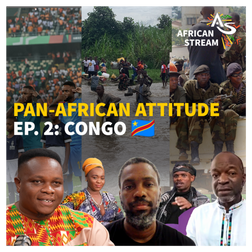
Pan-African Attitude Ep. 2: Congo 🇨🇩

Violence has escalated in the eastern part of the Democratic Republic of the Congo between M23 militants and the DRC army. Unfortunately, rockets and bombs have landed on universities, markets and villages, killing some civilians while others run for their lives. Many fear the conflict and the humanitarian crisis will cycle out of control as Goma, North Kivu province's largest city—home to 2 million people—might fall to the so-called rebels. African Stream hosted two guests from Friends of the Congo and the Center for Research on the Congo-Kinshasa to unpack the situation.
2 of 3