Activists Of Tech — The responsible tech podcast

Activists Of Tech — The responsible tech podcast

by Activists of Tech
Season 3

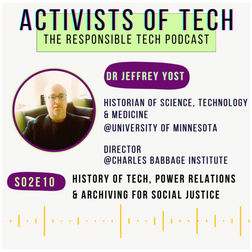
History of tech, power relations, & archiving for social justice with Dr Jeffrey Yost from the Charles Babbage Institute

Technology narratives are set in the present, and all of their promises set in the near future. We’ve heard about flying cars, automated jobs, robots able to annihilate Humanity, robots able to save Humanity, and went through many hype cycles, like crypto – a time that I personally tend to block from my memory. But looking at the past, at the evolution of technology, is actually critical for its impacts to be relevant and beneficial for everyone. We often say that History keeps repeating itself, so if we want to predict the future of technology, why not look at its past? Beyond that, I wondered how the History of Technology related to social justice and how interdisciplinary studies could advance social justice, as well as how to choose who and what to archive when it comes to Tech History, and how much AI could be useful or harmful in this endeavour. To answer these questions and more, I had the pleasure to welcome Dr Jeffrey Yost who studies power imbalances & societal inequality in our digital world. Dr Yost is a historian of science, technology, and medicine focused on the social, political, and cultural and intellectual history of the digital world. He is the Director of the Charles Babbage Institute (CBI) for Computing, Information & Culture, a computing and software studies research institute and the leading and most diverse historical archives center for students and scholars to study digital tech & its contexts. Created, hosted and produced by Mélissa M'Raidi-Kechichian.
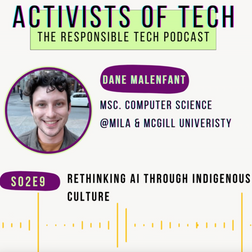
Rethinking AI through Indigenous culture with Dane Malenfant from McGill University & MILA

An interesting thing about AI systems is that without a deliberately designed structure to promote the concept of sharing, AI systems will focus solely on maximizing their individual rewards, even if this prevents them from successfully completing a task. This is fascinating, and Dane Malenfant is working on the long term credit assignment problem at MILA and McGill University, and researching solutions through an indigenous lens. Dane is a citizen of Métis Nation- Saskatchewan and originally from the traditional Métis Homeland of North Battleford (Treaty 6) and of Regina (Treaty 4). He advocates for Indigenous representation in STEM and offers a unique perspective in doing so. In this episode, we explored the role of Indigenous cultural values, like reciprocity, in reshaping AI development – and how diverse perspectives can address both technical and societal challenges. Dane also talked about the importance of having diverse voices in AI and about the systemic barriers that indigenous people face that prevent them from being part of the field of AI, and how we can change it. Created, hosted and produced by Mélissa M'Raidi-Kechichian.
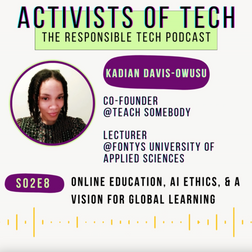
Online education, AI Ethics, & a vision for global learning with Kadian Davis-Owusu from TeachSomebody

More often than not, on Activists of Tech, we talk about the problems caused by technology and the solutions or alternatives to these issues. And I kind of feel guilty because I don’t want to convey the idea that AI is inherently bad. Though the mainstream culture surrounding AI certainly is, we have agency over what we create, over the AI systems we design and on how they impact others. Today’s guest is a great example and she is nothing short of inspiring: Dr Kadian Davis-Owusu has turned her passion for technology and learning into purpose, advocating for the power of online education and the ethical use of AI in learning. Kadian is the co-founder of TeachSomebody and a university lecturer at the Fontys University of Applied Sciences in the Netherlands. This episode is about tackling educational inequalities with technology, and we dived into Kadian’s work as an educator and technologist at TeachSomebody, a platform on a mission to bridge educational divides by making education accessible and providing equal opportunities to underserved communities. We talked about how online courses can address global inequalities, the potential of AI to revolutionize learning access, and what it takes to tackle concerns about privacy and AI ethics, and much more. Created, hosted and produced by Mélissa M'Raidi-Kechichian.
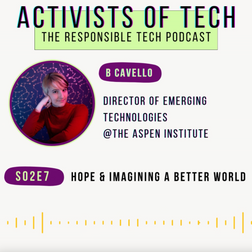
Hope & imagining a better world with B Cavello from the Aspen Institute

This episode was initially scheduled to be released in mid-December, but it was actually recorded last week, specifically one day after the American elections took place and after Trump was re-elected. B and I briefly talked about the elections in this episode, but I decided to edit and release earlier because B radically tries to move us forward and their dedication and energy made me feel so much better and hopefully this episode will make you feel better as well. In this episode, B Cavello, Director of emerging technologies at the @ Aspen Institute and I talked about responsible tech, what it looks like, what limits the design and development of ethical artificial intelligence, but also about the importance of media and tech literacy, and bringing diverse voices to the tech conversation. Created, hosted and produced by Mélissa M'Raidi-Kechichian.
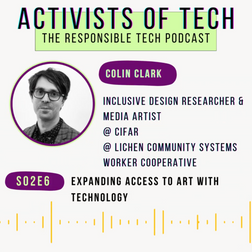
Expanding access to art using technology with Colin Clark

Culture, the arts, or what makes humans.. Humans. Yet it is not accessible to just everyone. When you think about it, how do you make a play accessible to visually or hearing impaired people? How can we use technology to translate art into senses they were not designed for in the first place? How does tech and art relate to disability justice? More often than not, people with disabilities are not included in the design process of artistic spaces that are not accessible and don’t accommodate bodies differing from the norm. In this episode, Colin Clark, inclusive designer and creative technologist and co-Founder of Lichen Community Systems Worker Cooperative Canada and Data Communities for Inclusion Solution Network at CIFAR joined me to talk about making the art world accessible with technology, the power of community led design, and move toward another yet related topic: the use of chat gpt by artists and the labor exploitation of the creative sector, and more! Created, hosted and produced by Mélissa M'Raidi-Kechichian.
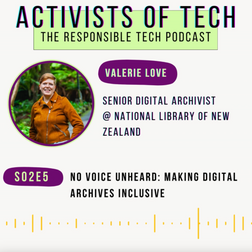
No voice unheard: Making digital archives inclusive with Valerie Love from the National Library of New Zealand

We produce a LOT of data, tweet for any reason, post a gazillion pictures online, and that somehow will give an idea to future generations about who we are and where we are at culturally speaking. Of course, and thankfully, not every digital content is archived, it has to have cultural or historical significance. But how do you determine that? Who should decide which stories get to be archived or unarchived? Are colonial dynamics taken into consideration when archiving contemporary records and what measures are being taken for archives to be inclusive? To answer these questions and more, I had the pleasure to welcome Valerie Love, Senior Digital Archivist at the Alexander Turnbull Library, which holds the archives and special collections for the National Library of New Zealand. Created, hosted and produced by Mélissa M'Raidi-Kechichian.
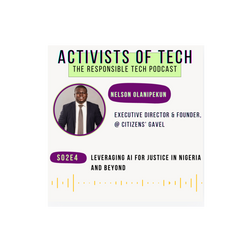
Leveraging AI for Justice in Nigeria and beyond with Nelson Olanipekun from Citizens' Gavel

Facing an injustice and requiring legal representation is a tedious, complex, and time-consuming process, on top of being expensive and not affordable by everyone who needs help. This hurdle greatly contributes to the prevalence of injustices, and today we are focusing on the case of a Nigerian non -profit, Citizens’ Gavel that is addressing this hurdle and leveraging AI to promote access to justice. Created, hosted and produced by Mélissa M'Raidi-Kechichian.
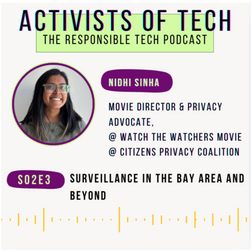
Surveillance in the Bay Area and beyond with Nidhi Sinha

Growing up in the Bay area with a future drawn for her, Nidhi Sinha did everything she was supposed to do: go to a private high school, pursue a degree in Computer Science and Mathematics, and work at a Big Tech company in the Bay. Until she got into AI ethics and burst the bubble she had grown in. What happens when surveillance happens in your own backyard, and the Big Tech companies you were told to reach for growing up are responsible for the harm of communities locally and beyond borders? Nidhi decided to get involved at CAIDP, at the Citizens Privacy Coalition, and recently to direct her first documentary on surveillance and privacy rights in the Bay area. In this episode, she talks about how Big Tech has impacted local Bay Area life, the growing wealth gap in the region, the extent of surveillance and most importantly what we can do to resist and fight back. Support the crowdfunding campaign: https://seedandspark.com/fund/watch-the-watchers?token=9a83801e4562a6e1e848ee4517b978856dfb832076e4e508745120edc4701853 Created, hosted and produced by Mélissa M'Raidi-Kechichian.
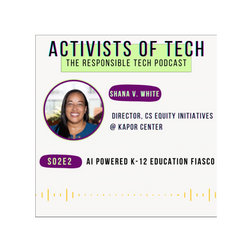
AI powered K-12 education fiasco with Shana V. White from the Kapor Center

AI products and features are becoming ubiquitous. When the targets of AI systems are children in school, it should be common sense that the impacts of these technologies should be assessed before reaching the “market” and the privacy of kids subjected to them should be the number one priority of school boards. Of course, it’s not, and serious questions arise. How does the AI hype and the mass deployment of AI “solutions” impact education in the United States? What are the risks and benefits for the educational system? Who is in charge and who does it impact? To answer these questions and more, I am thrilled to have welcomed the most ✨outspoken✨ person I know (and I know quite a few), Shana V White, who works at the intersection of racial justice and tech as the Director of CS equity initiatives at the Kapor Center. Created, hosted and produced by Mélissa M'Raidi-Kechichian.
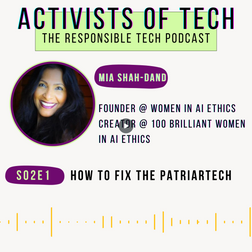
How to fix the patriartech with Mia Shah-Dand, founder of Women in AI ethics

Sexism and oppression are tied to culture, which in turn impacts the tech industry, tech design and deployment. To talk about the relationship between the patriarchy, women in tech, and how to fight back, I talked with Mia Shah-Dand, founder of Women in AI ethics and creator of the 100 Brilliant Women in AI Ethics. In this episode, Mia talks about her personal story and upbringing, what women have to put up with when they work in tech, gender based violence enabled by technologies, diversity in tech, and how to fight back to reclaim space. Created, hosted and produced by Mélissa M'Raidi-Kechichian.
2 of 4