The Canadian Podcast

The Canadian Podcast

di The Canadian
Stagione 1

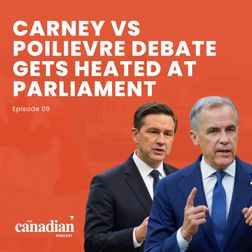
Carney’s Sleeping Lines about Poilievre Stuns Question Period

The House of Commons returned to a sharp clash between Mark Carney and Pierre Poilievre over Buy Canadian, federal procurement, LNG steel, and jobs in Hamilton. Poilievre accused the government of breaking its promise to buy and build Canadian. He cited reporting that the share of federal contract money going to American companies has risen sharply, and he attacked the use of Chinese steel on LNG Canada Phase 2 while Stelco moves ahead with layoffs in Hamilton. Carney answered with a project record. He pointed to major defence-related investment in Canada, cross-country builds with shovels already in the ground, LNG Phase 2 as one of the largest private-sector investments in Canadian history, and Pacific Link as a clear outlet for Canadian steel. He said Stelco workers deserve better from their American-owned parent and that the government will pursue those employment commitments to the full extent of the law. He also challenged the opposition to support legislation aimed at getting Canada building faster. Five exchanges. One fight over whether the government is delivering construction and Canadian content — or only promising it. Subscribe to The Canadian Podcast for Question Period, the build file, and the decisions shaping the country.

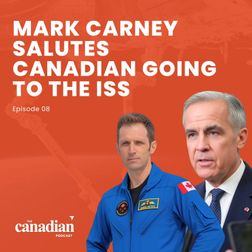
Mark Carney Calls Canadian Astronaut Bound for ISS

Mark Carney spoke by phone with a Canadian astronaut preparing to board the International Space Station. The crew member is inside the NASA quarantine facility, waiting for final clearance before launch. Once on orbit he will help manage the station, carry out repairs, and support the science program. In the conversation Carney held up the Canadian five-dollar bill issued while he was Governor of the Bank of Canada. The note is linked to Chris Hadfield’s time on the ISS. Carney used it to highlight Canadarm2 and the Canadian robotic systems that remain essential to daily station operations. Every spacefaring partner still relies on that technology. He described the image of Canadian hardware against the Earth as the real meaning of Canadian leadership — something the country does not merely claim but feels. The astronaut carries the maple leaf on his shoulder as he prepares for the mission. The call connects past national achievement with Canada’s continuing presence in space. Subscribe to The Canadian Podcast for clear coverage of Canadians on the global stage, major decisions at home, and the moments that show what the country contributes.

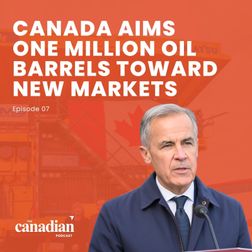
Is Canada Becoming The Next BIG Energy SUPERPOWER?

Mark Carney has listed a new West Coast bitumen pipeline — Pacific Link — as a project of national interest under the Building Canada Act. In this episode of The Canadian Podcast, we break down what the designation means and why it matters. Over the next year the Major Projects Office will set conditions on ownership, environmental protections, benefits, and local hiring, with a target of September 1 next year before the path to construction is cleared. Canada and Alberta are to share equal ownership. Indigenous communities are to be offered a minimum 10% stake, financed through loan-guarantee programs. Pembina is the private partner. Trans Mountain will lead development. The strategic case is direct. About 90% of Alberta’s oil still goes to the United States. Pacific Link is designed to add roughly one million barrels a day of export capacity toward Asia. Government estimates include about 140,000 jobs, more than $20 billion a year in GDP, and over $100 billion in public revenue by 2060. The package is tied to the Pathways carbon-capture project, a southern route that protects the northern B.C. coast, and port expansion at Roberts Bank. Carney’s governing line is unchanged: Canada keeps high standards, but high standards do not require slow decisions. In a more dangerous and divided world, speed and certainty are treated as competitive advantages. The wider map includes LNG on the Pacific, clean power in the east, and the long-promised claim that Canada can still build at the scale of an energy superpower. Subscribe to The Canadian Podcast for major project decisions, the energy file, and the politics that shape them.

Carney’s Approval Rating in Canada is Hitting an all Time High - But Why?

Mark Carney’s personal approval has reached the highest level of his time as prime minister. Abacus Data finds 56 percent of Canadians hold a positive impression of him. Overall government approval sits at 60 percent. In the same snapshot, the Liberals lead the Conservatives 46 to 34. The rise is not random. Pollsters say it is driven almost entirely by how Canadians rate Carney’s handling of the Canada–United States relationship. Despite anxiety over the trade conflict, the public still sees Carney and the Liberals as best able to deal with President Trump and the border fight. That judgment is lifting his personal numbers and opening a wide gap over Pierre Poilievre. The advantage shows up everywhere. Carney posts positive ratings in every region, including about plus 20 in Alberta and Saskatchewan. The net favourability gap with Poilievre is around 40 points. Some projections based on current numbers point to a large Liberal seat total and a sharply reduced Conservative caucus. A halo effect is also visible: on cost of living, housing, and crime, more people still approve than disapprove of the government. This is The Canadian. Subscribe for polling, the border file, and the political numbers that shape Ottawa.

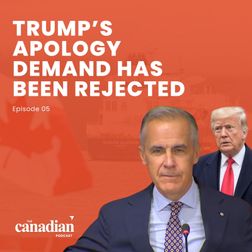
Carney Launches Major LNG Project while LAUGHING OFF Trump's Apology Demand

Mark Carney spent the day in British Columbia confirming major energy capital and refusing to let U.S. pressure set the agenda. After President Trump suggested Canada would apologize and drop tariffs within weeks, and after Peter Navarro told Canadian advocates to leave Washington, Carney put a different record on the table. LNG Canada Phase 2 locked in more than $30 billion. The expansion is set to become the second-largest facility of its kind in the world, create thousands of jobs, and supply partners in Asia and Europe. Coastal GasLink Phase 2 is moving with it. The federal Major Projects Office took the file from referral to final investment decision in twelve months. Carney’s line was clear: Canada is a country of high standards, but high standards do not require slow decisions. He placed the decision in a more dangerous and divided world, where export diversification strengthens sovereignty and where speed and reliability are competitive advantages. A proposed West Coast bitumen pipeline remains under national-interest review under a protect-while-we-build approach, with the North Coast tanker ban staying in place. On the U.S. import ban and the question of escalation, he said Canada is ready for a mutually advantageous deal that respects sovereignty, and that Ottawa’s timing is not dictated by the American political calendar. The same day also tied major building to ocean protection: prosperity and sovereignty on one side, a duty to pass Canada’s first waters on in better condition on the other. Subscribe to The Canadian Podcast for analysis of major projects, the border file, and the decisions shaping Canada at home and abroad.

U.S. Import Ban Hits Canadian Beer at Midnight - What are Carney's Options?

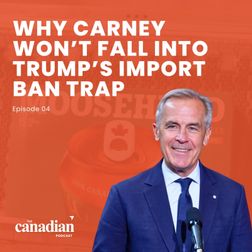
A United States import ban on a list of Canadian products is now in force. Alcohol — especially beer — is the hardest hit. Certain dairy products, motorcycles and mopeds are also on the list. This is a pressure tactic. Washington is punishing Canada for pushing back on earlier tariffs while choosing goods American consumers can replace more easily. The overall hit to Canadian exports is limited — under half a percent in some estimates. For companies on the list, the hit is immediate and severe. Moosehead, which sends about 15% of its business to the United States, had already been shipping under a 50% tariff since August just to hold shelf space. As of midnight it cannot ship at all. Stock in the U.S. may last into early November. After that, retailers will fill the slots. A temporary ban can still erase years of market access. Mark Carney has said he will not escalate the tariff war for show and is open to talks when Canadian sovereignty is respected. The U.S. trade representative says Washington is comfortable and in no rush. The phone line remains open. The bait — rush back and settle weak — is still there. So far Carney is not taking it. This is The Canadian. Subscribe for the border file as it develops.

Why Mark Carney is NOT Rushing a BAD DEAL with United States

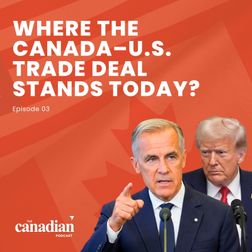
Where does the Canada–United States trade deal actually stand, and is Mark Carney walking into Donald Trump’s pressure play? In this episode of The Canadian Podcast, we break down the current state of the border file in plain language. There is still no comprehensive new agreement. Washington has signalled it feels no urgency to restart formal talks. Canada has not publicly forced a new round. At the same time, Carney has said he continues to speak with Trump regularly. The public file looks frozen. The private channel is not closed. The latest U.S. import measures are targeted. They hurt real Canadian businesses — including a serious hit to Ontario’s spirits trade — without defining the entire economy. That pattern looks like leverage designed to extract concessions, not an attempt to collapse the whole relationship in one move. Ottawa’s wider answer is diversification. After years of deep integration with the United States, dependence on one customer is now treated as a strategic weakness. New partnerships, investment commitments, European ties, and higher defence spending are being used as an insurance policy while the bilateral talks drag. Supply management remains a Canadian red line. Falling for Trump’s tactic would mean rushing a weak deal just to stop the pain and the headlines. The position we examine here is different: keep the phone line open, absorb selective hits, refuse to be panicked, and use the limbo to build other options. Subscribe to The Canadian Podcast for clear analysis of Canada–U.S. relations, trade, and the decisions shaping the country at home and abroad.

Anita Anand Delivers GREAT Speech at the UN for Canada

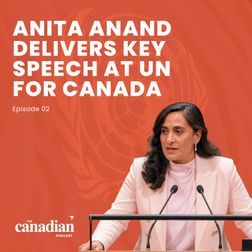
Canadian Foreign Affairs Minister Anita Anand addressed the United Nations General Assembly and described a rupture in the global order. In this episode of The Canadian Podcast, we go through the core of her speech. Anand said the tide has turned. Great powers are walking away from economic cooperation and too often treating the sovereignty of other states with disdain. Canada’s answer is greater strategic autonomy: the ability to make its own choices, reduce over-reliance on any one partner, and build stronger relationships with both new and old partners. She outlined issue-based coalitions, including more than thirty partners on Ukraine, the Arctic Seven, and the Nordic-Baltic Eight, and announced the Partners for Multilateralism initiative to reform the UN and other institutions. On the economy she pointed to a goal of $1 trillion in investment over five years, more than twenty new economic and defence partnerships, and nearly $500 billion committed at the first Canada Investment Summit. She said Canada is deepening ties with Europe through an Alliance for the Future and expanding work beyond North America. On security she said Canada is making the largest defence investments in generations, with spending already above 2% of GDP and a path toward NATO’s 5% pledge by 2035. The Arctic, she argued, is central to Canadian identity and security, with new steps including a consulate in Nuuk, Greenland. She closed by rejecting nostalgia and despair. Canada will move with confidence, keep long-term partnerships, and deal with the world as it is. Subscribe to The Canadian Podcast for analysis of Canadian foreign policy, the United Nations, Canada–U.S. relations, Europe, and the decisions shaping the country at home and abroad.

Carney’s HISTORIC New York Times Interview Explained

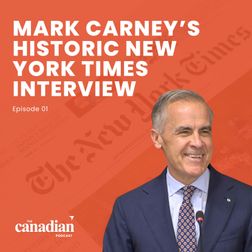
Mark Carney sat down with the New York Times in New York and set out how Canada plans to reduce its reliance on the United States. In this episode of The Canadian Podcast, we break down the full interview in plain language. Carney said his government examined the extreme tail risk of U.S. military action after President Trump’s talk of a fifty-first state. He said that is not his expected outcome, and that refusing to study it would have been irresponsible. He also confirmed that he still speaks to Donald Trump frequently, including after trade talks collapsed, and that a mutually beneficial Canada–U.S. trade deal remains possible. He discussed potash and North American fertilizer independence, the integrated auto sector, and why Ottawa is reluctant to cut oil or electricity exports to the United States. On technology and defence, Carney said Canada will diversify away from Starlink, is reviewing the planned F-35 order against Sweden’s Gripen, wants more economic contact with China without a defence relationship, and argued that a financial system built only on the U.S. dollar is not stable over the long run. His core line: once you have seen dependence used as leverage, you cannot unsee it. This episode covers the interview section by section — risk, the Trump phone line, energy, cars and fertilizer, satellites and jets, China, and the U.S. dollar — so you hear the position as Carney stated it. Subscribe to The Canadian Podcast for analysis of Canadian politics, Canada–U.S. relations, Europe, and the decisions shaping the country at home and abroad.