Quantum Curiosities & Tech Revelations

Quantum Curiosities & Tech Revelations

di Anna Dean and Professor Clarke Halloway
Stagione 1
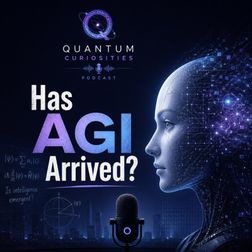
Has AGI Arrived?
IA
The chatter around OpenAI's GPT-6 Astra has reached fever pitch. In this episode of Quantum Curiosities, hosts Anna and Professor Halloway cut through the hype to ask the question everyone's whispering: is this actually it — the moment artificial general intelligence stops being a phrase and becomes a thing? From Astra's real-time reasoning and multimodal fluency to the quiet benchmark numbers the press release glossed over, the pair dissect what a "general" intelligence would really need — and whether we're looking at a breakthrough, a very clever autocomplete, or something in between.
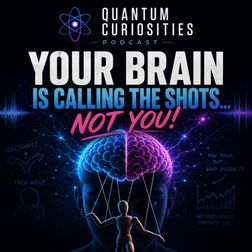
Your Brain Is Calling The Shots...Not You!
IA
This episode likely explores is the Libet effect: in the 1980s, neuroscientist Benjamin Libet had subjects flex their wrist whenever they felt the urge, while EEG tracked their brain activity. He found that a "readiness potential"; a buildup of neural activity in the motor cortex — fired roughly half a second before people consciously felt they'd decided to move. In other words, the brain appears to begin preparing a choice before we're aware of making it, which seems to demote conscious will from the cause of our actions to a kind of after-the-fact witness. This kicked off a decades-long free-will debate: some argue it proves free will is an illusion (we're just narrating what the brain already chose), while others counter that we may still have a "veto power" — the ability to consciously cancel a prepared action before it happens (Libet himself proposed this). More recent experiments have refined the picture, showing decision-related activity in the brain up to several seconds before choice in some cases, though critics point out the effect is strongest for trivial, spontaneous actions, not deliberate deliberation. Where the "quantum curiosities" angle comes in is the temptation to see quantum indeterminacy — true randomness at the subatomic level — as the loophole that rescues free will: if the brain amplifies quantum fluctuations, maybe our choices aren't fully determined by prior physical states. But physicists and philosophers usually respond with a dilemma: if a choice rides on quantum randomness, it's not free choice, just dice rolls — and either way, the conscious self still seems to arrive on the scene after the action has begun, not before. So the episode's takeaway is probably that the brain's "decision" unfolds earlier and more automatically than our inner sense of choosing suggests — a humbling mix of neuroscience, philosophy, and poorly little quantum sparkle.
Quantum Weirdness: The Delayed-Choice Experiment
IA
In this episode Anna and Professor Halloway examine the delayed-choice experiment. The delayed choice experiment demonstrates that a "wave or particle" is not a property of the photon alone, it's a property of the entire experiment, including choices made later. Nothing travels backward; the universe simply doesn't assign a definite wave/particle history to the photon until the full measurement context is fixed. It remains one of the most vivid (and misinterpreted) demonstrations of quantum weirdness — and a core reason quantum mechanics rejects naive realism about what's "really happening" between measurements.
The Keepers Of A Noble Breed
IA
Anna and Professor Halloway discuss Halloway's new science fiction book, The Keepers Of A Noble Breed. The discussion gets lively as Anna takes the opposing view that Professor Halloway intended as the writer of the book.
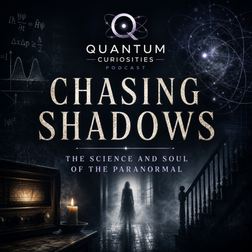
Chasing Shadows: The Science and Soul of the Paranormal
IA
In this episode of Quantum Curiosities, we explore the fascinating intersection of acoustic physics, architecture, and human biology to investigate the real physical mechanics behind paranormal encounters. Centered around the paper "The 19Hz Frequency: The Physics of Perceived Apparitions," Anna and Professor Halloway break down how invisible environmental triggers, from insidious carbon monoxide leaks to inaudible, low-frequency sound waves known as infrasound, can hijack the human body. By examining landmark discoveries like Vic Tandy’s vibrating 19Hz laboratory fan and real-world experiments in subterranean spaces like Edinburgh's Mary King’s Close, this episode reveals how standing waves can literally vibrate our eyeballs to project shadowy optical illusions, spike our cortisol levels, and transform everyday rooms into accidental "ghost-making machines."
Many World's, Many You's
IA
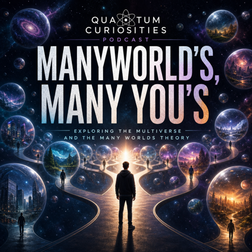
Welcome to this episode of Quantum Curiosities, where Anna and Professor Halloway examine the Many Worlds Interpretation of quantum mechanics. They explain how every atomic variation splits the universe into countless parallel physical states where all possible outcomes actually occur. You will hear how physicist Hugh Everett the Third originated this concept in the nineteen fifties, turning it into a major mathematical position in modern physics. The hosts break down the underlying mechanics using the wave function and the Schrödinger's cat thought experiment to show how reality separates without a mathematical collapse. The discussion then explores how quantum decoherence seals off these alternate realities permanently by reviewing a specific case study of Saturn's moon, Hyperion. You will learn how constant environmental interaction forces physical objects into definite paths in our specific version of reality. The episode also examines the direct impact this theory has on your personal identity, morality, and free will. Finally, Anna and the Professor cover David Deutsch's quantum computer thought experiment to demonstrate the physical reality of these multiple states and explain why human beings remain trapped in a single timeline.
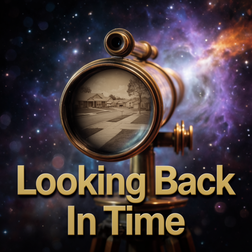
Looking Back In Time
IA
Quantum Curiosities with Anna Dean and Professor Clarke Halloway invites you on a mind-bending journey into the nature of time itself. In this episode, they explore what it really means to look back in time—from the cosmic echoes of the early universe to the strange ways memory, observation, and quantum theory intertwine. Pull up a chair at the edge of spacetime as they blend storytelling, science, and speculation to ask whether the past is truly gone…or still quietly shaping our present.
Forever Young-The Quest To Cure Aging
IA
Episode Intro Blurb In this episode of Quantum Curiosities, hosts Anna and Professor Halloway dive into the front lines of longevity science to explore whether we can actively roll back the biological clock. Unpacking Harvard geneticist David Sinclair’s Information Theory of Aging, the episode breaks down the radical idea that getting older isn't permanent physical wear-and-tear, but rather corrupted cellular software—scratches on our epigenetic instructions that can be buffed out using modified Yamanaka factors (OSK gene therapy). Balancing high-stakes science with essential skepticism, the hosts trace longevity research from the overhyped failures of resveratrol and NMN supplements to groundbreaking 2026 FDA-approved human clinical trials. From eye-stroke treatments governed by antibiotic safety switches to supercomputers screening billions of molecules for age-reversing pills, this episode examines what happens when geroscience shifts from science fiction to human reality—and weighs the massive economic, moral, and psychological implications of doubling the human healthspan.
GLP-1 Gila Monster Venom and the Science Of Appetite
IA
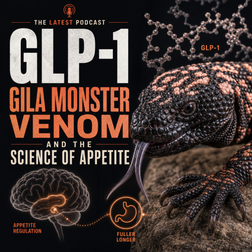
In the latest episode of Quantum Curiosities and Tech Revelations, hosts Anna Dean and Professor Clarke Halloway delve into "The GLP-1 Gila Monster Venom and the Science Of Appetite." This episode explores the fascinating origins of transformative weight loss drugs, drawing connections to the Gila monster's venom, and critically examines their associated pros, cons, and the currently unknown long-term effects, offering listeners a comprehensive scientific overview of this rapidly evolving field.
Jevon's Paradox - Efficiency and Consumption
IA
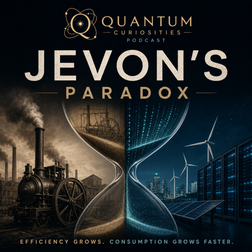
What happens when making something more efficient actually makes us use more of it, not less? In this episode of Quantum Curiosities and Tech Revelations, we dive into Jevons' Paradox—the counterintuitive 19th-century economic principle originally observed with coal consumption—and explore its startling relevance to our AI-saturated present. As artificial intelligence makes computation, energy, and even human attention dramatically cheaper and more accessible, are we witnessing history repeat itself on a technological scale nobody quite anticipated? Join us as we unpack how efficiency gains in AI might be fueling unprecedented consumption rather than conservation, with consequences rippling across energy grids, data centers, and the very fabric of how we work and think. To help navigate this paradox, we're joined by Anna, whose sharp curiosity and knack for asking the questions everyone's thinking but nobody voices, and Professor Halloway, whose academic rigor and historical perspective ground our speculative leaps in solid reasoning. Together, they'll trace Jevons' Paradox from Victorian coal mines to modern GPU clusters, debating whether AI's relentless efficiency gains are steering us toward abundance or toward an entirely new category of resource anxiety. Expect sparks of disagreement, unexpected historical parallels, and a few uncomfortable questions about what "progress" really means when the tools themselves start consuming more than they save.
1 di 2