Dangelo68⚔️🔥

Dangelo68⚔️🔥

di JDangelo
Stagione 253

Love Will Cost You Something

Love Will Cost You Something Christian love is beautiful, but it is not always convenient. Jesus did not demonstrate love by protecting His comfort. He laid down His life. That is the standard we have been given. Loving the church will sometimes require inconvenience. It may require you to forgive when you would rather hold on to the offence. It may require you to stay patient with someone who is difficult. It may require you to serve when you are tired, listen when you would rather leave, or put another person's needs ahead of your own. This is why selfishness is such a serious enemy of love. When everything revolves around what makes us comfortable, we will naturally resist anything that costs us. But love is willing to surrender something for the good of another person. Paul described his own ministry in remarkably sacrificial terms. His life was not centred on himself. He was willing to spend himself for the sake of the people God had entrusted to him. This does not mean that healthy boundaries are wrong. It does not mean allowing people to abuse you or refusing to exercise wisdom. It means that inconvenience alone cannot become our excuse for withholding love. Sometimes we need to ask ourselves an uncomfortable question: Am I refusing to love because this person is genuinely impossible to love, or because loving them will cost me something? Christ loved us when loving us cost Him everything. We learn to love the church by allowing that same self-giving spirit to shape our lives. Love is not lazy. Love moves towards people. Love makes room. Love sacrifices. And every time we choose love over selfishness, we become a little more like Jesus. Prayer Jesus, teach me to love beyond convenience. Help me to lay down selfishness and become willing to sacrifice for the good of others. Give me wisdom to love well, courage to forgive, and grace to serve even when it costs me something. Amen.
Stagione 251

Rebuilding Your Defenses

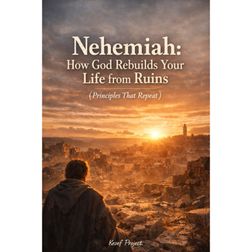
Rebuilding Your Defenses When Nehemiah heard about Jerusalem, the city walls were in ruins, and the gates were burned with fire. This book shifts our focus entirely to the internal government of your soul—your mind, will, and emotions. In the ancient world, a city without walls had no identity or defense. Walls kept out invading armies and wild animals. Without them, the people were completely vulnerable. The enemy could walk in at any hour to steal their harvest, terrorize families, and dictate their narrative. This reveals that you can be fully born again, legally delivered from Babylon, and yet still find your soul living in ruins. This is why many genuine believers still struggle deeply with intense bitterness, explosive anger, and deep-seated unforgiveness. Your spirit belongs to God, but if your emotional and mental walls are broken down, you live without gates. Any toxic comment, old offense, or dark thought can walk straight into your mind, leaving you defenseless against spiritual ambush. Living with broken walls directly degrades your mental health. This vulnerability is where clinical depression often takes root—a state of persistent sadness and loss of interest that deeply impairs daily functioning, Leaving a person trapped under an oppressive blanket of hopelessness (the feeling that things will never improve) and helplessness (the belief that you lack the power to change circumstances). Like ancient Jerusalem, a soul with burned gates feels entirely exposed to the dark. But Nehemiah didn't just weep over ruins; he organized a rebuild. Scripture records that it took fifty-two days of intense, focused labor to rebuild the walls of Jerusalem. This timeline serves as a poignant reminder that internal restoration is a gradual process that takes time. Healing from trauma, evicting bitterness, and re-training your mind to forgive do not happen overnight. It is a daily, stone-by-stone process. God does not want you living as a defenseless casualty. It is time to set up guardrails, filter opinions through Scripture, and actively eliminate the thoughts that rob you of your peace. Reflection Identify one broken gate today—like a lingering offense fueling bitterness or an insecurity that triggers anger. The moment a bitter or helpless thought hits your mind, consciously arrest it and replace it with Scripture. Give yourself grace for the timeline; clearing emotional debris is a daily, stone-by-stone process. Prayer Father, forgive me for leaving my mind wide open to anger, bitterness, and hopelessness. Holy Spirit, give me the patience to rebuild my emotional walls. Amen. Declaration I am no longer a city without walls. Though restoration takes time, I am actively guarding my gates, evicting bitterness, and rebuilding the government of my soul.
Stagione 249

Love Gives💕

Love Gives Love eventually becomes visible. We can speak beautifully about loving the church, but genuine love eventually finds an expression. It gives. It listens. It notices. It visits. It serves. It makes itself available. The early church understood this. When believers saw someone among them in need, they did not treat that person's need as somebody else's problem. They had begun to see one another as family, and family changes the way we respond to need. When someone in your family is struggling, you do not always wait for them to announce their need publicly before you care. You notice. You ask questions. You make yourself available. That is the kind of consciousness Scripture calls us towards. Generosity is therefore much bigger than money. Of course, our resources matter, and Scripture repeatedly teaches us to give. But sometimes the most valuable thing you can give someone is your attention. You can give someone your time. You can listen to their tears. You can visit someone who has become isolated. You can encourage someone who is discouraged. You can notice the person who seems to have disappeared from church and reach out. You can quietly meet a need without waiting to be praised for it. This is the practical nature of Christian love. The world often teaches us to protect what belongs to us. Christ teaches us to hold our possessions, time and abilities with open hands. Look around your church family. There are people carrying burdens you may know nothing about. Some are struggling financially. Some are lonely. Some need encouragement. Some simply need someone willing to listen. Love pays attention. Ask God to make you more observant. You may discover that there are opportunities to love all around you. Prayer Father, make me generous with what You have entrusted to me. Help me to notice the needs around me and respond without waiting to be asked. Teach me to give not only my resources but also my time, attention, presence and compassion. Amen.
Stagione 247

Image of the Invisible God

Image of the Invisible God Lord Jesus, you are exalted to the highest place. Your name is above every other name – every ruler and principality and power, in heaven and on earth and under the earth. So today we pray in the name of Jesus—that every knee would bow and every tongue confess that you are Lord. Not because we have the strength to make it happen, but because you do. Not because our plans are sufficient, but because your power is limitless. Read: Psalm 42:8 Pause and pray Today I am reflecting on Jesus as both creator and reconciler of all things, through this beautiful Christological hymn, found in Colossians... Read: Colossians 1:15–20 Jesus is not just partially divine, one way to God amongst many others – he is the complete fullness of God. He is supreme; he is utterly unique, the one in whom all things hold together. Interestingly, the phrase “all things” is used five times in this short section. These verses zoom out to show us the whole sweep of the God story: from creation, to the Cross, through resurrection, to the day of ultimate redemption. Jesus is in it all. Yet, I ask myself the question: Is Jesus present in all of my life? Jesus, you show me what God looks like. You reveal yourself to me in a way I can know, see and understand. I look to you and thank you that I have complete access to your character and nature. I invite you to be in every aspect of my life. Pause and pray Lord Jesus, in an age where many seek to add to you — whether through mystical experiences, human philosophy, or religious traditions- would you call them to fully comprehend your sufficiency and supremacy? I pray now for my nation, asking that many would come to see you, the “image of the invisible God”. Pause and pray As I return to today’s passage, I listen for a word or phrase that speaks particularly into my personal context today... Read again: Colossians 1:15–20 I take a moment to reflect now on any word or phrase that the Holy Spirit is highlighting for me. Pause and pray I’m drawn to the word “image”. This is the nearest word in the New Testament to our word photograph. Photographs mean more to me when I know the subject of the photo. I imagine having a photograph of God. Where would I put it? How often would I look at it? Am I just gazing at the photo occasionally? Is it stuck to my fridge, or does it make me yearn to be with the subject of the photograph? “Image of the invisible God”, I yield to you today. May you not just be a distant image to me. Come and inhabit all of my life. Amen.
Stagione 245

Why We Hide

Why We Hide “And they heard the voice of the Lord God walking in the garden in the cool of the day: and Adam and his wife hid themselves from the presence of the Lord God amongst the trees of the garden.” Genesis 3:8 (KJV) It fascinates me that the first response to sin wasn’t confession. It was hiding. Adam and Eve had enjoyed unhindered fellowship with God, yet the moment they disobeyed Him, their instinct was to disappear. They covered themselves with fig leaves, hid among the trees, and hoped, somehow, to avoid the One who had always walked with them. We’re not very different. When we fail, something inside us says, “Stay away from God until you’ve sorted yourself out.” We pray less. We avoid Scripture because it exposes what we’d rather ignore. Even worship can become uncomfortable because shame has a way of convincing us that we no longer belong in the Father’s presence. The tragedy is that we start running from the very person we need most. Notice what God does in Genesis 3. He comes looking for them. Then He asks a question that has echoed through every generation: “Where art thou?” God wasn’t asking because He had lost Adam. He knew exactly where Adam was. The question wasn’t about Adam’s location. It was about Adam’s condition. That’s still how the Father deals with us today. He doesn’t expose us to humiliate us. He calls us so He can restore us. Shame always pushes people into hiding, but grace invites them into the light. The enemy wants you to believe that your failure has changed God’s heart toward you, but God’s word says something entirely different. Your failure may have affected your fellowship, but it has not changed the Father’s desire to have you near Him. That’s why Jesus came. He didn’t come merely to forgive sinners. He came to bring sons and daughters back home. If you’ve been hiding, today is a good day to stop. The Father is still calling your name. Prayer Father, thank You that Your first response to my failure is not rejection but invitation. Give me the courage to stop hiding and to come honestly into Your presence, trusting that Your grace is greater than my shame. In Jesus’ name, Amen.
Stagione 243

Hidden Grace and Total Preservation

Hidden Grace and Total Preservation Over the last two days, we have seen how God delivered us from Babylon and immediately revived our human spirit for worship, as described in the book of Ezra. But as we continue, we encounter a different struggle: the vulnerability of our physical lives and bodies in a hostile world. To understand how God protects this physical dimension, we look to the second post-exilic book: Esther. The book of Esther contains a startling fact: the name of God is never mentioned a single time. Furthermore, the name Esther means "hidden." This reveals a profound truth: just because God is silent does not mean He is still. Just because He is hidden does not mean He is absent. While Ezra focuses on the spirit, Esther focuses entirely on the (body) physical preservation of God’s people. After leaving Babylon, the Israelites were exposed and vulnerable. Seizing this weakness, a wicked man named Haman plotted a systematic genocide to physically wipe them off the earth. Haman represents the enemy we face today. Satan doesn't just want to distract your mind; he wants to break your physical health, sabotage your relationships, and destroy your future. But behind the scenes, the "hidden" God is moving pieces on a divine chessboard. He positioned Esther in the palace and completely reversed the plot, causing Haman to hang on his own gallows. We live in an exhausting world where the enemy constantly tries to wear down the physical life of the believer through overworking, stress, chronic fatigue, or anxiety. You might look around and cry, “God, why can’t I see You fixing this?” Look at Esther. God is actively at work in the hidden chambers of your life. He is quietly doing the unseen work of healing your body, helping you extend forgiveness, dismantling bitter roots, and setting up divine boundaries for your protection. Even when the culture is hostile, your physical life is shielded by the God you may not see. He is preserving you for such a time as this. Reflection Identify one physical area (like your health, job, or a strained relationship) where God feels completely silent right now. Write down three specific ways God has quietly protected or sustained your physical life in the past. Intentionally rest your body for 15 minutes today without digital screens, practicing quiet trust in His unseen care. Prayer Father, thank You for Your hidden work in me. Even when I cannot see You, I trust that You are shielding my health, my mind, and my future from the enemy's plots. Amen. Declaration God is quietly preserving my life and my body, turning every trap of the enemy into my victory.
Stagione 241

The First Wave and the Hidden Friction

The First Wave and the Hidden Friction Yesterday, we closed with a powerful truth: God does not bring you out of captivity only to abandon you in the ruins. But how exactly does He begin the restoration? The answer is found in a sequential blueprint hidden across three post-exilic books: Ezra, Nehemiah, and Esther. As the Apostle Paul outlines in 1 Thessalonians 5:23, we are tripartite beings made of spirit, soul, and body. When God restores a broken life, He always begins from the inside out, starting with the spirit. When the seventy years of exile finally ended, the very first batch of people to return home did so under the leadership of Ezra. Their primary mission was not to fix the city or repair the economy. It was to rebuild the temple. This first wave represents what happens the moment you get born again. Through King Cyrus, God granted immediate, legal permission for His people to return and restore worship. In the same way, your salvation was instantaneous. The moment you accepted Christ, the legal decree of heaven was signed, your captivity to sin ended, and your spirit was instantly made perfectly alive in Christ through justification. But the first batch of exiles quickly discovered a frustrating reality: while the decree of freedom was immediate, the work of clearing decades of burnt debris and laying the foundation stone by stone required intense, daily labor. Worse yet, the moment they rolled up their sleeves to rebuild the temple, intense opposition erupted. The surrounding nations didn't care when the Israelites were weeping and broken in Babylon, but they fiercely resisted the restoration of their worship. They sent threatening letters, used political sabotage, and tried to manipulate them through fear. This is the same friction you face in your walk. The moment you commit to prayer, reading Scripture, or breaking a toxic cycle, warfare turns up. The enemy attacks and tries to stop you when you start building. But do not be discouraged by the resistance or the slow, daily labor of transformation. Your spirit has been made alive through salvation. Keep holding your tools and refuse to be deterred. Reflection Identify one spiritual discipline (like prayer or Scripture) where you face the most intense resistance or distraction. Remind yourself that this friction isn't a sign that your salvation failed; it's proof that you are building something. Commit to spending just 10 uninterrupted minutes in that specific discipline today, intentionally pushing past the heavy feelings of resistance. Prayer Father, thank You that the moment I confessed Jesus as Lord, my spirit was instantly rescued and made alive for worship. Help me remember that while my salvation is a finished work, the daily restoration of my life takes consistent effort. When opposition and doubts arise against my progress, give me the strength to keep building. In Jesus' name, Amen. Declaration I will not be intimidated by the enemy's opposition or discouraged by the daily process of transformation. He who called me is faithful, and He will do it.
Stagione 239

The Slow Drift

The Slow Drift “Take heed, brethren, lest there be in any of you an evil heart of unbelief, in departing from the living God. But exhort one another daily… lest any of you be hardened through the deceitfulness of sin.” Hebrews 3:12-13 (KJV) Have you ever noticed that people rarely realize they’re drifting while it’s happening? That’s true in almost every part of life. A marriage doesn’t usually fall apart because of one conversation. Friendships don’t disappear because of one missed phone call. They fade through a hundred small moments that seemed insignificant at the time. Our fellowship with God often works the same way. Very few believers wake up one morning and decide they no longer want God. Most of us don’t walk away. We simply become distracted and postpone time with Him because life is busy. We rush through prayer, and we open the Bible less often. Days become weeks, and weeks become months. Then one day we find ourselves asking a question we never expected to ask. “Why does God feel so far away?” The book of Hebrews we read shows distance starts from the heart. He doesn’t tell us to watch for dramatic rebellion first. He tells us to guard our hearts. Why? Because the heart rarely drifts all at once. It drifts quietly, almost unnoticed, until what we once enjoyed becomes something we find it difficult to do. Here’s the encouraging part. Drifting isn’t the same as being abandoned. Father God hasn’t stopped calling your name because you’ve become distracted or drifted. He’s inviting you to return before distance becomes your new normal. Don’t wait until you “feel spiritual” again. Don’t convince yourself that you’ll come back when life becomes less busy. Come as you are. Give God your attention today. A relationship is strengthened one conversation at a time, and fellowship with God is no different. The way back doesn’t begin with striving. It begins with turning your heart toward the One who has never stopped loving you. Prayer Father, forgive me for the ways I’ve allowed distractions to take my attention away from You. Awaken my heart again. Teach me to treasure fellowship with You above everything else, and help me return to You with joy, not fear. In Jesus’ name, Amen.
Stagione 237

Reading the Word, or Reading the Person?

Reading the Word, or Reading the Person? Philippians 1:15–18 We live in a digital world now, and John's dilemma shows up differently for us — it shows up in a feed. Someone from church posts a testimony, a scripture, a milestone. And before we've even taken in what they've shared, we've already reacted to who shared it. Here's an honest confession worth borrowing: some posts get a genuine "like," and some get a like that isn't really from a happy heart. Same platform, same gesture, very different heart behind it. The scripture being shared hasn't changed — only the eyes reading it have. Paul faced something similar in prison. Some were preaching Christ "out of envy and rivalry," even trying to stir up trouble for him while he was chained. His response is striking: "But what does it matter? The important thing is that in every way... Christ is preached. And because of this I rejoice."(Philippians 1:18, NIV) Paul separated the message from his feelings about the messenger. That's the same move Jesus is asking of the disciples in Luke 9 — and the same move available to us every time we scroll. The goal isn't to stop noticing who posted something. The goal is to let the Word do its work in us regardless of who carried it. Reflect: Can I name one person whose posts I scroll past too quickly, and ask God to help me actually receive what they share, apart from how I feel about them? What would it look like this week to engage the Word first, and the person second? Prayer Lord, when Your Word comes to me through someone I struggle with, don't let my feelings toward them rob me of what You want to say to me. Teach me to receive truth wherever it comes from.

Stagione 235

Why Am I Still Struggling?

Why Am I Still Struggling? Have you ever found yourself asking, "If I'm born again, why am I still struggling?" Perhaps you love Jesus, but you still wrestle with fear, anxiety, shame, temptation, or painful memories from your past. You know God has saved you, yet there are moments when you wonder why certain battles seem to linger. Nehemiah's story begins with a similar tension. While living in the Persian capital of Susa, Nehemiah received a report from his brother Hanani concerning the Jews who had returned to Jerusalem. These were not captives waiting for freedom. They were survivors who had already come out of captivity. For seventy years, God's people had lived under Babylonian rule. Babylon was one of the most feared empires in history. Nations were conquered, families were separated, and entire communities were scattered across the empire to weaken their identity and prevent rebellion. Jerusalem had been destroyed, its temple burned, and its people carried away into exile. Then God intervened. Just as He had promised through the prophets, He raised up Cyrus, king of Persia, who defeated Babylon and allowed the Jewish exiles to return home. Freedom had finally arrived. But when Nehemiah asked about the people, the report was heartbreaking: "Those who survived the exile are in great trouble and disgrace." Think about that for a moment. They had survived Babylon, yet they were still struggling. The chains were gone, but the scars remained. The captivity had ended, but the rebuilding had not begun. Many believers find themselves in the same place. Jesus has rescued them, but they still carry wounds from rejection, disappointment, addiction, failure, trauma, or loss. They are saved, yet certain areas of life still feel broken. Perhaps that's where you are today. You survived the heartbreak, but trusting again feels difficult. You survived the loss, but fear still whispers. You survived the battle, but your soul feels weary. The good news is that God does not bring His people out of captivity only to abandon them in the ruins. The same God who delivered them from Babylon was committed to rebuilding what Babylon had destroyed. And that's where our journey begins. Reflection Reflect on a season God has brought you through. Identify one area where the effects of that season still linger. Invite the Holy Spirit to begin revealing what needs rebuilding. Thank God that your story did not end in Babylon. Prayer Father, thank You for bringing me out of the places that were meant to destroy me. Help me recognize the areas of my life that still need Your healing and restoration. Give me the courage to trust You in the rebuilding process. In Jesus' name, Amen. Declaration I am no longer a prisoner of my past. God has brought me out of Babylon, and He is faithfully rebuilding every broken place in my life.
5 di 30