In The Garden

In The Garden

di Gordon Clinton Williams, M.Ed.
Stagione 1

Genesis 15: A Promise Made in the Dark

Genesis 15 is one of the most mysterious and formative chapters in the Bible. It contains vision and ritual, fear and promise, sacrifice and grace. To modern readers, it can feel primitive or unsettling—but to its original audience, it was a profound declaration of trust, responsibility, and hope. The chapter opens with Abram wrestling honestly with God. Though promised descendants, Abram remains childless and wonders whether the promise will ever be fulfilled (Genesis 15:1–3). God responds not with explanation, but with reassurance—inviting Abram to look at the stars and trust that his future will be shaped by God’s word, not by present circumstances (Genesis 15:4–5). Abram believes God, and that trust—before any evidence—is “counted to him as righteousness” (Genesis 15:6). Faith here is not moral perfection, but relational trust. God then instructs Abram to prepare animals for a covenant ritual (Genesis 15:7–10). In the ancient Near East, covenants were “cut” through sacrifice. Both parties would normally walk between the divided animals, symbolically declaring that the fate of the animals would fall upon anyone who broke the promise. As Abram waits, birds of prey descend on the carcasses, and Abram drives them away (Genesis 15:11). The scene emphasizes vigilance and anticipation—guarding a promise still unfolding. As night falls, Abram enters a deep and dreadful darkness (Genesis 15:12). In Scripture, such darkness often accompanies encounters with the divine—moments of awe rather than comfort (cf. Exodus 20:18–21). In this darkness, God speaks truthfully about the future: Abram’s descendants will suffer oppression before eventual deliverance (Genesis 15:13–16). The promise will be fulfilled, but not quickly or painlessly. Then the heart of the passage: a smoking fire pot and a flaming torch—symbols of God’s presence—pass between the pieces of the sacrifice (Genesis 15:17). Abram does not walk through. God alone does. This is the theological shock of Genesis 15. God assumes full responsibility for the covenant. The promise does not rest on Abram’s ability to perform, but on God’s commitment to remain faithful. The chapter closes with God reaffirming the promise of land and descendants (Genesis 15:18–21), grounding hope not in human strength, but in divine faithfulness. For believers, Genesis 15 reveals the foundations of grace. For those familiar with ritual and symbolism, it presents a radical inversion—God binding Himself to humanity. For skeptics, it offers a powerful ethical claim: that true relationship is sustained when the stronger party bears the cost. And for the merely curious, it asks a universal question: Who carries the weight when promises are broken? Genesis 15 is not escapist religion. It is a promise made in the dark—and a declaration that faith, if it exists at all, is sustained not by certainty, but by trust. Key Scriptures Referenced: Genesis 15:1–21 Genesis 15:6 Exodus 20:18–21

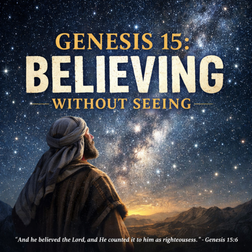
Genesis 15: Believing Without Seeing

At the center of Genesis 15 is a single sentence that echoes throughout the entire Bible: “And he believed the Lord, and He counted it to him as righteousness.” (Genesis 15:6) Abram believes God before anything changes. He is still childless. The promise is still unfulfilled. There is no visible evidence—only God’s word. Scripture presents this belief, not achievement or certainty, as the foundation of righteousness. Abram’s response matters because it establishes a biblical pattern: God does not require proof before trust, nor perfection before promise. He speaks, and He invites belief. This theme is not isolated. Centuries later, the prophet Habakkuk summarizes the same truth: “The righteous shall live by his faith.” (Habakkuk 2:4) Jesus affirms this pattern when speaking to Thomas after the resurrection: “Blessed are those who have not seen and yet have believed.” (John 20:29) The New Testament repeatedly returns to Genesis 15:6 to explain the Gospel. The apostle Paul cites it directly: “For what does the Scripture say? ‘Abraham believed God, and it was counted to him as righteousness.’” (Romans 4:3) Paul emphasizes that this belief came before the law, rituals, or religious systems—making faith, not performance, the starting point (Romans 4:9–11). Scripture does not define faith as denial of reason. Hebrews offers a working description: “Now faith is the assurance of things hoped for, the conviction of things not seen.” (Hebrews 11:1) Faith, as presented in the Bible, acknowledges limits. Human life already depends on belief without full certainty—relationships, commitments, and meaning all require trust beyond evidence. Jesus does not reject honest doubt. He engages it. He invites listening, following, and discernment—but He also issues a challenge: “Do not disbelieve, but believe.” (John 20:27) Genesis 15:6 confronts skepticism with a deeper question. Not whether belief can be avoided—but whether refusing belief is truly neutral. Scripture insists that everyone lives by faith in something. The question is not if belief exists, but what belief is worthy of shaping a life. Abram looks at the stars, hears a promise, and trusts the God who speaks. According to the Bible, that moment becomes the foundation of redemption itself.

Genesis 14: Melchizedek, the King Abram Wouldn’t Become

After Abram’s astonishing military victory and the rescue of Lot, Genesis 14 shifts the focus away from war and toward worship. As Abram returns from defeating the eastern kings, he is met not first by the king of Sodom, but by Melchizedek, king of Salem and priest of God Most High (Genesis 14:17–18). Melchizedek is a unique figure in Scripture. He appears suddenly, without genealogy, without recorded beginning or end. He is both king and priest, a combination that Israel will never successfully unite under the Law. His name means “king of righteousness,” and he rules over Salem, meaning “peace” (Genesis 14:18; Hebrews 7:1–2). Melchizedek brings bread and wine and blesses Abram, declaring: “Blessed be Abram by God Most High, Maker of heaven and earth; and blessed be God Most High, who has delivered your enemies into your hand” (Genesis 14:19–20, ESV). This offering is not merely refreshment after battle. In the ancient world, sharing bread and wine was covenant language—an act of fellowship, unity, and kinship. It was a way of saying: we are bound together; we are one people. This moment anticipates the covenant meal Jesus will later offer His disciples at the Last Supper (Matthew 26:26–28; Luke 22:19–20). The New Testament identifies Melchizedek as a type and prefigurement of Christ. Hebrews describes him as one who resembles the Son of God, remaining a priest forever—not by lineage, but by divine appointment (Hebrews 7:1–3). Jesus, like Melchizedek, is both King and Priest, mediating blessing through covenant rather than conquest (Psalm 110:4; Hebrews 7:17). Abram’s response is just as revealing. He gives Melchizedek a tenth of everything (Genesis 14:20), acknowledging that the victory came not from military strength but from God Most High. Abram, who could have claimed authority through power, instead submits to divine priesthood. He chooses blessing over dominance, covenant over kingship. Immediately afterward, Abram refuses the wealth of the king of Sodom, swearing that no earthly ruler will be able to say, “I have made Abram rich” (Genesis 14:22–23). Abram will not become the kind of king the world understands. He will remain a man of promise, trusting God alone to provide and exalt. This passage shows us that Genesis 14 is not ultimately about war—it is about what kind of kingdom God is building. Melchizedek represents a rule founded on righteousness and peace, fulfilled later in Jesus Christ. Abram’s choice reveals a faith that values covenant relationship with God above power, wealth, or reputation. The bread and wine of Salem point forward to the bread and wine of the cross—a declaration that God is forming a family, uniting people not by bloodlines or empires, but by covenant grace through Christ. Key Scriptures Cited Genesis 14:17–24 Genesis 14:18–20 Genesis 12:1–3 Psalm 110:4 Hebrews 7:1–3, 7:17 Matthew 26:26–28 Luke 22:19–20

Genesis 14: When Empires Collide and Faith Steps In

In Genesis 14, we witness the first recorded international conflict in Scripture—a clash of empires and city-states that sets the stage for God’s promises to Abram to shine. Four powerful kings from the east—Amraphel of Shinar, Arioch of Ellasar, Chedorlaomer of Elam, and Tidal of Goiim—march westward, sweeping through the lands of the Rephaim, Zuzim, Emim, and Horites (Genesis 14:1–7). These are remnants of pre-Israelite peoples, warriors of the post-Flood world, representing the full spread of nations descended from Shem, Ham, and Japheth. Against them stand five city-state kings in the Jordan Valley: Sodom, Gomorrah, Admah, Zeboiim, and Bela (Zoar)—all descendants of Ham → Canaan (Genesis 10:15–19). For twelve years, these cities had paid tribute; in the thirteenth year, they rebelled. By the fourteenth year, the eastern alliance responds with overwhelming force (Genesis 14:4–9). When the kings plunder the cities, Abram’s nephew Lot is taken captive. Abram, a sojourner with no army of his own, mobilizes 318 trained men born in his household (Genesis 14:14). Without hired soldiers, without alliances, and without political power, Abram pursues the invaders through the night, dividing his forces strategically and defeating the kings in battle (Genesis 14:15–16). All captives and possessions are restored—including Lot. Abram’s victory demonstrates that God’s promises are not constrained by human power. It is not wealth, weapons, or numbers that determine the outcome, but faithful obedience and reliance on God. This chapter sets the stage for the encounter with Melchizedek, priest of God Most High, in Genesis 14:17–24, which we will explore in our next episode. There, the focus shifts from military victory to spiritual reality—blessing, worship, and the recognition that God’s plan triumphs through righteousness, not conquest. Key Scriptures: Genesis 14:1–17 – The war and Abram’s pursuit Genesis 10:15–19 – Descendants of Canaan, the cities of the plain Genesis 12:1–3 – God’s promise to Abram as backdrop to his faith Genesis 14:4–9 – The kings, their rebellion, and conquest Genesis 14:14–16 – Abram’s rescue mission Takeaway: Even when the world seems dominated by powerful empires, God’s promises cannot be thwarted. Abram’s faith and courage remind us that God’s presence and purpose surpass every human obstacle.

Genesis 13: When Letting Go Makes Room for More

In Genesis 13, Abram and his kinsman Lot face a moment of necessary separation. Their flocks have grown so large that the land cannot support them together, and tension arises—not from sin, but from abundance (Genesis 13:5–7). Abram responds in a way that defies human instinct. Rather than asserting seniority or claiming the best land, he gives Lot first choice: “If you take the left hand, then I will go to the right, or if you take the right hand, then I will go to the left.” (Genesis 13:9) Lot lifts up his eyes and chooses what appears best by sight—the fertile, well-watered Jordan Valley, described as being “like the garden of the Lord” (Genesis 13:10). He settles near Sodom, pitching his tents toward the city (Genesis 13:12). Abram remains. Then Scripture marks a decisive turning point: “The Lord said to Abram, after Lot had separated from him…” (Genesis 13:14) Only after Abram releases his claim does God speak again. God invites Abram to lift up his eyes—not to choose, but to receive—and promises the land in every direction: “For all the land that you see I will give to you and to your offspring forever.” (Genesis 13:15) The promise expands further: “I will make your offspring as the dust of the earth…” (Genesis 13:16) What Abram gives up, God returns—multiplied. Lot walks by sight. Abram walks by faith, embodying what Scripture later names clearly: “For we walk by faith, not by sight.” (2 Corinthians 5:7) God then tells Abram to physically walk the land he has been promised: “Arise, walk through the length and the breadth of the land, for I will give it to you.” (Genesis 13:17) This is not immediate possession, but faith practiced in advance—a covenant promise extending beyond Abram’s lifetime. The New Testament reflects on Abram’s posture of faith: “For he was looking forward to the city that has foundations, whose designer and builder is God.” (Hebrews 11:10) Jesus later teaches the same kingdom logic Abram lived: “Whoever loses his life for my sake will find it.” (Matthew 16:25) “Where your treasure is, there your heart will be also.” (Matthew 6:21) “Seek first the kingdom of God and his righteousness, and all these things will be added to you.” (Matthew 6:33) Genesis 13 reminds us that God’s promises are not secured by grasping, but by trusting. Sometimes the blessing comes after we let go—and discover that what God has promised was never truly at risk.

Genesis 12: When Faith Meets Fear

In this episode of In the Garden, we explore one of the most human moments in Abraham’s story: the tension between faith and fear. God has called Abram to leave his homeland and promises land, descendants, and blessing for all peoples (Genesis 12:1–3). But almost immediately, reality presses in: a famine strikes the land (Genesis 12:10), testing Abram’s trust. Fear rises. Abram worries for his life and the safety of his wife Sarai. He tells a half-truth: “Say you are my sister, that it may go well with me because of you…” (Genesis 12:13) Abram’s decision is human, yet flawed. God intervenes, preserving Sarai and protecting the covenant: “The Lord afflicted Pharaoh and his house with great plagues because of Sarai.” (Genesis 12:17) This episode highlights a timeless truth: Abram is not perfect. His fear and human cleverness are evident, and this pattern echoes in his descendants. Abraham repeats the “she is my sister” lie to Abimelech in Genesis 20:2, and Isaac repeats it in Genesis 26:7. Yet Scripture emphasizes what counts: faith, not flawless deeds: “Abraham believed God, and it was counted to him as righteousness.” (Romans 4:3) Abram’s story shows that faith can coexist with fear. Trusting God does not require perfection; it requires following Him despite uncertainty. This episode also connects to Genesis 13, where Abram demonstrates growth. After his nephew Lot chooses the fertile Jordan Valley, Abram steps back: “If you take the left hand, then I will go to the right, or if you take the right hand, then I will go to the left.” (Genesis 13:9) Lot walks by sight; Abram walks by promise. God responds: “Lift up your eyes from where you are, northward and southward and eastward and westward, for all the land that you see I will give to you and to your offspring forever.” (Genesis 13:14–15) The promise still comes, even though Abram is still human and imperfect. Faith grows not by avoiding mistakes, but by trusting God through them. Jesus later summarizes the principle of faith amid fear: “Whoever would save his life will lose it, but whoever loses his life for my sake will find it.” (Matthew 16:25) Abram tried to save himself in Egypt. Later, he learned to trust God enough to step aside and let God’s plan unfold. His faith—not his deeds—secured the promise. Scriptures cited in this episode: Genesis 12:1–3 — God’s call and promise to Abram Genesis 12:10 — The famine in the land Genesis 12:11–13 — Abram’s fear and half-truth about Sarai Genesis 12:17 — God’s intervention and protection Genesis 20:2 — Abraham repeats the “sister” lie Genesis 26:7 — Isaac repeats the pattern Romans 4:3 — Abraham’s faith counted as righteousness Genesis 13:9 — Abram offers Lot first choice Genesis 13:14–15 — God promises Abram the land Matthew 16:25 — Jesus on losing life to find it

Genesis 12: The Promise That Holds the World Together

Genesis 12 marks a turning point in Scripture. After creation, fall, flood, and dispersion, God speaks a promise that will shape all redemptive history. The Call of Abram God calls Abram to leave his land, people, and father’s house—not with explanations, but with a promise grounded entirely in God’s initiative. Genesis 12:1–3 — God promises land, descendants, blessing, and that “in you all the families of the earth shall be blessed.” This promise is spoken into a fractured world still reeling from the scattering at Babel. Genesis 11:1–9 — Humanity divided by pride, language, and fear. Grace Before Obedience Abram is not chosen because of merit or strength. Scripture emphasizes God’s “I will,” revealing that the covenant rests on divine faithfulness, not human perfection. Even Abram’s failures later in the chapter do not nullify the promise. Genesis 12:10–20 — Abram’s fear in Egypt (background context). The Promise Repeated God reaffirms this blessing to Abram’s descendants, showing continuity across generations. Genesis 26:4 — Promise confirmed to Isaac Genesis 28:14 — Promise extended to Jacob The Prophetic Hope Israel’s prophets cling to this promise during seasons of collapse and exile, envisioning a future where the nations are restored. Isaiah 2:2–4 — Nations drawn to the Lord Micah 5:2 — A ruler coming from Bethlehem Fulfilled in Jesus The New Testament declares that this ancient promise finds its fulfillment in Christ. Luke 1:31–33 — The angel announces Jesus’ kingship John 8:56 — Jesus says Abraham rejoiced to see His day Galatians 3:8 — The gospel preached beforehand to Abraham Jesus is the true descendant through whom the blessing reaches the world. Reversing the Curse Where Adam brought death, Christ brings life. Where Babel scattered the nations, the gospel gathers them. Genesis 3:17–19 — The curse introduced Romans 5:12 — Death through Adam Galatians 3:7 — Those of faith are sons of Abraham The Foundation of Our Faith Genesis 12 teaches that faith is not confidence in ourselves, but trust in a God who keeps promises across generations. The covenant spoken to Abram, fulfilled in Christ, continues to bless the world today.

Psalm 3: Save Me, O My God

Sunday Psalms is a weekly addition to our daily Scripture reading—a deliberate pause to slow down and linger. While daily readings help us move steadily through God’s Word, Sundays invite us to sit with a single Psalm, allowing it to speak into the real pressures, fears, and questions of our lives. Psalm 3 is the first Psalm in the Psalter that is explicitly set in a moment of crisis. Traditionally attributed to David during his flight from his son Absalom, it is a prayer born out of betrayal, danger, and deep distress. The Psalm opens with brutal honesty: enemies are many, opposition is rising, and voices declare that even God will not save him. This is not polite prayer. It is raw and unfiltered. David names both the external threat and the internal wound—the doubt planted by others that his situation is beyond God’s help. The pause marked by Selah invites us to stop and sit with that weight. Yet Psalm 3 pivots on a powerful word: “But you.” “But you, O Lord, are a shield about me, my glory, and the lifter of my head.” God is described not only as protection, but as the One who restores dignity and hope. To lift the head is to restore a person who has been bowed down by shame or fear. David cries aloud to the Lord—and the Lord answers. The response does not remove the danger immediately, but it restores trust. That trust leads to one of the most striking lines in the Psalm: “I lay down and slept; I woke again, for the Lord sustained me.” Surrounded by threats, David rests. His sleep becomes an act of faith, a declaration that God remains watchful even when he is not. As the Psalm continues, fear gives way to courage. David does not deny the presence of enemies, but he refuses to be ruled by them. His confidence grows, not because the situation has changed, but because his focus has. Psalm 3 ends with a declaration that grounds the entire prayer: “Salvation belongs to the Lord.” Deliverance is not something we manufacture or earn. It is God’s to give. The final blessing—“Your blessing be on your people”—widens the prayer beyond the individual, reminding us that God’s saving work is communal as well as personal. Psalm 3 teaches us that faith does not require calm circumstances. It invites us to bring our fear honestly before God, to trust Him enough to rest, and to believe that even in the night, He sustains us. When we feel surrounded, misunderstood, or overwhelmed, this Psalm reminds us that God is still our shield—and that salvation belongs to Him.

Luke 3: The Genealogy That Walks Backward

Luke places the genealogy of Jesus immediately after His baptism, where the Father declares: “You are my beloved Son; with you I am well pleased.” — Luke 3:22 Only then does Luke trace Jesus’ lineage—not forward, but backward. Unlike Matthew, who begins with Abraham (Matthew 1:1–17), Luke begins with Jesus and walks back through ordinary men, forgotten names, kings briefly mentioned, and promises quietly carried (Luke 3:23–31). This genealogy is not a climb toward power. It is a descent toward solidarity. Luke continues past David (Luke 3:31), past Abraham (Luke 3:34), past the tower of Babel and the scattering of nations (Genesis 11:1–9), past the flood (Genesis 6–9), and through the long funeral rhythm of Genesis 5 (Genesis 5:1–32). Each repeated phrase—“and he died”—echoes the judgment spoken in Eden: “You shall surely die.” — Genesis 2:17; Genesis 3:19 Luke does not stop where Genesis 11 stopped. He goes all the way back: “the son of Enos, the son of Seth, the son of Adam, the son of God.” — Luke 3:38 Adam was called the son of God (Genesis 1:26–27). Adam fell (Genesis 3:6–7). Jesus is called the Son of God (Luke 3:22). And He will not fall. This genealogy proclaims that Jesus does not save humanity from above history—but from within it. He steps into the full human line, bearing every fracture introduced by sin. Genesis 11 shows humanity building upward—seeking security, permanence, and a name apart from God (Genesis 11:4). Luke 3 shows God walking downward—entering the family line Himself. Where humanity tried to reach heaven by towers, God comes down through incarnation. This prepares us for what follows: • Jesus will face temptation where Adam failed (Luke 4:1–13). • He will remain faithful where Israel wandered (Deuteronomy 8:2; Luke 4:4). • He will carry humanity’s story forward into redemption. Luke’s genealogy is not a list of names. It is a confession of hope. The Son of God became the Son of Adam so the sons of Adam might become children of God (John 1:12; Romans 5:18–19). No matter how far back the fracture goes, grace goes farther still.

Luke 2: Where the Covenants Meet

This episode traces the unified story of Scripture—from Genesis to the cross to the resurrection—and shows how Jesus stands at the meeting place of the old covenants and the new. From the Beginning: Why the Cross Was Necessary The story opens in Genesis 2–3, where humanity falls in the garden. Adam, created good, fails to obey God’s command. Sin enters the world, bringing death and separation from God (Genesis 2:16–17; 3:6–19). From that moment forward, the human problem is not ignorance, but rebellion. God’s covenants unfold across Scripture—Abrahamic, Mosaic, Davidic—not because humanity can keep them, but because God is faithful. The Law reveals righteousness but cannot produce it. It exposes sin without curing it. The Law and Its Limits The Law is holy and good, yet powerless to make humanity good (Romans 7:12). Scripture is clear about the human condition: “None is righteous, no, not one.” (Romans 3:10) This includes Adam, Abraham, Moses, and David. Even the best men fall short. Jesus: Born Under the Law Luke’s Gospel shows that Jesus enters fully into this broken story. He is born under the Law and fulfills it in every detail (Luke 2:21–24, 39). Paul summarizes this moment: “When the fullness of time had come, God sent forth his Son, born of woman, born under the law, to redeem those who were under the law.” (Galatians 4:4–5) Jesus does not abolish the Law. He fulfills it perfectly: “Do not think that I have come to abolish the Law or the Prophets; I have not come to abolish them but to fulfill them.” (Matthew 5:17) The Only Good Man Where Adam disobeyed, Jesus obeyed completely. His life is marked by perfect faithfulness—to God, to the Law, and to His calling. Paul contrasts Adam and Christ directly: “By the one man’s disobedience the many were made sinners, so by the one man’s obedience the many will be made righteous.” (Romans 5:19) The cross only saves because the life that led to it was flawless. The Promise to Abraham Fulfilled As we return to Genesis and Abraham, Scripture reframes the promise: “The promises were made to Abraham and to his offspring… who is Christ.” (Galatians 3:16) The blessing of Abraham does not rest on lineage or effort. It is inherited through Christ alone. Cross and Resurrection: The Meeting Place At the cross, the Law’s demands are satisfied. At the resurrection, God declares the sacrifice complete (Luke 24:1–7). The empty tomb is the verdict: Sin is defeated Death is undone The righteous Son is vindicated Big Idea The birth, life, death, and resurrection of Jesus are one unified act of redemption. This is where Genesis finds its answer, the Law finds its fulfillment, and the covenants meet—not in contradiction, but in Christ. Key Scriptures Referenced: Genesis 2:16–17; Genesis 3:6–19 Luke 2:21–24, 39 Matthew 5:17 Romans 3:10; Romans 5:19; Romans 7:12 Galatians 3:16; Galatians 4:4–5 Luke 24:1–7
8 di 10