The Reading Instruction Show

The Reading Instruction Show

di Dr. Andy Johnson
Stagione 23

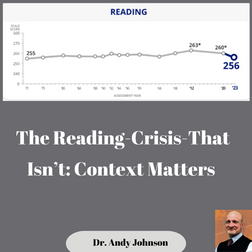
The Reading Crisis the Isn't: Context Matters
Words are always encountered in the context of a sign, product, or sentence. In the same way, to be understood, data must be understood and evaluated in the context in which it was collected. Reading research can only be fully understood in the context of a wider array of research studies within a theoretical perspective. And theories must be understood in the context of a paradigm. The Science of Reading movement must be understood in the greater social and political context and in the context of past educational reform movements (NCLB).

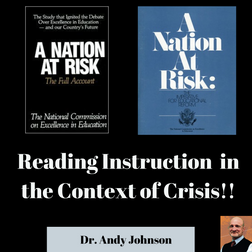
Reading Instruction in the Context of Crisis
If you were to consume a lot of popular media today related to education, you would be led to believe that there is a reading crisis. Apparently, it’s all “deeply concerning”. I can’t help but wonder if this current crisis is a new crisis or an extension of an old crisis. In 1983 the United States was said to be “at risk” because of a crisis that started in 1963 (National Commission on Excellence in Education, 1983). Was that crisis ever resolved? Is this crisis an extension of that crisis? Or is it brand new crisis? In 1983 teachers were told they need to get back to the basics. Did we not get back far enough? Did we not get basic enough? Did our basic backtracking not take? Do we need to get back to basics much harder? Are we still basic backtracking? If we’re not getting back to basics, what are we getting to?

LETRS Does Not Meet Basic SoR Standards

Conclusions The Science of Reading promotes the exclusionary use of strategies and practices that have been shown to be effective using controlled experimental or quasi-experimental research conducted in actual classroom settings. Further, this standard should be the basis upon which decisions should be made about reading instruction and reading policies. LETRS fails to meet this basic SoR standard.

LETRS: Weasels or Engery Efficient Light Bubls
This podcast examines Language Essentials for Teachers of Reading and Special (Lexia) or LETRS. I wanted to find the “reliable, trustworthy, and valid evidence” that “has demonstrated” that LETRS had “a record of success in increasing students' reading competency in the areas of phonological and phonemic awareness, phonics, vocabulary development, reading fluency, and reading comprehension”. I was eager to start reading all the research showing that LETRS professional development had a demonstrated record of success in increasing students’ reading competency. Specifically, I was looking for three things: 1. A vast, interdisciplinary body of scientifically-based research linking LETRS to improved teaching performance. 2. A vast, interdisciplinary body of scientifically-based research linking LETRS to improved student reading outcomes. 3. A vast, interdisciplinary body of scientifically-based research providing evidence that LETRS was more effective than other types of professional development in improving teacher performance or student reading outcomes.

Of Mice and Minnesota: Mouse World and Reading Instruction
Yes, state legislatures have the right to impose statues. Absolutely. But teacher's unions have the right, and the moral obligation to respond. The Read Act and other SoR mandates strip away teachers' right and obligation to provide the type of instruction that is best for their mice-students. They’re forcing teachers to spend hours in state-mandated professional development programs, paid for by state tax dollars. They force schools to purchase state-mandated reading programs. The teaching profession is being de-professionalized and you say nothing. Teachers are now expected to open the teachers’ manual and follow the script. We don’t have mouse-teachers, we have script-followers. Teacher empowerment has been central to good education. Teachers' unions led to better schools, better educational outcomes, and better teachers. Yet, teachers' unions have let outside interests change public education. You have sat silent as teachers have been asked to do more with less. You’ve sat silence as teachers are forced to implement one-size-fits-all scripted reading programs. Teachers are forced to engage in state-mandated educational malpractice for reading instruction … and you say nothing. Anybody can say nothing. The only thing worse than not having a union is having a union that does nothing.

Emily Hanford is the Alexa App of Reading Instruction
A fact may be true. But the truth of the fact is limited to the context in which it was found. Outside a meaningful context, the fact may mean something different. Also, facts without context can be misapplied and misunderstood. This is true of many of the facts used to support SoR structured approaches to reading instruction known as structured literacy. It is a house built on a series of decontextualized facts.

The New Reading Anti-Science Movement in Minnesota
This is an interview with a Minnesota reading Professor. Ideology has replaced science when it comes to reading instruction in Minnesota.

12 Essential Elements of a Comprehensive Reading Program
In 1997 Congress asked the National Institute of Children’s Health and Development to work with the U.S. Department of Education to establish a National Reading Panel. Their task was to evaluate existing research in order to find the best ways of teaching children to read. In 2000 the panel issued their 500-page report (National Reading Panel, 2000). This report has been widely cited in books and journal articles related to reading instruction. The NRP describes five-pillars are reading instruction. The SoR zealots and state reading laws describe these as five foundation reading skills. They are: phonemic awareness, phonics, comprehension, vocabulary, and fluency. It's not that I disagree with the five "pillars" of reading instruction as described by the NRP report and repeated ad nauseam by SoR zealots. My concern is that they're seven pillars short of a full load. In this podcast, I describe the 12 essential elements of a comprehensive reading program – or comprehensive literacy instruction.

I Was Wrong: Holy Books, Sacred Texts, Theories, Paradigms, and Reading Instruction

Questions: How is it that one interprets the same thing differently across time? How is it that one can read a book, have an experience, or observe phenomena and draw completely different conclusions when the only thing different is the time in which it was read, experienced, or observed? Is time a variable in comprehension or understanding? Is it a variable in constructing meaning? A book that seemed so insightful at one point, with the passage of time, can become meaningless. Likewise, books that I once thought meaningless can sometimes become filled with insight, interesting, and important ideas with the passage of time. Same book. Same person. Same brain.
Stagione 22

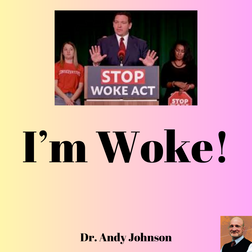
I'm Woke!!!

There are conditions that tip the scale in favor of some groups and restrict or disadvantage others. There are communities, that seem to get the economic opportunities, good schools, good teachers, health care, good nutrition, housing opportunities, small class sizes, community libraries, well-stocked school and classroom libraries … Go to a 3rd-grade classroom in a poor, inner-city school, or poor rural district. Now go to a 3rd grade classroom in a weather suburb. It's like going to a different planet. Not everybody has the same opportunities. A person is privileged because of their environment and station in life. Communities that are predominantly white seem to have disproportionately more of these privileges and more opportunities. Communities that are predominantly black seem to have more restrictions and fewer opportunities.
9 di 34