BSPE Legal Marketing Podcast

BSPE Legal Marketing Podcast

di Viktoria Altman
Stagione 5

What Is an OASAS Evaluation in New York After a DWI Arrest? - Randall F. Inniss

From The Inniss Firm, PLLC - What Is an OASAS Evaluation in New York After a DWI Arrest? explains what happens after a DWI arrest in Middletown or the Hudson Valley, why New York Vehicle and Traffic Law § 1198-a requires an OASAS evaluation in most impaired driving cases, and how the results can affect sentencing, plea negotiations, and license reinstatement. This episode breaks down the role of the Office of Addiction Services and Supports, what courts in Middletown City Court, Orange County Court in Goshen, and surrounding Hudson Valley communities often expect, and why this evaluation becomes such an important part of a DWI or DWAI case. Listeners will learn what an OASAS evaluation involves, including the 60-to-90-minute clinical interview, collateral contacts, document review, toxicology screening, and the difference between a basic screening and a full assessment. The episode also covers when evaluations are commonly required after a first-time DWI, aggravated DWI, DWAI, repeat offense, or during DMV license reinstatement through the Impaired Driver System, along with what to bring to the appointment and how to avoid costly mistakes that can delay a case. The podcast also explores the possible evaluation outcomes, from no clinical concern to education through the Impaired Driver Program, outpatient treatment, and intensive outpatient or inpatient rehabilitation. It highlights how prosecutors in Orange County, judges in local courts, and the New York DMV may use the findings, and why these results can carry added consequences for professionals such as nurses, teachers, physicians, certified public accountants, attorneys, and real estate agents dealing with arrest or conviction reporting issues. Drawing on the background of Randall F. Inniss, Esq., founder of The Inniss Firm, PLLC, this episode gives listeners a practical look at the OASAS process through the lens of someone who served more than 22 years with the New York State Police as a Trooper, Investigator, and Senior Investigator before becoming a DWI defense attorney. It also touches on his experience with Standardized Field Sobriety Testing, his work representing clients in Middletown, Goshen, and across Dutchess, Orange, Putnam, Rockland, Ulster, and Westchester counties, and why preparation can make a meaningful difference in the outcome of a DWI case. The Inniss Firm, PLLC 280 NY-211 Suite 203, Middletown, NY 10940, United States (845) 533-0265 https://www.google.com/maps?cid=9803142138284851286

What are Hardship Driving Privileges After a DWI Arrest in New York? - Randall F. Inniss

From The Inniss Firm, PLLC - What are Hardship Driving Privileges After a DWI Arrest in New York? explains how drivers in New York may seek limited, court-ordered driving privileges after a DWI arrest, and why the issue becomes urgent at arraignment. The episode walks through the suspension pending prosecution rule under New York Vehicle and Traffic Law § 1193(2)(e)(7), what happens when a chemical test shows a BAC of 0.08% or higher, and how a hardship privilege can allow travel for work, necessary medical treatment, or school during the first 30 days. The podcast also explores what “extreme hardship” means in a Middletown DWI case and why documentation matters. Listeners will hear how courts in Orange County and across the Hudson Valley evaluate evidence such as employer letters, pay stubs, medical records, public transit schedules, rideshare costs, and school enrollment records, along with why your own testimony is not enough under VTL § 1193(2)(e)(7)(e). The discussion highlights the practical realities facing families when license suspension threatens employment, medical care, childcare, and daily life. Featuring insight drawn from the work of Middletown DWI lawyer Randall F. Inniss, Esq., this episode also covers who may be disqualified from receiving a hardship privilege, including drivers accused of refusing a chemical test under VTL § 1194, those with a prior DWI or DWAI conviction within five years, and those without a valid driver’s license at the time of arrest. It also explains how hardship privileges differ from DMV-issued options such as the pre-conviction conditional license, or PCCL, under VTL § 1193(2)(e)(7)(d), and the restricted use license under VTL § 530. Listeners will come away with a clearer understanding of the timeline after a DWI arrest in New York, from arraignment through the first 30 days and beyond, plus the steps that should be taken immediately to protect limited driving rights. The episode spotlights The Inniss Firm, PLLC, based at 280 NY-211, Suite 203, Middletown, and the background of Randall F. Inniss, including his 22 years with the New York State Police, service in Binghamton, New York City, and Buffalo, his education at Binghamton University and the University at Buffalo School of Law, and his work defending drivers throughout Orange County and the Hudson Valley. The Inniss Firm, PLLC 280 NY-211 Suite 203, Middletown, NY 10940, United States (845) 533-0265 https://www.google.com/maps?cid=9803142138284851286

Disability Discrimination and Reasonable Accommodation in Miami - BT Law Group, PLLC

From BT Law Group, PLLC - Disability Discrimination and Reasonable Accommodation in Miami explores how employees in Miami and South Florida are protected under the Americans with Disabilities Act (ADA), the ADA Amendments Act of 2008 (ADAAA), and the Florida Civil Rights Act (FCRA) when facing workplace discrimination. This episode breaks down how disability is defined, what qualifies as a major life activity, and how protections extend to hiring, termination, promotions, and workplace conditions across Miami-Dade County and beyond. Listeners will gain a clear understanding of reasonable accommodations, including modified work schedules, assistive technology, remote work, reassignment, and workplace adjustments. The discussion highlights the legal requirement for employers to engage in the interactive process and what happens when companies fail to comply. Real-world examples illustrate how employees with conditions such as PTSD, diabetes, cancer, and mobility impairments are protected under federal and Florida law. Featuring insights from Jason D. Berkowitz and Anisley Tarragona, this episode also walks through the legal process of filing a disability discrimination claim with agencies like the Equal Employment Opportunity Commission (EEOC), the Florida Commission on Human Relations (FCHR), and the Miami-Dade County Commission on Human Rights. The conversation covers deadlines, investigations, right-to-sue letters, and the role of institutions like the U.S. District Courts for the Southern District of Florida and the Eleventh Circuit. Finally, the episode outlines the types of compensation available in disability discrimination cases, including back pay, front pay, compensatory damages, punitive damages, and attorney’s fees. Whether you are in Miami, Fort Lauderdale, Boca Raton, or West Palm Beach, this podcast provides essential guidance on protecting your rights, understanding employer obligations, and taking action when workplace discrimination occurs. BT Law Group, PLLC 3050 Biscayne Blvd STE 205, Miami, FL 33137 (305) 507-8506 https://www.google.com/maps?cid=1652198006057542154

Gun Seizure and Forfeiture Lawyer in New Jersey - Adam M. Lustberg

From Lustberg Law Offices, LLC - Gun Seizure and Forfeiture Lawyer in New Jersey breaks down what happens when firearms are seized in New Jersey and what gun owners need to know about protecting their rights. This episode follows the legal realities behind gun seizure and forfeiture, from criminal charges and domestic violence allegations to restraining orders, mental health concerns, and Extreme Risk Protective Orders, while explaining how these cases can move quickly through Bergen County and the surrounding region. The conversation highlights the four legal pathways the state uses to seize and forfeit firearms, including criminal forfeiture under N.J.S.A. 2C:64-1, domestic violence forfeiture under N.J.S.A. 2C:25-21, the Health Care Professional Duty to Warn under N.J.S.A. 2A:62A-16, and Extreme Risk Protective Orders under N.J.S.A. 2C:58-20 to 58-32. Listeners will hear how the process unfolds after a seizure, why deadlines like 45 days or 10 days can shape the outcome, and what happens in forfeiture hearings before a Superior Court judge at venues such as the Bergen County Superior Court and the Bergen County Justice Center in Hackensack. Featuring insights tied to the work of Adam M. Lustberg, Esq., founder of Lustberg Law Offices, LLC, this episode also explores the credentials and courtroom background behind the practice. It touches on his path through Seton Hall University School of Law, the Essex County Public Defender's Office, and Seton Hall's Juvenile Justice Clinic, along with recognition from Avvo, SuperLawyers Rising Stars, (201) Magazine, and National Trial Lawyers Top 100 Trial Lawyers. The episode also references organizations connected to his professional involvement, including the American Bar Association, the New Jersey State Bar Association, the Bergen County Bar Association, the Hudson County Bar Association, and the Association of Criminal Defense Lawyers of New Jersey. Listeners will also learn how TROs, FROs, TERPOs, and FERPOs can affect firearms, permits, and FPID cards, what happens when prosecutors object to returning seized weapons, and why timing is critical when dealing with the Bergen County Prosecutor’s Office. With practical discussion of forfeiture hearings, transfer or sale options, compliance risks, and the consequences of failing to surrender firearms, this episode offers a clear overview of a high-stakes area of law for individuals across New Jersey. Lustberg Law Offices, LLC 1 University Plaza Dr #212, Hackensack, NJ 07601, United States (201) 880-5311 https://www.google.com/maps?cid=17248268094099978177

Can You File a Wrongful Death Lawsuit Against a Nursing Home? - Colucci, Colucci & Marcus, P.C.

From Colucci, Colucci & Marcus, P.C. - Can You File a Wrongful Death Lawsuit Against a Nursing Home? explains how Massachusetts law allows families to pursue a wrongful death lawsuit when negligence or abuse in a nursing home leads to a resident’s death. Referencing Massachusetts General Laws Chapter 229, Section 2, the episode outlines who can file a claim, including the executor or administrator of the estate, and highlights common causes such as falls, medication errors, untreated infections, and failures in care plans. The discussion features Boston personal injury attorney Dino M. Colucci, who represents families across Massachusetts and shares insight into how nursing homes may fail to meet required standards of care. The episode explores federal regulations under 42 CFR Part 483 and state rules under 105 CMR 150.000, emphasizing the importance of individualized care plans, adequate staffing, and proper supervision to prevent harm to vulnerable residents. Listeners will also gain a clear understanding of how to prove negligence in a wrongful death case, including the four legal elements of duty, breach, causation, and damages. The podcast breaks down key evidence such as medical records, staffing logs, and Massachusetts Department of Public Health inspection reports, while also explaining the medical malpractice tribunal process under G.L. c. 231, § 60B and pre-suit notice requirements under G.L. c. 231, § 60L. Finally, the episode covers the types of damages available under G.L. c. 229, § 2, including loss of companionship, funeral expenses, and punitive damages, as well as the three-year statute of limitations. With additional perspective from attorneys Darin Colucci and Matthew J. Marcus, the conversation provides practical steps families can take after a nursing home death and explains how legal action can hold negligent facilities accountable across Boston and throughout Massachusetts. Colucci, Colucci & Marcus, P.C. 424 Adams St #101, Milton, MA 02186, United States (617) 698-6000 https://www.google.com/maps?cid=6757336485323234120

What Qualifies as High Net Worth Divorce in Chicago, Illinois? - Caesar & Bender, LLP

From Caesar & Bender, LLP - What Qualifies as High Net Worth Divorce in Chicago, Illinois? explores how Illinois law approaches complex divorces involving substantial assets, high income, and intricate financial structures. Centered in Chicago and Cook County, the discussion highlights how cases filed in the Circuit Court of Cook County, including the Domestic Relations Division at the Richard J. Daley Center, often require deeper financial analysis and strategic planning when wealth reaches significant levels. The article breaks down how high net worth divorces differ from standard cases and why they demand a more detailed legal and financial approach. The episode dives into the critical financial thresholds that shape these cases, including how a combined income of $500,000 impacts spousal maintenance under statutes like 750 ILCS 5/504. It explains how Illinois courts move away from standard formulas and instead rely on discretion, evaluating factors such as lifestyle, earning capacity, and long-term financial contributions. With insights tied to statutes like 750 ILCS 5/503 and 750 ILCS 5/505, listeners gain a clear understanding of how courts divide marital vs. non-marital property and determine fair outcomes in high-income situations. Listeners will also learn how complex assets—ranging from business interests and executive compensation to real estate portfolios and investment accounts—are valued and divided. The conversation explores the role of forensic accountants, valuation professionals, and financial documentation in uncovering hidden assets, proving dissipation claims, and ensuring equitable distribution. It also addresses the importance of agreements under the Illinois Uniform Premarital Agreement Act (750 ILCS 10), showing how prenuptial and postnuptial agreements can shape the outcome of high-asset divorces. Featuring the experience of Molly E. Caesar and Michael Ian Bender, the discussion brings perspective from decades of handling complex divorce matters throughout Chicago. With connections to institutions like DePaul University College of Law and recognition from organizations such as the North Suburban Bar Association, along with media appearances on ABC 7 Chicago, Fox 32, WGN Radio, and the Chicago Tribune, the episode provides a well-rounded look at the legal, financial, and personal dimensions of high net worth divorce cases in Illinois. Caesar & Bender, LLP 150 N Michigan Ave #2130, Chicago, IL 60601, United States (312) 236-1500 https://www.google.com/maps?cid=10482794179944044586

Stalking Charges in Bronx Domestic Violence Cases - David Mejia Colgan

From David Mejia Colgan, Esq. - Stalking Charges in Bronx Domestic Violence Cases explores how a single allegation in the Bronx can trigger immediate legal consequences, including arrest, orders of protection, and proceedings in Bronx County Criminal Court and the Bronx County Integrated Domestic Violence Court. This episode unpacks how New York law approaches stalking within domestic relationships and why these cases receive heightened scrutiny across both criminal and family court systems. Drawing on over 30 years of experience, David Mejia Colgan, Esq., a former Bronx Assistant District Attorney, shares insight into how cases are built and challenged under New York Penal Law Sections 120.45 through 120.60. The discussion breaks down the four degrees of stalking charges—from Class B misdemeanors to Class D felonies—and explains how factors like prior convictions, alleged conduct, and use of technology such as GPS tracking influence penalties, including jail time, fines, and mandatory minimum sentences. Listeners will gain a clear understanding of how stalking cases move through arraignment at Bronx County Criminal Court, the role of Temporary Orders of Protection and Final Orders of Protection, and how the Bronx County District Attorney’s Office prosecutes these cases. The episode also explores the structure of the Integrated Domestic Violence Court, where one judge may oversee criminal charges alongside custody, visitation, or matrimonial matters, shaping outcomes that extend beyond criminal penalties. The episode concludes with practical guidance on defense strategies and next steps after an arrest, including protecting your rights, avoiding violations of orders of protection, and documenting evidence. It also addresses collateral consequences such as impacts on employment, housing, immigration status, firearms restrictions, and child custody. David Mejia Colgan, Esq. emphasizes the importance of early legal action and understanding how charges may be reduced, dismissed, or resolved through avenues like Adjournment in Contemplation of Dismissal under New York Criminal Procedure Law Section 170.55. David Mejia Colgan, Esq 910 Grand Concourse Suite 1F, Bronx, NY 10451, United States (718) 484-8820 https://www.google.com/maps?cid=10458568621536558650

New Jersey Drunk Driving Statistics (2026): Arrests, Fatalities, and Trends - Rachel Kugel

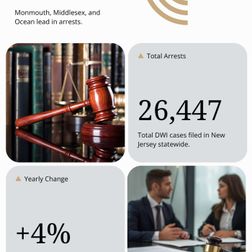
From The Kugel Law Firm - New Jersey Drunk Driving Statistics (2026): Arrests, Fatalities, and Trends explores the latest data on DWI arrests, fatal crashes, and evolving impaired driving patterns across New Jersey. This episode breaks down key findings including the 684 traffic fatalities recorded in 2024, the 15% decline in 2025, and the growing concern around cannabis surpassing alcohol as the most common substance found in deceased drivers involved in fatal crashes. Listeners will gain insight into how New Jersey police filed 28,048 DWI cases between July 2024 and June 2025, while courts resolved only 26,412, contributing to a 17% backlog. The discussion highlights enforcement trends, statewide disparities, and county-level data from Monmouth County, Middlesex County, Ocean County, Bergen County, and Atlantic City, where DUI arrests remain concentrated. It also explores how initiatives like the Target Zero Commission and the ignition interlock credit law are shaping outcomes. The episode also dives into substance-related trends, including the rise of cannabis following New Jersey’s legalization in April 2022, and the challenges law enforcement faces due to gaps in implied consent laws and reliance on Drug Recognition Experts. Time-of-day crash data, demographic patterns, and findings from the NJ State Comptroller investigation into courtesy card practices provide additional context into how and why impaired driving continues to evolve across the state. Featuring insights connected to Rachel Kugel, Esq., of The Kugel Law Firm, this episode also outlines DWI penalties, court procedures, and what individuals can expect when facing charges in New Jersey. With references to institutions like the National College of DWI Defense, DUI Defense Lawyers Association, New Jersey Bar Association, and media appearances on CNN, FOX News, CourtTV, MSNBC, and HLN, this podcast offers a comprehensive, data-driven overview of impaired driving trends and legal implications in New Jersey. The Kugel Law Firm 1 Gateway Ctr SUITE 2600, Newark, NJ 07102, United States (973) 854-0098 https://www.google.com/maps?cid=3822170752710866861

When Should I File For Divorce In Illinois? - Russell D. Knight

From The Law Office of Russell D. Knight - When Should I File For Divorce In Illinois? breaks down the key timing considerations that can shape a divorce filing in Illinois. This episode explores how a spouse may be ready to move forward emotionally, but still needs to think carefully about residency, court procedure, and whether filing now or later could affect the overall divorce process. The conversation explains that, contrary to common belief, a person does not necessarily have to wait before filing for divorce in Illinois, but one of the spouses generally must meet the 90 days resident requirement connected to the divorce petition. The episode also highlights how the court approaches a judgment of dissolution of marriage, including situations involving military presence in the state. Listeners will also hear how irreconcilable differences and the irretrievable breakdown of the marriage factor into an Illinois divorce. The discussion touches on reconciliation, the best interests of the family, and why timing matters when deciding whether to file immediately or wait until legal and practical conditions are more favorable. The episode closes with a practical look at filing strategy, including where a petitioner may file, how county choice can matter, and what can happen if one spouse files first and the other fails to respond, including the possibility of default. Overall, this podcast description captures a clear, grounded discussion of divorce, court procedure, and the real-world timing questions that affect families across Illinois. Law Office of Russell D. Knight 1165 N Clark St #700, Chicago, IL 60610, United States (773) 334-6311 https://www.google.com/maps?cid=13056420905624162796

Orders of Protection in the Bronx - David Mejia Colgan

From David Mejia Colgan, Esq. - Orders of Protection in the Bronx breaks down what happens when someone is served with an order of protection in Bronx County and suddenly faces restrictions affecting home, family, and daily life. This podcast explores how temporary and final orders can arise in Bronx Family Court and Bronx Criminal Court, what respondents need to know about full stay-away orders and limited refrain-from orders, and why fast, informed action matters from the moment service takes place. Drawing on more than 30 years of legal experience, David Mejia Colgan discusses the realities of defending domestic violence-related matters in the Bronx, including the impact of Family Court Act Article 8, Section 842, and Section 812. The episode also highlights his background as a former Assistant District Attorney in the Bronx County District Attorney's Office, where he worked in the domestic violence and sex crimes bureaus, giving listeners insight into how these cases are built, challenged, and defended. Listeners will hear a practical discussion of the order of protection process at Bronx Family Court, located at 900 Sheridan Avenue, including ex parte applications, service, return dates, consent without admission, and fact-finding hearings. The podcast also covers available defenses such as false or exaggerated allegations, insufficient evidence, lack of a qualifying relationship, self-defense, and conduct that does not meet the definition of a family offense, along with the serious consequences tied to New York Penal Law Sections 215.50, 215.51, and 215.52. The episode further examines how protective orders can affect custody, visitation, firearms rights under 18 U.S.C. Section 922(g)(8), and proceedings in Integrated Domestic Violence Court. It also explains when an order may be modified or vacated, what happens when Family Court and Criminal Court orders overlap, and why respondents must avoid all prohibited contact even if the petitioner initiates it. Featuring guidance from David Mejia Colgan, Esq., a New York University School of Law graduate admitted in New York State and the U.S. District Courts for the Southern, Eastern, Northern, and Western Districts of New York, this podcast offers a clear overview for people confronting orders of protection in the Bronx, New York City, and surrounding counties. David Mejia Colgan, Esq 910 Grand Concourse Suite 1F, Bronx, NY 10451, United States (718) 484-8820 https://www.google.com/maps?cid=10458568621536558650
33 di 178