Have you received a suspicious email offering to pay you thousands of dollars to appear on a podcast? Or maybe someone promised instant fame if you just pay a “small fee” to a promotion service?
You’re not alone.
As podcasting keeps growing, scammers and bad actors are taking notice. And, you guessed it. They’re targeting both new and experienced podcasters with increasingly clever schemes.
Let’s explore the most common scams, how to spot them, and what to do if you become a victim.
Why Podcasters Are Prime Targets

Scammers love podcasters for three main reasons:
– The desire for exposure
– Technical complexity
– Money on the table
According to the FBI, cybercriminals stole a record $16.6 billion in 2024. That’s a 33% increase from 2023. Let’s break down the top scams you need to watch for in podcasting.
Scam #1: The Fake Podcast Guest Invitation
This is the most common scam targeting podcasters and content creators right now.
How This Scam Works
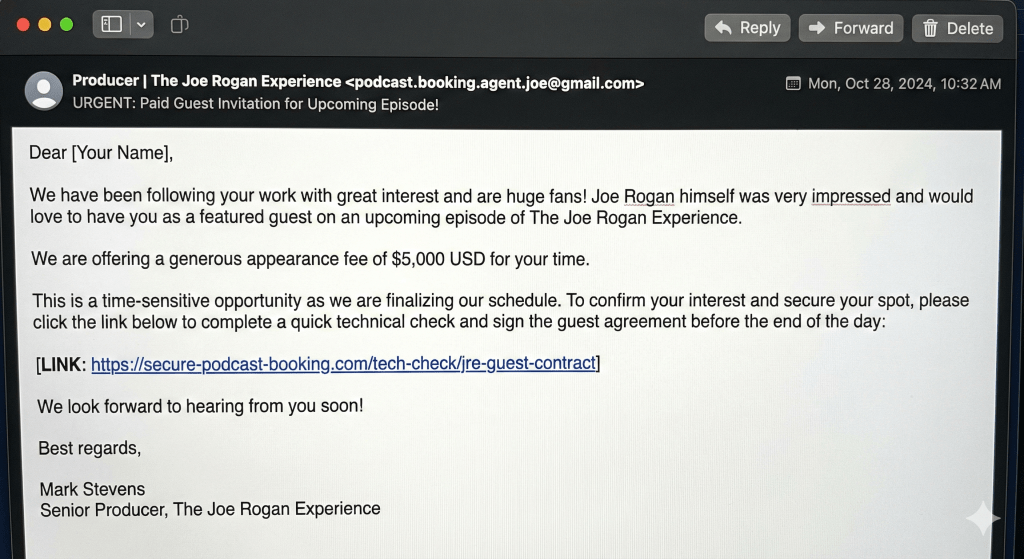
You receive an email from someone claiming to be a producer or manager for a popular podcast. They say they’ve seen your work and want you as a guest. They might even offer to pay you between $2,000 and $3,000 for a single appearance.
The email looks professional. They reference your recent work or social media posts.
Everything seems legitimate.
Then comes the “tech check.”
They want to make sure your audio and video setup works before the actual interview. During this call (usually on Zoom, Facebook, or Instagram), they ask you to:
- Share your screen
- Download special software
- Change your social media account settings
- Grant them access to your Facebook page to set up “Facebook Live”
Once you do this, they lock you out of your accounts. They steal your credentials and take over your social media.
What Happens Next
After gaining access to your accounts, scammers will:
- Post spam or scam content
- Look for private photos to use for extortion
- Access credit cards linked to your accounts
- Use your audience to scam your followers
- Delete all your content
People That Could Have Been Victims
Bill Murphy Jr., Inc.com columnist, received dozens of fake podcast invitations over a year, sometimes offering thousands of dollars.
Alex Kantrowitz reported in CMS Wire that he received an invitation claiming to be from a “top 1%” podcast. Through research, he found that the podcast didn’t even exist. Luckily, he didn’t give anything to the bad actors that could have hurt him.
Kate Mansi, an actor and TikTok creator, told Distractify that she received a sophisticated fake invitation to appear on Amy Poehler’s “Good Hang” podcast. It had real logos, professional formatting, and authentic-looking links.
There are dozens upon dozens of other stories like this, and they are becoming more common.
Our product evangelist Joe shared that he too has heard about this scam circulating, and that people have even attempted it on him. He hasn’t fallen for it firsthand, but notes these attempts are very real. Yep, even for experienced podcasters who know what to look for.
Red Flags to Watch For
- Gmail or Yahoo addresses instead of professional domains
- Generic praise that sounds AI-generated
- Misspelled names or poor grammar
- Large, bolded names or odd formatting
- They’ll PAY YOU to be a guest (real podcasts rarely do this)
- Large sums ($2,000-$3,000) for minimal work
- Little to no negotiation on terms
- No formal contract or paperwork
- Share your screen
- To change account settings
- Download “special software” for the interview
- Grant admin access to your social pages
- No episodes found on Apple Podcasts, Spotify, or ListenNotes.com
- YouTube channel with one video and one subscriber
- Can’t find the host anywhere online
- No official website or media kit
How to Protect Yourself
Before accepting any invitation you should:
- Search for the podcast on ListenNotes.com, Apple Podcasts, and Spotify
- Verify it has real episodes with actual guests
- Google the podcast name + “scam” to check for complaints
- Look up the host on LinkedIn with a professional email domain
- Check their social media for authentic, active profiles
- Ask for their official website and recent guest list
During communication it’s best to:
- Never share your screen with someone you don’t know
- Never change social media settings at anyone’s request
- Never provide passwords or account access
- Don’t download software for “tech checks”
- Be skeptical if they offer payment for being a guest
- Always enable two-factor authentication on all accounts
Scam #2: Fake Podcast Promotion Services
“Get to #1 on Apple Podcasts guaranteed!” or “10,000 downloads in your first week or your money back!”
These services promise to make your podcast instantly popular. They say they have special connections or secret methods to boost your rankings.
Here’s an example of a podcast promotion service found on Fiverr:
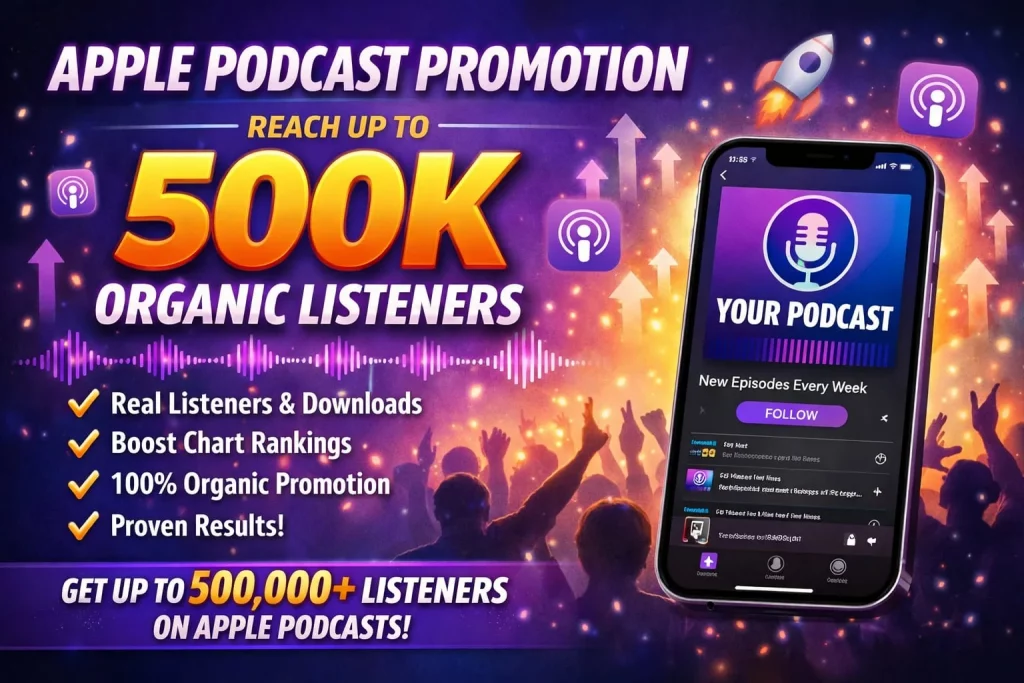
How the Scam Works
You pay them, often several hundred dollars upfront. Then they:
- Deliver downloads from bots, not real people
- Create fake engagement that looks uniform and repetitive
- Generate reviews from fake accounts
- Boost your numbers temporarily with no lasting impact
The worst part? When you try to cancel, they threaten to flood your podcast with negative reviews unless you keep paying.
Real Examples
PJ Vogt, host of the Search Engine podcast, told Semafor he was contacted by iBoostReach. They offered to boost his podcast to the top of charts for a few dollars. They offered to prove effectiveness by boosting his trailer episode with thousands of downloads. Vogt refused because it would mislead advertisers and violate contracts.
LinkedIn Podcast Promoters were investigated in Jack Rhysider’s “Darknet Diaries” podcast episode 27. He found promoters, mostly from Bangladesh, who learned to game iTunes charts. They use thousands of Apple IDs to subscribe to shows (about 50 per day) to manipulate chart positions. Fiverr actively bans accounts offering this service because it violates iTunes terms. – Podcast Hero, “LinkedIn Podcast Promoter (scams).”
Joe said these kinds of offers are “a dime a dozen” in his inbox, and that he approaches every one of them with healthy skepticism. His rule of thumb? If it seems too good to be true, assume it is.
Brandon Rimes, Radio Host of the Consumer Quarterback Show, shared with us that he learned this lesson firsthand.
Here’s what he told us:
“A few years back, I had a ‘media agency’ reach out promising they’d book me on 50 high-profile shows for a flat fee. They showed me logos, testimonials, the whole deal. I paid $3,500 upfront. What I got was 4 appearances on dead podcasts with maybe 12 downloads each. When I pushed back, they vanished. I’ve built genuine relationships in broadcast over the years with Salem Media and Cox. None of those connections came from a paid placement service. They came from showing up consistently and providing real value. The shortcuts in this industry almost always cost me more than they saved.”
Red Flags
- Guarantees of specific chart positions
- Won’t explain their methods in detail
- Asks for large upfront payment
- Has no verifiable track record
- Shows you examples of uniform, repetitive engagement
- No legitimate reviews from other podcasters
- Threatens you when you try to cancel
Legitimate services explain their methods, show real case studies, and have transparent pricing. No guarantees and no pressure.
Scam #3: The Reverse Scam (Fake Guests Offering to Pay YOU)
In this version, the scammer doesn’t invite you to be a guest. Instead, they offer to pay YOU thousands of dollars to appear on YOUR podcast.
The Real Goal
The scammer uses the promise of payment to:
- Gain access to your recording platform
- Get you to share your screen
- Request admin access to promote the episode
- Steal your social media credentials
What Makes It Convincing
Scammers will claim to be promoting a book or product. Or they will say the episode is “sponsored” by a major brand. They’ll even use professional language and formatting, and reference specific details about your podcast.
Joe noted he’s seen this scam in the wild, though he’s never been personally victimized by it. He also flagged a closely related version worth knowing about. (See the bonus scam at the end of this article!)
Bennett Maxwell, CEO of Franchise KI and host of Deeper than Dough, reached out and shared a similar experience a friend went through.
He said, “She had a guest on who, right after recording, started spamming her with promo requests. The whole pitch was just a setup for free advertising. Now I always check people out. I look for a real website or some social media profiles that actually seem active. It keeps my show focused on actual conversations instead of ads.”
Red Flags
- Anyone offering to pay you to be on your podcast
- Claims the appearance is “sponsored by” a major brand
- Asks for screen sharing or account access
- Poor grammar despite claiming professional status
- Can’t verify their identity or previous appearances
- Requests unusual payment methods
Scam #4: Fake Sponsorship and Partnership Offers
You get an exciting email from someone claiming to represent a major brand. They want to sponsor your podcast. The deal sounds amazing.
Common Tactics
- Major brand willing to pay big money – Especially when you’re a smaller podcast!
- Minimal requirements or vetting
- Quick turnaround needed – Urgency is a big thing with scammers!
- Access to your hosting account
- Wants detailed analytics before formal agreement
- Asks for payment information “to set up direct deposit”
- They’ll sponsor you, but you need to pay a “processing fee”
- Requires payment for “marketing materials”
- Asks you to buy products to review
We generated an image of what an email like this might look like:
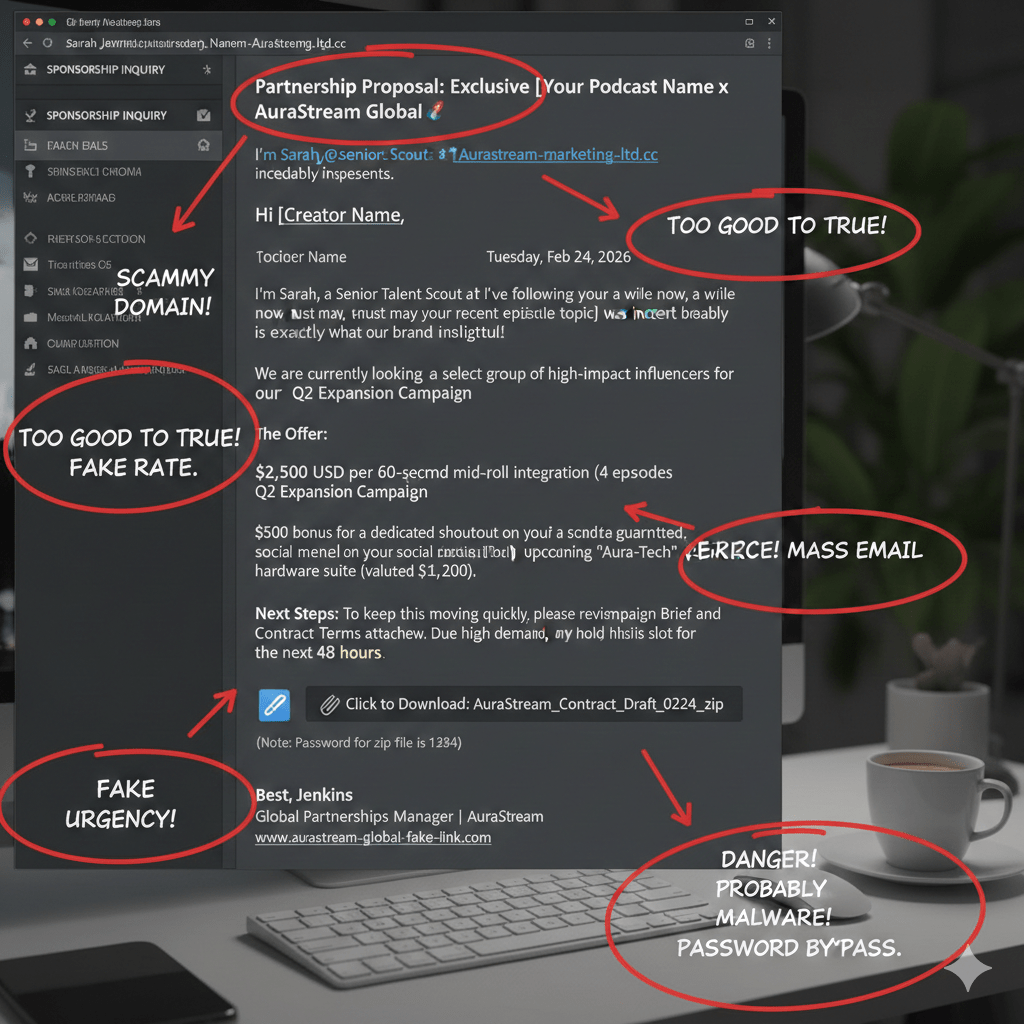
Our product evangelist Joe shared that this one has almost gotten him, and some of his clients. He’s even gone pretty far into negotiations before something felt “off.”
He says his approach is to stick to the payment terms you’re used to, demand to be paid upfront, and remember that money should only ever flow from the brand to you. If a brand ever asks you to pay anything, even to “buy the product first and get reimbursed via PayPal,” that’s a hard no.
Hans Graubard, COO & Cofounder of Happy V, told us he too has seen this play out multiple times in his network. Here’s what he shared with us:
“One podcaster I know was asked to install ‘media kit’ software to preview the ads, which turned out to be malware. Another was given a forged contract and bank deposit confirmation to make it look like they’d been paid upfront, only to realize the transfer had never cleared and the scammer disappeared right after they started running the ads. The common thread is urgency. Scammers push for fast action and bypass typical vetting steps. Most legitimate sponsors expect some back-and-forth, not instant agreements.”
Protecting Yourself
- Verify the person on LinkedIn with their company email
- Contact the company directly through their official website
- Never provide account credentials before a signed contract
- Have any contract reviewed by a lawyer – In a pinch, at the very least, run the contract through ChatGPT/Claude and ask for red flags
- Research the company’s previous podcast sponsorships
- Ask for references from other podcasters they’ve worked with
Scam #5: Counterfeit Podcast Equipment
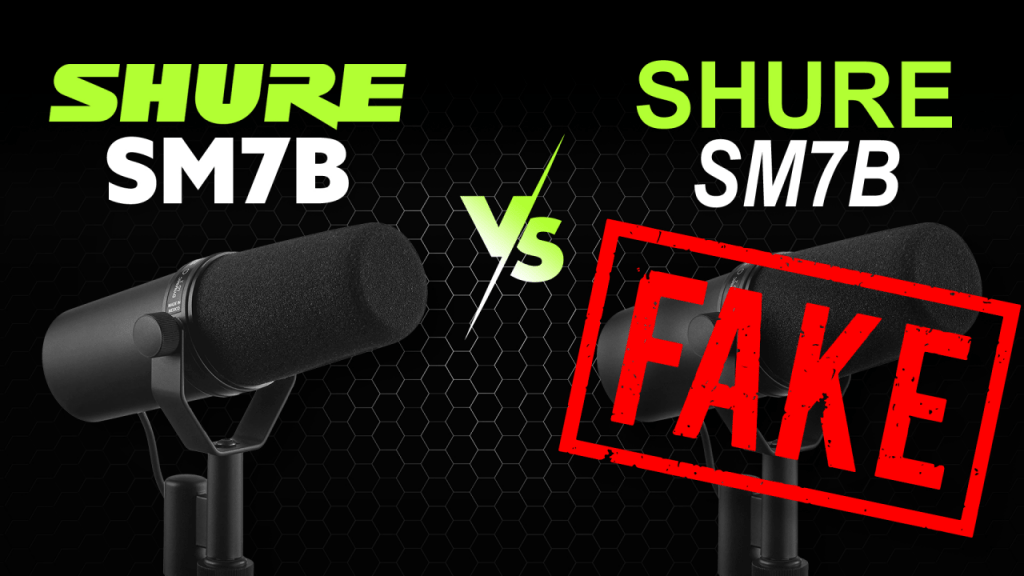
Yep, podcast equipment gets counterfeited just like knockoff designer bags. The most counterfeited podcast equipment we’ve heard about is the Shure SM58. It’s the world’s most popular microphone, and it’s not exactly the cheapest one on the market either.
How the Scam Works
Scammers sell fake versions of popular podcast equipment through platforms like:
- EBay
- Amazon
- Craigslist
- Facebook Marketplace
And, they sell them at prices 20-80% below retail.
The fakes can be incredibly convincing. Some have official-looking packaging, correct serial number formats, and even the proper weight and appearance
Real Examples
David Hooper, the podcast expert behind Big Podcast Extra, bought what he thought was a Shure SM58 off eBay. He only discovered it was fake when he compared it side-by-side with a real one. The fake contained inferior components.
According to DFO Drum Forum, an eBay seller from China/Sacramento was selling brand new SM58 mics for $70 (retail $105 at Sweetwater). They sold seven mics in 24 hours with “MORE THAN 10 available.” The seller also sold unrelated items like flea collars, laser pointers, and Christmas ornaments. That’s a red flag for counterfeit operations.
The same forum also reported that fake SM57s on Craigslist showed up in New Jersey. Someone advertised them as genuine, “two for $65.” They claimed the mics were from a church that never used them. Multiple buyers called them out for selling fakes, with one showing photos comparing genuine internals to the knockoff.
Even Joe admitted this one got him! He spotted a shotgun microphone he’d been eyeing that was normally around $1,200. It was listed on Amazon for $700 and he jumped on it. Before it arrived, he took a closer look at the seller and noticed the account was full of Chinese characters and had very little history on the platform.
When the mic showed up, it didn’t sound right. After doing some research, he found that a genuine version of the mic has a screw of a very specific color inside, and his didn’t match. He sent it back and was fortunate to get a full refund through Amazon’s return policy. His takeaway: on Amazon, always make sure the item is sold and fulfilled directly by Amazon.com or the verified brand itself.
What’s Actually Inside The Box?
Some counterfeit microphones have been found to contain:
- Newspaper and hot glue instead of transformers
- Cheap components that break quickly
- Electronics that deliver poor audio quality
Red Flags
- Prices significantly below retail (20%+ discount)
- Sellers with limited feedback
- “Too good to be true” deals
- Missing serial numbers or packaging
- Sold as “brand new” but listed as “used”
- Non-authorized dealers
How to Protect Yourself
- Buy only from authorized dealers
- Check serial numbers with manufacturers
- Compare photos carefully to official product images
- Ask for proof of purchase from authorized dealer
- Check the seller’s return policy
When Buying Used:
- Meet in person when possible
- Test equipment before paying
- Ask for original receipt
- Be extra cautious with “new in box” used items
A Few More Scams to Watch Out For

Predatory Podcast Awards
- High entry fees ($150-$500+) with vague judging criteria
- Everyone receives some type of “award” or “honorable mention”
- Heavy focus on selling winner badges and plaques
- Look for transparent judging process, reasonable fees, and an established reputation
On this front, Joe said he’s exactly these kinds of solicitations. One claimed to be “the number one podcast newsletter,” and he immediately knew it wasn’t PodNews. He’s also been approached by PR firms promising to feature him in a “top 10 podcasters” list, only to reveal a $1,000 price tag after the fact.
His rule: the moment someone shifts from an altruistic-sounding offer to asking for money, he’s out.
Copyright Extortion Schemes
- Aggressive DMCA takedown notices for minimal music use
- Pressure to pay expensive licensing fees or face content removal
- Protect yourself by using only royalty-free music and keep all licensing documentation
AI-Generated Scam Podcasts
Note: This is one Joe says he’s seeing more and more!
- Fake podcasts using AI voices to promote illegal products or investment scams
- Mimic legitimate show styles to build false credibility
- Watch for hosts with no verifiable identity, unrealistic promises, high-pressure tactics
Fake Podcast Directories
- Charge submission fees for “premium” podcast listings
- Promise enhanced discoverability that never materializes
Keep in mind, major directories (Apple Podcasts, Spotify, Amazon, etc.) are free to submit to!
Bonus Scam: The Guest Invitation That’s Really a Sales Call
Joe flagged this one as a scam not to overlook, and he confessed it got him twice.
Here’s how it works: You get invited to be a guest on a podcast with a generic-sounding name.
The host interviews you for about 15 minutes. Then, once the recording wraps up, they pivot and ask if you’ve ever considered their product or service. Suddenly, you’re in the middle of a sales call you never agreed to.
The red flags? They’ll say something like “it’s no cost to come on my show” which is a red flag because appearing on a podcast shouldn’t cost anything.
These shows also tend to publish multiple episodes per day and often feature multiple hosts, because each salesperson on the team is recording interviews and then following up with their own pitch.
Joe also noted that when he finally told one of these shows he’d never buy and asked to be removed from their database, his episode was taken down at the same time. His contact record in their CRM was tied directly to his episode.
It won’t cost you money, but it will cost you time, and it’s more widespread than you might think.
If It Sounds Too Good to Be True…
You know how this saying ends. The podcasting industry is thriving, and scammers know it.
They’re constantly evolving their tactics to separate you from your money, your content, or your accounts.
But here’s the good news: most scams follow predictable patterns. When you know what to look for, you can protect yourself and your show.
Remember these three things:
- Verify first, trust later – Check credentials, search for complaints, and don’t rush into opportunities
- No legitimate service will pressure you – Real opportunities allow time for research and consideration
- Protect your accounts like your livelihood depends on it – Because it might
We’re keeping our ear to the ground for new podcasting scams as they emerge. If we hear about schemes that should be on your radar, we’ll update this post to keep you informed.
Stay safe out there, and keep creating great content. Don’t let the scammers win.