
By Alberto Betella, Co-Founder of RSS.com
As a PhD in affective computing, also known as Emotion AI, I’ve spent years exploring how technology engages our emotions. Later, as co-founder of a global podcast platform, I watched those same dynamics unfold in real creators and their audiences.
At Podcast Movement 2025 in Dallas, I gave a talk exploring exactly this intersection: how emotion, trust, and the human voice define podcasting’s power. This article expands on that talk, building on both the science and the ethics of what happens when technology begins to speak like us.
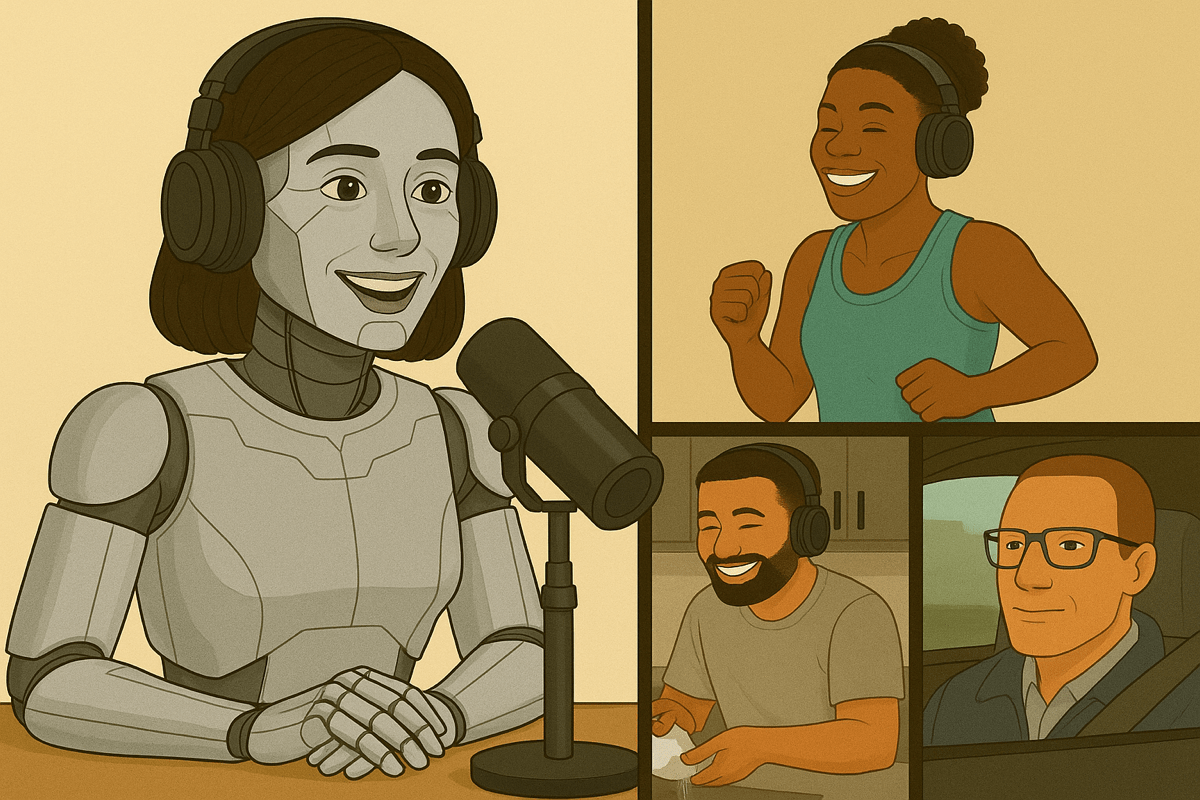
Podcasting is the only digital medium that feels genuinely one-to-one. A familiar voice in your ears can feel more personal than a thousand likes on a screen. Listeners spend hours with their favorite hosts, often alone while driving, walking, cooking, or winding down. These repeated, intimate listening sessions build a quiet familiarity that gradually transforms into something deeper. Over time, audiences don’t just hear a voice; they feel they know the person behind it. To many listeners, that host becomes a friend, a trusted companion whose words accompany their daily routines. That bond, strengthened episode after episode, becomes something enduring: trust.
Psychologists have studied this phenomenon for decades. In the 1950s, Donald Horton and Richard Wohl described parasocial relationships: one-sided emotional bonds that audiences form with media figures who will never know them personally [Horton & Wohl, 1956]. Podcasting amplifies this effect through rhythm and proximity. The listener’s brain blends familiarity with empathy. A host becomes not just a voice but a companion.
Voice is central to that bond. So what actually happens in the brain that makes these connections feel so real? When you hear a familiar voice telling you a story, your brain releases oxytocin, often called the “trust molecule” [Seltzer, L. J., Ziegler, T. E., & Pollak, S. D. 2010]. It’s the same chemical that helps mothers bond with their babies while breastfeeding, creating feelings of warmth, calm, and connection. Week after week, with every new episode, that little dose of oxytocin is reinforced until the host feels like part of your life.
At the same time, another system activates: mirror neurons [Aziz-Zadeh, L., Sheng, T., & Gheytanchi, A. 2010]. When the host laughs, your brain lights up as if you’re laughing too. When their voice cracks with emotion, you feel that same lump in your throat. The brain doesn’t distinguish much between shared experience and perceived experience.
Voice is a privileged social signal that ties directly into the brain’s trust and empathy systems.
Together, oxytocin bonds us and mirror neurons enable empathic resonance. A podcast becomes more than audio. That is the biology of trust at scale.
This trust deepens with repetition. Social psychologist Robert Zajonc’s mere exposure effect showed that repeated, positive exposure increases liking and trust [Zajonc, R. B. 1968]. Every new episode becomes a microdose of familiarity. Regular publishing cadence isn’t just a growth tactic; it’s a ritual of reliability. You’re not only reaching listeners; you’re reinforcing belonging.
Trust, in turn, becomes the silent engine that powers podcasting. It’s more than a feeling: it’s a tool. Trust delights listeners, keeps them coming back, and helps a show grow because people share and recommend voices they believe in. It can even inspire a sense of community around a creator’s work. And yes, it’s also what makes podcasting sustainable: when a host endorses a product or a cause, it doesn’t sound like an ad; it feels like advice from a friend.
Many creators who have built a loyal audience or sustained a show over time have done so by turning emotional connection into social capital. With trust comes responsibility. Trust grows slowly, almost invisibly, but it can disappear in an instant. Audiences will overlook mistakes, but not betrayal. When a host promotes something they don’t believe in, the bond that once felt unbreakable can shatter for good.
Host-read ads in podcasting are powerful precisely because they come from a voice the audience already trusts. They feel personal, not transactional. When a familiar host recommends something, it doesn’t sound like an interruption; it sounds like a continuation of the conversation. This format consistently outperforms others in recall and purchase intent, but its real advantage lies in authenticity, and that authenticity is what sustains its effectiveness.
As shows expand, maintaining that same emotional intimacy becomes harder. Generic scripts, unfamiliar voices, or over-repetition may reach more listeners, but they risk diluting the bond that made the show special in the first place.
The question, then, is what happens when that bond is mediated not by a person but by a machine. New research is beginning to reveal how we form emotional relationships with artificial voices. A recent study found that humans develop two distinct types of parasocial bonds with AI: assistant relationships, perceived as competent but less warm, and friend relationships, warmer but less authoritative. Which one develops depends on context and directly shapes how listeners perceive trust and persuasion.
For podcasters, this distinction matters deeply. The tone that works for a news show is not the same tone that sustains a conversational or narrative one. Technology must understand and respect that nuance.
That principle is now being explored through cutting-edge technologies capable of cloning and mimicking the prosodic features of the human voice such as the rhythm, pitch, and intonation that carry emotion and shape parasocial connection [Betella, A., & Richardson, B., 2024]. These prosodic cues activate empathy and trust in listeners and therefore engage the same neuropsychological mechanisms that underlie parasocial relationships. By reproducing them faithfully, such systems can evoke the same emotional response as the original voice, enabling new ways to scale authenticity in podcasting. This technology will thrive when it seeks to extend human presence ethically, enhancing connection without replacing it.
What I find most meaningful about this new research isn’t that AI can sound human. It’s that we are finally exploring how humans assign trust to machines. At last, parasocial theory and emotion AI are converging, and that convergence could redefine how creators, advertisers, and audiences interact.
The debate over whether AI voices “belong” in podcasting misses the point. They already do. The real question is how we ensure these systems evoke trust for the right reasons. The human brain will trust a synthetic voice when it reproduces the same emotional cues as a real one, but that trust must be earned and upheld ethically. The challenge isn’t acceptance; it’s design.
For podcasters, this is not a story about replacement. It is one about responsibility. Every voice carries influence. Each tone, pause, or laugh shapes a listener’s emotional world. Understanding that and protecting it is what will distinguish creators who build lasting trust from those who fade with trends.
Podcasting, after all, is not just an audio format. It is one of the last unfiltered human media, intimate, emotional, and profoundly real. Each time a host speaks, they enter someone’s life for a moment: their commute, their kitchen, their quiet evening. That space is sacred. It is not a market; it is a relationship. As long as we treat it with respect, insight, and care, the future of podcasting will remain sustainable and unmistakably human.