A lot of podcasters ignore LinkedIn. Perhaps you can relate.
Maybe you focus only on audio platforms and Instagram clips. But, could you be missing the single most powerful place to build authority with your target audience?
LinkedIn has more than a billion professionals who come to the platform specifically to learn and grow.
According to Hootuiste, the engagement rate on LinkedIn posts averages 3.7%. instagram ‘s is 3.4% and X and Facebook tie for 1.7%.
Just by being in a niche, your podcast content likely fits the professional context people expect on LinkedIn.
The strategy top podcasters are using? Turn each episode into a LinkedIn article, or (at the very least) a solid post. It’s simpler than you think!
Why LinkedIn Matters for Podcasters
LinkedIn users aren’t there for entertainment. They’re there during work hours, seeking knowledge and practical solutions.
If you’re doing it right, that’s exactly what your podcast offers.
Think about it: professionals scroll Instagram for fun and distraction.
They go to LinkedIn for ideas they can use immediately.
Is your latest episode about productivity hacks, leadership strategies, or industry trends? That’s LinkedIn gold.
When you publish articles and posts on LinkedIn, you’re doing much more than just reaching your network. You’re also creating searchable, discoverable content that works for you long after you hit publish.
Plus, the algorithm still favors organic reach. And, LinkedIn rewards good content with genuine, organic distribution.
The LinkedIn Strategy: What Top Podcasters Are Doing
Smart podcasters have figured out a simple system. They take their best episodes and transform them into LinkedIn articles and posts.
Articles can add value and context. They’re not just word for word transcripts
This doubles your content’s reach and lifespan. The episode exists in audio form. The article exists in text form. Two formats, two audiences, one source of content.
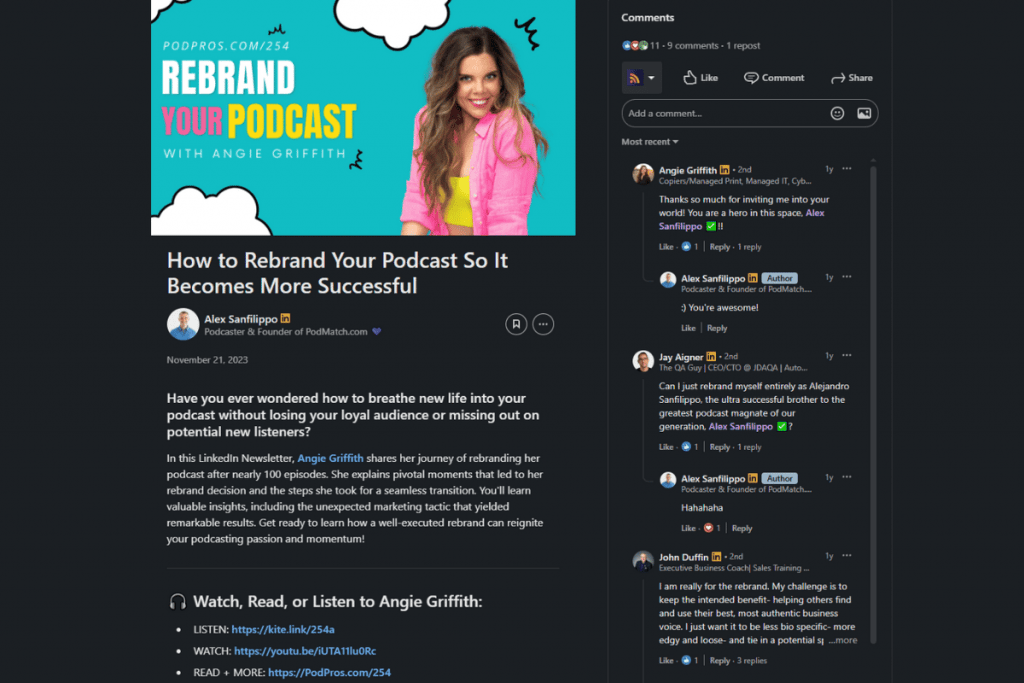
Podcaster and consultant Alex Sanfalippo of PodMatch publishes a LinkedIn article for every single episode of his show.
The result? His visibility skyrocketed. His downloads increased. His authority in the podcasting space became undeniable.
Here’s an example of one of Alex’s LinkedIn articles:
Here’s why this works: when someone discovers your LinkedIn article, reads it, and finds value, they see you as an expert.
Then they notice you have a podcast and subscribe.
That subscriber becomes a loyal listener who eventually might hire you, buy from you, or recommend you.
It’s an authority loop:
Your article builds credibility.
Credibility drives podcast listeners
Listeners become advocates.
Wash, rinse, repeat.
Step 1: Choose the Right Episodes to Transform
You might not want to try to turn every episode into an article or LinkedIn post.
Unless you have a team, or at least a dedicated VA, that’s a fast track to burnout.
Start with your best-performing episodes. Check your podcast analytics to see which episodes got the most downloads, longest listening time, or most shares. Those are your winners.
Focus on evergreen topics in your niche.
An episode about “2023 trends” loses value quickly. However, an episode about “how to handle difficult conversations at work” stays relevant for years.
Look for episodes with actionable insights.
LinkedIn users want to learn something they can apply today. Theory is fine, but practical steps win.
Episodes featuring interviews with experts work particularly well. You can highlight their insights, tag them in the article (with permission), and benefit from their network seeing your content.
Here’s the key: don’t just summarize. Add unique value.
Share what you learned after recording. Update the information with new examples. Give readers a reason to both read the article AND listen to the full episode.
Step 2: Structure Your LinkedIn Articles and Posts for Maximum Impact
Both articles and posts needs a specific structure to perform well on LinkedIn.
Here’s the winning formula:
- Opening Hook
- The Problem
- Key Insights
- Practical Application
- Episode Link, and
- Visual Elements
Opening Hook
Start with a question or compelling statement that makes people stop scrolling.
For example, “Most leaders avoid this conversation until it’s too late” works better than “In this episode, we discussed leadership.”
The Problem
What challenge does your episode address? State it clearly. Your readers need to see themselves in the problem you’re solving.
Key Insights
Share 3 to 5 main takeaways from the episode. Use your own words, not direct quotes. Add your perspective. This is where you demonstrate your expertise.
Practical Application
Give readers actionable steps. LinkedIn users want to know: what do I do with this information? Make it concrete and specific.
Episode Link
Include a clear call to action. “Listen to the full episode for more strategies” with a link to your show. RSS.com makes it easy to get a direct link to your episodes that you can share anywhere.
Visual Elements
LinkedIn favors multi-image posts, and they get a higher engagement rate. Add images, embedded video clips, or audiograms to make your article more engaging. Break up text with visuals.
We recommend you keep paragraphs short too. Think two to three sentences maximum.
Most LinkedIn users read on mobile devices. Long blocks of text kill readership.
Use subheadings liberally. They help people scan your article and find the parts most relevant to them.
A fabulous example that includes all of the winning elements of a stellar LinkedIn post can be found on Steven Barlett’s LinkedIn page. He recently shared a post complete with teaser video promoting an episode of his podcast featuring “Atomic Habits” author, James Clear:
Then, in the first comment, you can find the link to the full episode. But, he also shares on the last frame of his video the name of his podcast and where to find it.
Step 3: Optimize Your Posts and Articles for Discovery
Your brilliant article or post won’t matter if no one sees it. Optimization isn’t optional.
Headlines/Opening Statements That Work
- Use numbers: “5 Ways to…” or “The 3 Mistakes That…”
- Use how-to format: “How to Build…”
- Use questions: “Are You Making This Error?”
Test different formats to see what resonates with your audience.
Keywords Matter
Include your niche keywords naturally in the first paragraph. If you podcast about content marketing, those words should appear early.
Don’t stuff keywords. Write naturally and include them where they make sense.
Hashtags
Use 3 to 5 relevant hashtags at the end of your article. Not at the beginning.
LinkedIn’s algorithm doesn’t prioritize hashtags like Instagram does, but they still help with discovery. Choose specific hashtags over generic ones.
For example, #PodcastMarketing beats #Marketing.
Strategic Tagging
Mention guests with their permission. Tag relevant connections who might find the content valuable.
Don’t overdo it. Three to five tags maximum. More than that looks spammy.
Timing
Post when your audience is most active.
Sprout Social says these are the optimal times:
- Monday at 11 a.m. until noon
- Tuesday at 8 a.m. until 2 p.m.
- Wednesday and Thursday at 8 a.m. until noon
- Friday at 7 a.m. until 2 p.m.
- Saturday at 7 a.m. until 10 a.m., and
- Sunday from 6 a.m. until 8 a.m.
But test your own audience. Your LinkedIn Analytics will show when your connections are online.
Write a Compelling Preview
When you share an article to your feed, write a short preview post (not just “new article”). Give people a reason to click. Ask a question. Share a surprising stat. Create curiosity.
For this you technically don’t even need to go full out with writing an article!
Podcast pro Joel Oliver who recently co-hosted one of our podcasting masterclasses creates a simple post featuring a video with a caption to hook a potential listener. Then, he simply adds a link to the episode.
Here’s an example of one of Joel’s posts:
Engage Fast
It’s best to respond to comments within the first hour. LinkedIn’s algorithm rewards early engagement.
The more interaction your post gets quickly, the more the algorithm shows it to others.
We recommend you set aside 15 minutes after posting to reply to comments.
Step 4: Engage and Build Community
Publishing articles and posts on LinkedIn is just the beginning. Building authority requires conversation.
Respond to every comment, even simple ones.
A “Thanks for reading!” response shows you’re present and engaged.
Ask questions at the end of your articles to spark discussion.
Things like “Have you tried this approach?” or “What worked for you?” gives people a reason to comment.
Share behind-the-scenes insights in the comments too.
Let’s say someone asks about your recording setup. Answer in detail. People appreciate the access.
Use article feedback to inform future podcast episodes. If three people ask about the same topic in comments, there’s your next episode idea.
Pro Tip: Connect with engaged commenters.
If someone leaves thoughtful comments on multiple articles/posts, send them a connection request with a personalized note. Building your network strategically matters more than chasing connection numbers.
Join relevant LinkedIn groups and share your articles/posts following group rules.
Some groups prohibit self-promotion, but others welcome valuable content.
Read the rules first.
Cross-promote everywhere.
Mention your LinkedIn presence in your podcast episodes.
“Connect with me on LinkedIn where I share more behind the scenes of every episode.”
Give people multiple ways to engage with your content.
Also check out our video How to Promote Your Podcast on Social Media and Attract New Listeners!
Keep It Simple and Sustainable
LinkedIn success comes down to showing up consistently without burning out.
As you begin building authority on LinkedIn as a podcaster, be sure to avoid these two big mistakes:
- Skip the “New episode out now!” posts with no context. Lead with value, not promotion.
- Don’t copy-paste your show notes or ignore comments. LinkedIn rewards authentic engagement, not broadcasting. Add your unique perspective to everything you share. People connect with people, not robots.
Create a Realistic System
Turn episode creation into a simple workflow.
After recording, extract key points while they’re fresh, draft your article/post outline, and finish it later.
The whole process takes 30 to 45 minutes once you have a system.
Batch your work when you’re inspired.
Record three episodes? Write three article outlines immediately.
One article can become multiple posts throughout the week: quote graphics, short-form posts, polls, or videos. Use AI tools to brainstorm, but keep your voice front and center.
Start with one article per month. Scale to twice monthly, then weekly.
Use LinkedIn Analytics to track what resonates and double down on what works.
We challenge you to pick one episode this week and turn it into an article. Don’t aim for perfect and polished pieces though. Aim for published.
Just remember that you don’t need to be everywhere.
You need to be where your audience spends time. And for many professionals and decision-makers, that’s LinkedIn.
The podcasters building authority right now aren’t doing anything complicated. They’re showing up consistently, adding value, and trusting the process.
Your expertise deserves a professional platform. Your future clients, collaborators, and biggest fans are waiting to discover you.
Ready to grow your podcast? RSS.com provides everything you need to start, distribute, and promote your show. From analytics to automatic distribution, promotion tools to public podcast websites, we make podcasting simple.