
VOSS - Discover more from UC experts

VOSS - Discover more from UC experts

by VOSS Solutions
Season 4
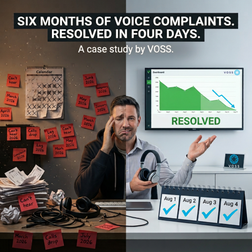
Six months of voice complaints. Resolved in four days.

AI
A managed services firm faced six months of intermittent Microsoft Teams voice quality issues across twelve regions. Despite various teams checking individual dashboards and policies, the root cause remained undiscovered. By deploying VOSS NetFlow, the organization identified that Teams media traffic was hitting capacity thresholds on VPN concentrators during specific peak windows. This end-to-end visibility allowed the network team to implement capacity adjustments and media bypass, resolving the issue in just four days. Hear how VOSS NetFlow provides cross-domain visibility across the entire traffic path to solve complex, intermittent problems that reside in the gaps between departmental tools.
Connecting the fabric - How APAC organisations are wiring VOSS into ServiceNow
AI
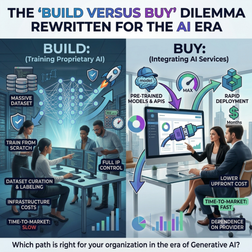
Brett Johnson, General Manager at VOSS Solutions for ANZ, discusses the critical importance of integration between communication platforms and IT service management systems, specifically ServiceNow, within the APAC region. He argues that as AI agents move into production, integration serves as a necessary governance layer to ensure autonomous actions are recorded via tickets, audit trails, and change records. The presentation highlights how VOSS utilizes the Model Context Protocol (MCP) to provide a standardized way for AI agents to interact with ITSM platforms, facilitating bidirectional ticket sync and CMDB alignment. Johnson concludes with strategic advice for IT leaders, including auditing tool overlap, separating human-approval workflows from autonomous ones, and prioritizing vendors that support open standards.
Why AI needs an automation fabric, not another script
AI
Mike Frayne, CEO of VOSS Solutions, discusses the critical distinction between AI-generated code and the domain expertise required for enterprise-grade automation. He argues that while AI can lower the cost of code, it cannot replace the judgment needed to know what to build or how to manage complex operational realities. Frayne warns against 'vibe coded' solutions—fragmented, disconnected scripts and unmanaged AI agents—which lead to technical debt, security gaps, and operational sprawl. He positions the VOSS automation fabric as an intelligence layer that provides the necessary governance, compliance, and domain-specific knowledge to connect AI orchestrators with enterprise systems. The blogcast concludes by emphasizing that successful AI transformation requires combining innovation with operational maturity and a trusted framework that learns from accumulated operational intelligence.
Your migration completed. But did anyone actually move?
AI
Discussing the critical distinction between technical deployment and organizational adoption in enterprise unified communications. Using a case study of a multinational organization that rolled out Microsoft Teams to 18,000 users, Jamie Litherland, VP of Business Development, VOSS, explains how standard deployment metrics failed to prove ROI to leadership. By implementing VOSS UC analytics, the organization moved beyond infrastructure health, to monitor behavioral patterns identifying specific business units with low engagement. This data allowed for a targeted re-engagement program rather than a costly full re-rollout, resulting in material adoption improvements within ten weeks, and that adoption should be treated as an ongoing operational discipline rather than a one-time project phase.
AI readiness isn't about the AI. It's about everything underneath it

AI
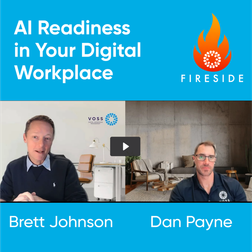
In the first episode of a new LinkedIn Fireside Chat series, Brett Johnson, General Manager at VOSS Solutions for ANZ, interviews CTO Dan Payne regarding AI readiness. The discussion emphasizes that true readiness depends on operational foundations rather than specific AI tools. Key pillars for success include understanding business processes, implementing modern tooling with API and MCP support, ensuring structured and accurate data, and defining measurable outcomes. The conversation also addresses challenges faced by lean IT teams, such as fragmented hybrid environments and inconsistent data, and suggests that organizations should focus on auditing workflows and data quality to build an effective orchestration layer.
Why DEM Belongs Inside Your UC Management Stack

AI
Derek Smith, Product Manager at VOSS, explains why Digital Experience Monitoring (DEM) should be integrated natively into UC management platforms rather than used as a standalone tool. He argues that VOSS's unified approach provides contextual alerts, streamlined root cause analysis, and single-workflow remediation by combining experience data with automation, provisioning, and analytics in one platform. Smith contrasts this with bolt-on solutions that require separate tools and specialists, sharing a case study of a public sector organization that reduced Mean Time To Resolution (MTTR), by consolidating monitoring and automation into a single management platform. He concludes by encouraging viewers to consider how alerts lead to action when evaluating DEM solutions.
August 2nd: The AI Act deadline your agents probably aren't ready for

AI
What are the critical implications of the EU AI Act's Article 50, which takes effect on August 2, 2026? Unlike high-risk AI obligations that were postponed, Article 50 remains on its original timeline, imposing transparency requirements on conversational AI, generative AI, emotion recognition, and deepfakes. The presentation highlights the risk enterprises face due to unmanaged AI agents and the inability to provide auditable evidence of disclosure. Introducing VOSS AI Agent Management as a solution, for creating a vendor-neutral inventory, and enforcing consistent governance controls across an organization's AI estate.
Are your people using the tools you've given them?

AI
Jamie Litherland from VOSS presents how their UC Analytics platform helps large enterprises optimize Microsoft 365 investments by providing detailed visibility into actual usage patterns. Through a case study of a 28,000-user organization, he demonstrates how the platform identified over 4,000 inactive accounts and 2,200 over-provisioned users, revealing adoption gaps and misaligned licensing. The solution provides department-level segmentation that enables IT and HR leaders to make evidence-based decisions about tooling, training, and organizational design. Rather than periodic audits, VOSS enables continuous monitoring through automated quarterly reviews, transforming IT leadership's relationship with the business by providing ongoing workforce insights that inform strategic decisions about digital workplace optimization.
Proactive Microsoft license management: From visibility to control
AI
Presenting a comprehensive approach to Microsoft license management, addressing the challenges organizations face in managing their Microsoft 365 environments. Tim Jalland, explains how traditional licensing approaches fail in dynamic cloud environments, leading to hidden costs, inactive spending, and governance gaps. The presentation outlines a five-step methodology for shifting from reactive to proactive license management: establishing full visibility, connecting usage to cost, actively recovering spend, strengthening governance, and building operational discipline. The VOSS platform provides comprehensive visibility, automation, and governance for Microsoft licensing through a single interface with advanced analytics, real-time dashboards, and role-based access control to help organizations optimize their license allocation and manage costs proactively.
What’s new in VOSS Meeting Room Management
AI
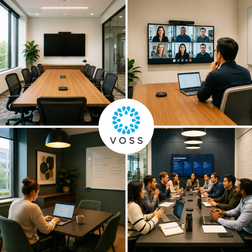
Keith Bareham from VOSS presents new meeting room management capabilities that help organizations optimize their hybrid workplace investments. He explains how meeting rooms are critical spaces for collaboration but are often underutilized, overbooked, or improperly sized. VOSS's solution goes beyond basic device monitoring to provide analytics-driven insights into room utilization, occupancy patterns, booking behavior, and no-show analysis. The platform offers customizable dashboards that help IT, workplace, and facilities teams identify underperforming spaces, optimize real estate usage, and improve collaboration experiences. Key features include multi-vendor environment support, capacity planning optimization, proactive monitoring, and AI-driven insights. The presentation emphasizes how analytics visibility is essential for maximizing meeting room investments and delivering better hybrid work experiences.
1 of 5