MICROCOLLEGE:  The Thoreau College Podcast

MICROCOLLEGE: The Thoreau College Podcast

by Thoreau College
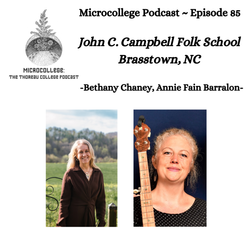
John C. Campbell Folk School - Bethany Chaney and Annie Fain Barralon
In this episode we learn about the John C. Campbell Folk School, located in Brasstown, North Carolina. Founded just over 100 years ago in 1925, the John C. Campbell Folk School was inspired by the Danish Grundtvigian folk high school tradition and established to serve the culturally distinctive, but economically depressed mountainous region of southern Appalachia. Today, it is one of the oldest and largest folk schools in North America and the guiding inspiration for dozens of younger folk schools around the country, including the Driftless Folk School here in Viroqua, Wisconsin. In this conversation I speak with JCCFS instructor and Programming Development Manager Annie Fain Barralon and Executive Director Bethany Chaney about this inspiring history and about what it is like to participate in a multi-day course in folk arts, craft, music, or dance on their beautiful campus in far western North Carolina. We talk about who attends and teaches these courses, as well as about opportunities for young people to spend longer periods at the Folk School such as their Work Study and Student Host programs (see links below). Finally, Annie Fain talks about what it is like to work as a creative artist in the context of a living folk arts tradition, walking the fine line between original innovation, cultural exchange, and loyalty to heritage. Annie Fain Barralon is a native of the crafts and music/dance community of Brasstown, North Carolina and the John C. Campbell Folk School's Programming Development Manager. She teaches a variety of classes at the school including book arts, clawhammer banjo, and several styles of dance–Appalachian clogging/flatfooting, English waltz clog, Northwest Morris, and Bal Folk (learned when she married into a French family). Annie Fain plays banjo and banjo uke for the all-woman string band, Blue Eyed Girl, and has danced with both Loafers Glory Clog Morris and the Green Grass Cloggers. She sells her handmade books, greeting cards, and original watercolors regionally and is a member of the Southern Highland Craft Guild. Bethany Chaney is Executive Director of the John C. Campbell Folk School. Prior to joining the Folk School, Bethany served more than 25 years in a variety of non-profit and public service roles, specializing in resource development, strategic planning, and community and economic development programming. She is an award-winning writer, a former NC Arts Council Fellow, and an avid maker of pine needle baskets, a craft she first nurtured as a Folk School student. In 2025 she was named by Country Living Magazine as a Top 100 Design Influencer as an arts advocate. John C. Campbell Folk School - https://www.folkschool.org/ JCCFS Work Study & Student Host Programs - https://www.folkschool.org/programs/student-host-and-work-study/ Find a Folk School near you! Folk School Alliance - https://www.folkschoolalliance.org/ Driftless Folk School - http://www.driftlessfolkschool.org/ Thoreau College - http://thoreaucollege.org/
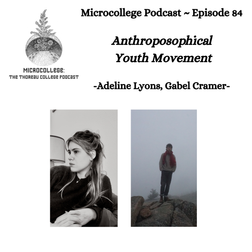
Anthroposophical Youth Movement - Adeline Lyons and Gabel Cramer
On this episode of the podcast we speak with Thoreau College alumna Adeline Lyons and her collaborator Gabel Cramer about the diverse activities of the Youth Section of the Anthroposophical Society in North America, including the upcoming Youth Conference to be held August 3-7, 2026 in Fair Oaks California with theme "Courage: From Initiative to Idea to Initiative." We also discuss other conferences and gatherings organized by the Youth Section and Futuring Now, their journal of essays, poetry, and artwork published in hard copy thrice yearly (please subscribe!). We also discuss Gabel and Adeline's life and work at Free Columbia (Philmont, NY) and the Threefold Youth CoLab (Chestnut Ridge, NY), two anthroposophical artistic and life sharing organizations in New York State that have appeared previously on the podcast. Join us for a refreshing conversation with two visionary young people taking the lead on curating spaces for deep conversation and creative work around questions of vocation, meaning, spirituality, and the deep work we are called to do in our time. Adeline Lyons lives and works in the Threefold Community outside of New York City. She is involved as community organizer and event planner, a coworker of the North American Youth Section, editor, writer, and stage artist. She received a degree in Creative Writing from UW-Madison, and is also an alumna of Thoreau College! She keeps a Substack: @writingaworld Gabel Cramer is the director of development at Free Columbia, a community arts initiative that weaves together creativity, artistic practice, accessibility, and education. Along with this, he is an organizing member of the North American Youth Section, helping to run the finances, put on conferences, and collaborate with other passionate young people. He is sometimes a musician, sometimes a potter and sculptor, and often busy cooking, growing plants, and undertaking fun projects. After getting a master’s degree in community development and planning, he has found great meaning in his work in the intersection of community, art, youth, education, and spirit, though often wondering how to bring it all into balance in his own life. For North American Youth Section: nayouthsection.org For Futuring Now: https://www.nayouthsection.org/initiatives-1/futuring-now For Courage conference: nayouthsection.org/courage To support the Courage conference: nayouthsection.org/donate Threefold Youth CoLab: threefold.org/youth Free Columbia Residency Program: https://www.freecolumbia.org/residency-program
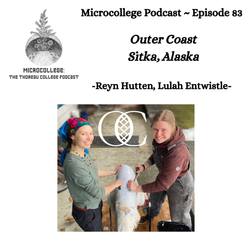
Reyn Hutten, Lulah Entwistle - Outer Coast, Sitka, Alaska
On this episode of the Microcollege Podcast we return for an update from one of the most inspiring success stories of the emerging microcollege movement. Rooted in the beautiful island community of Sitka, Alaska among the fjords and temperate rainforest of the southeastern panhandle of Alaska, Outer Coast is inspired by Deep Springs College and nourished by the unique cultural heritage of the Tlingit people of that region. Since 2015, Outer Coast has been developing as a peer and fellow traveler of Thoreau College, and now has launched a full 2-year undergraduate program granting academic credits through the University of Alaska Southeast suitable for an Associates Degree or transfer to a 4 year school. Join me as I speak with Outreach Lead Reyn Hutten and pioneer 2nd Year student Lulah Entwistle about entering higher education after growing up in a rural place, about the role of service learning in the context of tight knit local community, about the value of robust student self-governance, and about the impact of incorporating indigenous languages, storytelling, and culture into a full microcollege curriculum. Reyn Hutten is the Outreach Lead and periodic Summer Seminar Program Director at Outer Coast and has been in Sitka at Outer Coast for nearly 3 years. Hailing from the small island community of Wrangell, AK, Reyn is a long-time believer in (and beneficiary of) holistic, community-based, in-situ learning in southeast Alaska. She has focused on community building and education from many angles, including through her B.A. in ecology with a focus on the Arctic at Dartmouth College, as a field program coordinator, and as a ski and sea kayak coach. Reyn finds vibrance in many of life’s little moments but especially when moving her body outside, cooking, tinkering and connecting with people. Lulah Entwistle grew up homeschooled on a biodynamic farm in Middle Tennessee, where her family grew food to sustain themselves and ran a small CSA. When she is home, Lulah likes to ride her horses, play with the goats, and help on the farm. She is currently studying at Outer Coast and is in the process of finding a place to go next. For the past two years she has been walking around Sitka, listening to music and watching the mountains.
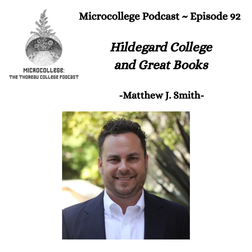
Antón Barba-Kay - Microcollege Education Against Digital Dehumanization
In this episode of the podcast, I spoke with Antón Barba-Kay, a philosopher and scholar whose life includes time as a student at St. John's College and as a professor at Deep Springs College. As a scholar, Antón has focused on exploring how the internet and digital technology in general have come to shape our inner lives and our experiences of reality. Rooted in classical and German philosophy, Dr. Barba-Kay engages with questions of aesthetics and interior formation as he articulates a view of digital technology as a "natural technology" - i.e. "a technology so intuitive as to conceal the extent to which it transforms our attention" and our sense of self. This has obvious implications for the design and practice of education, which Dr. Barba-Kay is uniquely placed to explore. Antón Barba-Kay is a fellow at the Carr-Ryan Center at the Harvard Kennedy School, a senior fellow at the Institute for Practical Ethics at UC San Diego, and a distinguished fellow at the Center on Privacy & Technology at Georgetown Law. He received a B.A. from St. John’s College, a B.A. in classics from Cambridge University, and a PhD from the Committee on Social Thought at the University of Chicago; he has been (tenured) Associate Professor of Philosophy at Catholic University and taught at Deep Springs from 2020-24 (two of those years as Robert B. Aird Chair of Humanities). In addition to his scholarly publications in nineteenth-century German philosophy, his essays about culture and technology have appeared in The New Republic, The Atlantic, The New Atlantis, Dissent , The Hedgehog Review, and The Point, among other magazines. A Web of Our Own Making: The Nature of Digital Formation –his book about what the internet is and what a difference it makes–was published in 2023 by Cambridge University Press. A Web of Our Own Making: The Nature of Digital Formation - https://www.cambridge.org/core/books/web-of-our-own-making/92F7F830EBEC409F05A526E64DDD1D9D Deep Springs College: https://www.deepsprings.edu/ St. John's College: https://www.sjc.edu/
Troy Vine - Masters in Transformative Learning, Ruskin Mill Centre, United Kingdom
On this episode we chat with Dr. Troy Vine with the Ruskin Mill Centre for Practice in the United Kingdom about a new Master of Arts program in Transformative Learning that will be launching this fall, offering a unique opportunity to explore the contemplative model of science pioneered by Johann Wolfgang von Goethe and practiced by Henry David Thoreau, Rudolf Steiner, and other out-of-the-box thinkers. Not only is this a different, more holistic way of doing science - it is also a pathway to inner transformation. After gaining a doctorate in particle physics from University College London, Dr. Troy Vine became interested in Goethe’s theory of colour. Studying with leading authorities on the topic, he has published extensively on Goethe’s colour science, both as writer and as editor. With artist Nora Löbe and physicist Matthias Rang he wrote the book Seeing Colour: A Journey Through Goethe’s World of Colour, published by Floris Books in 2022. Troy is in the final stages of a second doctorate, this time in philosophy, at the Humboldt University of Berlin, with a thesis focusing on the history and philosophy of Goethe’s colour science. Troy has taught Goethean colour science and the history and philosophy of holistic science more generally for over two decades, including at Schumacher College, where he was programme lead for MSc Holistic Science. Troy has recently drawn on this experience to design a MA programme in Transformative Learning for the Ruskin Mill Centre of Practice, that will begin this coming autumn. MA in Transformative Learning - https://rmcp.org.uk/ma-in-transformative-learning/ Seeing Colour: A Journey Through Goethe's World of Colour: https://www.florisbooks.co.uk/blog/2024/02/19/seeing-colour-a-journey-through-goethes-world-of-colour/ Thoreau College: https://thoreaucollege.org/
A Public Affair w/ Douglas Haynes on 89.9 WORT FM -- The State of the Microcollege Movement
This is the 80th episode of the Microcollege podcast! To celebrate this milestone, we would like to do something a little different. For this episode we will be sharing an interview that took place live on WORT 89.9 FM, Madison, Wisconsin’s community radio station. On February 2, Douglas Haynes, host of the WORT show “A Public Affair," interviewed me and Grace Greenwald of the Springboard Foundation about the state of the microcollege movement, including the origins and development of Thoreau College. Douglas was a great interviewer and this conversation serves as a reintroduction for myself and Thoreau College, as well as a status update on how things have changed in the past 3 and a half years, since the Microcollege podcast started on Henry David Thoreau’s birthday in July 2022. This podcast has proven to be an fun and amazingly effective way to explore, articulate, and promote this emergent model of education and the people and organizations who are making it happen. I have made connections with people and ideas that have informed my practice as an educator and organizational leader. The podcast has helped Thoreau College connect with new students, instructors, funders, and collaborators and has contributed to the formation of networks and gatherings of allied organizations, scholars, and educators, such as the International Folkmode for Educators in Denmark in 2025 and the now annual summits of the Nunnian Consortium, most recently here in Wisconsin in January 2026. Most exciting of all, I have increasingly begun to hear from ambitious educators and dreamers who tell me that the stories and examples shared on the Microcollege podcast are helping to inspire and inform their own plans to establish new holistic, humanly scaled educational programs on the microcollege model at locations around the world. This is so exciting and it makes this work seem ever more important and timely. In the past three and half years the sense of crisis in higher education and beyond has accelerated and deepened. Many legacy liberal arts colleges and smaller public campuses have closed, merged, or dramatically restructured during this time and the rapid emergence of Artificial Intelligence and other powerful digital technologies have cast many aspects of education, culture, and life in general into disarray. I feel so grateful to have this outlet as a platform for thinking about these complex times alongside creative and inspiring people who are crafting ambitious and original responses. Thank you to everyone who has been listening to these conversations - and also thank you to Liam McGilligan, the faithful producer of this show. To mark this 80th episode, please take a moment to leave a comment on the platform you use to listen to the show or send an email to me at admin@thoreaucollege.org to say what you appreciate about the show and/or what you would like to hear more about. That would be so exciting and inspiring for us! WORT FM: https://www.wortfm.org/ Springboard Foundation: https://www.springboardlife.org/ Thoreau College: https://www.thoreaucollege.org/
Matt Voz & Shawn Lavoie - Youth Initiative High School
In this episode I speak with Matt Voz and Shawn Lavoie, two leaders of the Youth Initiative High School, one of the key local partners of Thoreau College here in Viroqua, Wisconsin. This is a special conversation, as I participated in the founding of YIHS in 1996 when I was a teenager and subsequently returned to teach there for over 15 years alongside Matt and Shawn as we learned how to be teachers and build community together. Today, 30 years after it began, YIHS remains an unique and exemplary school and has served as a key influence on the development of Thoreau College. Founded as a Waldorf-inspired initiative, YIHS has remained connected with this global educational movement while taking the curriculum in distinct and innovative directions. YIHS students actively collaborate with faculty and parents as full citizens and stakeholders to staff committees and make decisions, to fund and represent the school to the public, and to clean and maintain the school. YIHS has also crafted a way to survive and thrive as an independent school in a small rural community while offering a dynamic and broad curriculum by welcoming a large number of part time teachers, supported by an experienced core staff. The school has also developed a profound expeditionary learning curriculum to support the cultivation of character and wisdom in the context of community. Matt Voz is the Administrator of the Youth Initiative High School, as well as a teacher of humanities, automechanics, and physical education and one of the house parents of the YIHS Boarding House. Hailing from western Minnesota, Matt holds a BA in History from the University of Minnesota-Morris and a MA in Agrarian History from Iowa State. Shawn Lavoie is the YIHS Faculty Chair, as well as a teacher of humanities, Spanish, and circus arts. He grew up in Massachusetts and received a BA in Anthropology from the University of Chicago and an MA in Arts Education from the Harvard Graduate School of Education. Today, Shawn also teaches aspiring and practicing Waldorf high school teachers through the Great Lakes Waldorf Institute. Youth Initiative High School - www.yihs.net Great Lakes Waldorf Institute - https://www.greatlakeswaldorf.org/ Kaleidoscope - the YIHS Podcast - https://www.wdrt.org/kaleidoscope/ Thoreau College - https://thoreaucollege.org/
Esther Crotser, Livian Roth-Amodt - Education for Solidarity and Resilience
In this episode of the podcast we dip our toes into the turbulent waters of current events in a conversation with Esther Crotser and Livian Roth-Amodt, two former students of mine and recent graduates of the Youth Initiative High School, our partner Waldorf-inspired high school here in Viroqua, Wisconsin. Since graduating in 2024 from YIHS, where students play a major role in governing, funding, and promoting the school, Esther and Livian have been living in the Twin Cities of Minneapolis/St Paul. For the past year they have been involved with a variety of political and social causes, including work with the Minnesota Immigrants Rights Action Committee (MIRAC). Since the start of 2026, Esther and Livian and the groups they are working with found themselves on the main stage of contemporary history as the eyes of the country and the world turned to Minneapolis as a result of the ICE enforcement surge and subsequent violence and unrest in that city. In our conversation, we talk about the work they have been doing and how their education at Youth Initiative prepared them to be able to respond constructively and resiliently and to take on leadership roles in this complex environment as engaged and passionate youth leaders. Towards the end we also discuss the Singing Resistance Movement, which is introducing Community Singing to the protests in Minneapolis as a tool of solidarity building and psychic resilience. Youth Initiative High School - https://www.yihs.net/ Minnesota Immigrant Rights Action Committee - https://www.miracmn.com/ GoFundMe for Janet (Esther's friend who was detained and then released by ICE) - https://gofund.me/dfd163256 Singing Resistance Songbook - https://docs.proton.me/doc?mode=open-url&token=407BQZDEPG#3JsVHndYmmhy Singing Resistance on CNN - Anderson Cooper 360 - https://www.facebook.com/reel/1264918162211154 Thoreau College - https://thoreaucollege.org/
Kristen Case - The Monson Seminar and Henry David Thoreau's Kalendar
On this episode we talk with Dr. Kristen Case about Henry David Thoreau and the enduring pedagogical relevance of his life and writing, as well as about the Monson Seminar, a full-scholarship three-week residential course for highly-motivated Pell-eligible and first-generation college students pursuing creative and research-based projects based in Monson, Maine, and accredited through the University of Southern Maine. Kristen is the Executive Director and Lead Faculty of the Monson Seminar, which is entering its 5th year. She is a lifelong teacher in elementary, middle school, and university settings, as well as an award winning poet and an important Thoreau scholar. In this conversation, we explored Kristen's recent book Henry David Thoreau's Kalendar: Charts and Observations of Natural Phenomena, published in 2025 by Milkweed Editions. This beautiful book presents a fascinating project from the last years of Thoreau's life for the first time, namely an ambitious effort to chart and document both natural and inner seasonal phenomena across multiple years in a graphic visual form. Using this rich source material, Kristen's essays present a stimulating interpretation of Thoreau's most mature and seasoned vision of how to live a meaningful and grounded life here on Earth. The Monson Seminar - https://www.themonsonseminar.org/ Henry David Thoreau's Kalendar - https://milkweed.org/book/henry-david-thoreaus-kalendar The Mountain School - https://www.mountainschool.org/ Thoreau College - https://thoreaucollege.org/
L. Jackson Newell - Lucien L. Nunn, Deep Springs College History, History and Philosophy of Experiemental Higher Education
L. Jackson Newell is an American historian and philosopher of higher education, specializing in the study and leadership of progressive colleges such as Antioch College, Berea College, and Deep Springs College. He has served as professor of educational leadership and dean of Liberal Education at the University of Utah, and as president of Deep Springs College. Newell accepted the presidency of Deep Springs College in 1995.[9][4] During his tenure, he led an $18 million capital campaign, rebuilt the physical plant, and recharged the endowment. After nine years, he returned to teaching in the University of Utah's Honors College. He studied liberal arts and sciences at Deep Springs College and the University of California, Davis, then finished his BA degree at Ohio State University in history. He spent his college summers as a mule packer and crew chief fighting forest fires at Glacier, Crater Lake, and Grand Canyon National Parks. Newell earned his MA degree at Duke University in American history with a divinity school minor. He taught for six years at Clemson University, Deep Springs College, and the University of New Hampshire before returning to Ohio State where he completed his PhD as the Thomas Holy Fellow focusing on the history and philosophy of higher education. He has also published a major study of progressive institutions, Maverick Colleges: Fourteen Notable Experiments in American Undergraduate Education, and edited the refereed journal, The Review of Higher Education. Deep Springs College: https://www.deepsprings.edu/ Thoreau College: https://thoreaucollege.org/
1 of 9