The Why We Build Podcast!

The Why We Build Podcast!

by Greg Woleck & Remodelers Advantage
Season 2
The Talent Advantage: Why Great People Choose Great Companies
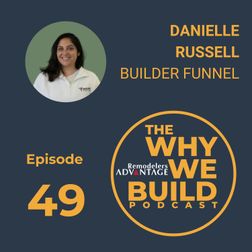
Episode Summary Finding great people has become one of the biggest challenges facing remodeling companies today. But what if the real question isn't "How do I find good people?" What if it's "Why would great people choose to work here and stay?" In this episode, Greg sits down with Danielle Russell, President and part owner of Builder Funnel, to explore the future of talent, leadership, and company culture in the remodeling industry. Danielle shares how Builder Funnel has built an award-winning workplace culture while achieving remarkable growth, and why intentional leadership, mentorship, and transparency may be the ultimate competitive advantage. Together, they discuss the widening labor gap, the importance of mission, vision, and core values, how open book management creates ownership, and why mentorship may be the most overlooked leadership responsibility in our industry today. If you're struggling to attract or retain great people, this conversation offers practical ideas you can begin implementing immediately. Key Takeaways The real hiring question is not "How do I find good people?" but "Why would a high performer choose to work here and stay?" Company culture is a strategic advantage, not a perks program. Clarity, accountability, and leadership matter more than pizza parties. Mission, vision, and core values only matter when they are actively lived and integrated into everyday operations. Great companies continuously attract talent, even when they are not actively hiring. Open book management can help employees think and act like owners when paired with proper education and training. Mentorship is becoming increasingly important as experienced industry professionals retire faster than new workers enter the trades. "Clarity is kindness." Clear expectations and honest conversations are essential to strong leadership. Connect with Danielle Russell LinkedIn: Danielle Russell Builder Funnel: BuilderFunnel.com About Our Guest Danielle Russell is the President and part owner of Builder Funnel, a digital marketing agency dedicated exclusively to helping remodelers and custom home builders grow through strategic digital marketing. During her time at Builder Funnel, Danielle has helped lead the company to significant growth while cultivating an award-winning culture centered around transparency, leadership development, and employee engagement. She is passionate about helping organizations create workplaces where high performers thrive. Connect With The Why We Build Podcast The Why We Build Podcast explores the people, processes, and purpose behind exceptional remodeling companies. Each episode features conversations with industry leaders who are committed to building better businesses, stronger teams, and more fulfilling careers. Follow, subscribe, and share this episode with someone who is building the future of our industry—one project, one team, and one conversation at a time.
Upstream Profit Protection: Why Great Projects Start Long Before Construction
Too often in remodeling, profit leaks are blamed on the construction phase. A delayed material order, a missing detail, an indecisive client, or a subcontractor waiting for answers can quickly derail a project. But what if those costly problems actually began long before construction started? In this episode of The Why We Build Podcast, Greg sits down with veteran designer and business coach Betsy Brandenburg to explore the concept of Upstream Profit Protection and why the design phase may be the most powerful risk management tool in your business. Betsy shares how incomplete design, poor communication, and unclear processes create downstream chaos, and how intentional planning can dramatically improve profitability, client experience, and team alignment. In This Episode, You'll Learn: Why incomplete design is one of the biggest causes of lost profit in remodeling projects. How "profit bleed" often starts months before construction begins. The hidden costs of allowances, delayed decisions, and long-lead items. Why fully completed design packages reduce stress for both production teams and clients. How design-build companies can improve collaboration between design and production. The importance of structured handoff meetings and buildability reviews. Why treating design as an investment rather than overhead changes everything. How visible processes build trust and reduce homeowner anxiety.
YOUR WARRANTY IS A PROFIT CENTER — YOU JUST DON’T KNOW IT YET
Callbacks and warranty work are a fact of life in remodeling. Something breaks six months after a job closes, you send a crew back on your dime, and chalk it up to the cost of doing business. But what if that cost could actually build wealth instead of drain it? Tim Byrd has spent more than 30 years helping home service businesses do exactly that. As founder and CEO of Warranty RE, he’s brought the concept of captive reinsurance — the same financial engineering large corporations use to manage risk and accumulate capital — to remodelers, HVAC companies, plumbers, electricians, and every trade in between. In this episode, Tim breaks down how you can own your own warranty company, eliminate the third-party middleman, stop paying premiums into someone else’s pocket, and start building a capital resource that grows tax-advantaged inside a company you control. He also gets into succession planning, enterprise value, and the mindset shifts that separate business owners who drift from those who build. Website: warranty-re.com Email: tim@warranty-re.com
Building the Future Workforce: Why Shop Class Still Matters with Noah Hughes
In an industry constantly talking about the labor shortage, it's easy to focus on the problem and miss the people creating solutions. This week, Greg sits down with Noah Hughes, a carpentry and Career & Technical Education (CTE) teacher at Caroline High School in Virginia, to discuss the critical role shop classes play in developing the next generation of skilled trades professionals. Noah shares his unconventional journey from framing houses, trim carpentry, and running construction businesses to becoming a high school teacher. Along the way, he discovered a new mission: helping students see the trades as a viable, rewarding career path while creating meaningful connections between classrooms and the construction industry. The conversation explores the misconceptions surrounding the trades, the importance of making shop class visible, and why builders, remodelers, and industry leaders need to play an active role in supporting local CTE programs. Noah also shares practical ways companies can get involved, whether through guest speaking, mentoring, internships, or simply showing students what a successful career in construction can look like. If you've ever wondered where the next generation of builders will come from, this episode offers both hope and a challenge: stop waiting for someone else to solve the workforce problem and become part of the solution. In This Episode Why Noah left contracting to become a high school carpentry teacher How modern CTE and shop programs are preparing students for real careers The biggest misconceptions parents and educators still have about the trades Why students are eager to learn from industry professionals The importance of industry partnerships and community involvement How social media is helping make shop class visible again Lessons learned from building Habitat for Humanity homes with students The role AI may play in the future of construction education Why companies that invest in young people today will lead the industry tomorrow Practical ways builders and remodelers can support local trade education programs Resources & Links Follow Noah Hughes on Instagram: @we_learn_building Listen to the Four Man Podcast Learn more about Career & Technical Education (CTE) programs in your local community Connect with your local high school's shop or vocational program Connect With The Why We Build Podcast If you enjoyed this episode, please subscribe, leave a review, and share it with a builder, remodeler, educator, or industry leader who cares about developing the next generation of skilled trades professionals. The future workforce isn't someone else's responsibility. It's ours. And it starts by showing up. #WhyWeBuild #ConstructionLeadership #SkilledTrades #CTE #TradeEducation #WorkforceDevelopment #ConstructionCareers #RemodelingIndustry #ShopClass #FutureBuilders
The Cost of Keeping the Wrong Person
In this episode of The Why We Build Podcast, Greg tackles one of the hardest leadership decisions in remodeling: knowing when it is time to move on from an underperforming team member. This conversation is not about blame. It is about clarity. Many owners already know the decision they need to make, but fear, timing, sunk cost, and self-doubt keep them stuck. Greg breaks down the real cost of waiting, including lost productivity, management time, team morale, client risk, and cultural damage. In this episode: Why owners delay hard personnel decisions The hidden financial cost of keeping the wrong person How underperformance affects your best people Warning signs that the decision has already been made How to have the conversation with honesty and dignity Why moving on cleanly protects your culture Key Takeaway: The cost of keeping the wrong person is rarely just one salary. It is financial, operational, emotional, and cultural. Strong leaders do not make perfect hires. They recognize when something is not working, act with integrity, and protect the team. Best Quote: “Your standard will only elevate to the worst possible behavior you will tolerate.”
More Than the Build: The Human Side of Remodeling with Mike Whalen
In this episode of The Why We Build Podcast, Greg sits down with longtime lead carpenter and industry leader Mike Whalen for an honest conversation about what remodeling really demands from the people doing the work. This isn’t just a conversation about tile layouts, production schedules, or project management systems. It’s about the human side of remodeling. The part that often gets overlooked. Mike shares his journey from building tree forts as a kid to working in commercial construction, running his own company, and eventually finding a long-term home at DBS Remodel, where he has spent more than two decades helping shape projects, teams, and company culture. Together, Greg and Mike explore: Why remodeling is as emotional as it is technical The importance of communication and empathy on the jobsite Managing client expectations during stressful projects The balance between craftsmanship and customer experience What separates healthy remodeling companies from unhealthy ones How leadership evolves from “bags on” production to strategic thinking The role of organizational culture in long-term success Why continuing education transformed Mike’s career The impact of industry communities like JLC Live Mike also shares practical insight into: Leading monthly production meetings Using client feedback to improve communication Reading client personalities and stress levels Managing trade partner relationships Handling recurring project challenges Maintaining craftsmanship while scaling leadership responsibilities One of the biggest themes in this episode is that great remodeling professionals are not just builders. They are guides, communicators, problem-solvers, and leaders helping clients navigate deeply personal experiences inside their homes. This episode is a reminder that success in remodeling is not just about technical excellence. It is about how you show up for people.
Why Skilled Trades Are the Future: Alvin Townley on Scholarships, Workforce Gaps, and Building a Skilled Nation
In this episode of The Why We Build Podcast, host Greg Woleck talks with Alvin Townley, CEO of Skilled Nation, about the future of skilled trades, workforce development, and why career pathways in the trades deserve more respect, visibility, and support. For years, the common message around success was simple: go to college, get a degree, and follow the traditional path. For some people, that path works. But for many others, it can lead to debt, uncertainty, and work that does not feel meaningful. At the same time, industries like construction, remodeling, manufacturing, transportation, energy, and home services continue to need skilled people who can build, fix, install, create, and solve real problems. Alvin shares how Skilled Nation is working to close that gap by providing scholarships for people pursuing training in high-demand skilled careers. These scholarships help cover more than tuition. They can also help with tools, transportation, childcare, and other real-life barriers that often prevent people from completing training. Greg and Alvin also discuss the perception problem facing the trades. Too often, skilled careers are treated like a backup plan instead of a smart, honorable, and profitable path. But that conversation is beginning to change. More parents, students, educators, and employers are starting to recognize that skilled work offers dignity, stability, purpose, and opportunity. The conversation also explores the impact of AI, the importance of better storytelling, and the responsibility industry leaders have to help build a stronger talent pipeline for the future. Key Takeaways The skilled trades are not a backup plan. They are honorable, needed, and often highly rewarding careers. The workforce gap is also an awareness gap. Many people simply do not understand the opportunities available in skilled careers. Scholarships can remove real barriers. For many students, the issue is not motivation. It is affordability and access. Industry has a responsibility to help build the pipeline. Employers, educators, foundations, and trade partners all benefit when more people are trained and connected to meaningful work. Technology will change the trades, but it will not eliminate the need for skilled people. AI may reshape the workforce, but hands-on skilled careers remain essential. Featured Guest Alvin Townley is the CEO of Skilled Nation, an organization focused on expanding access to skilled career training through scholarships and industry partnerships. Alvin is a social entrepreneur, author, fundraising executive, and storyteller who is passionate about helping people discover meaningful opportunities and build better futures through skilled careers. Why This Episode Matters For those of us in remodeling and construction, this conversation hits close to home. We do not just need more workers. We need more people who can see a future in this work. That means better messaging. Better pathways. Better support. And a stronger commitment from business owners, educators, and industry leaders to tell the story of the trades with the respect it deserves. The future of remodeling depends on the people willing to build, fix, solve, lead, and carry the work forward. Resources Mentioned Skilled Nation skilled-nation.org Partners mentioned include The Home Depot Foundation, 3M, DeWalt, Ford Philanthropy, GE Vernova Foundation, Schneider Electric, Norfolk Southern, PulteGroup, Ball Corporation, and others.
Building the Future: Gregg Helmich on Trades Education, Mentorship, and the Power of Showing Up
In this episode of The Why We Build Podcast, Greg Woleck talks with Gregg Helmich, Building Trades Associate Professor at North Iowa Area Community College, about trades education, mentorship, industry partnerships, gratitude, and developing the next generation of craftspeople. Gregg shares how his love for building began as a child, working beside his father, tearing down old barns, straightening nails, reusing lumber, and helping build an A-frame cabin with hand tools. Those early experiences gave him a lasting appreciation for craft, usefulness, and the pride that comes from making something with your own hands. He also reflects on the shop teachers who shaped him. They gave him extra time, saw potential in him, and made the shop feel like a place where he belonged. That same spirit now shows up in the way Gregg teaches and mentors his own students. A major thread in the conversation is the challenge and value of trades education today. Gregg talks about the difficulty of measuring hands-on learning, assessing soft skills, and balancing curriculum standards with the real-world nature of job-site training. He also shares his vision for an ideal program: a large facility where students could build full homes indoors, work from permanent mockups, and learn in a more controlled environment. Gregg and Greg also dig into job-site culture. Employers want technical ability, but they also need people who are willing to learn, work safely, clean up, support the team, and bring humility to the job. Gregg models that by working alongside his students, even in the simple tasks. One of the strongest parts of the episode is Gregg’s approach to industry partnerships. He explains how a fun student idea involving a rewritten Brooks & Dunn song led to a major Makita tool donation, and how that moment helped him see the power of intentional relationships. Since then, Gregg has helped build partnerships that have brought more than $1.7 million in equipment and in-kind support to the program. The conversation also touches on social media, generosity, and the importance of giving back. Gregg’s “attitude of gratitude” is clear in how he thanks partners, promotes their work, and continues nurturing relationships long after a donation or event. Key Takeaways The next generation does not happen by accident. People enter the trades because someone encouraged them, taught them, and helped them see what was possible. Trades education is about more than technical skill. Students need safety, communication, humility, teamwork, and a willingness to keep learning. Mentorship matters. Gregg was shaped by teachers who saw something in him, and now he is doing the same for others. Partnerships work best when they are relational. The strongest industry partnerships are built on mutual value, trust, gratitude, and long-term connection. Generosity has a ripple effect. When companies invest in students and educators, they help build the future workforce and strengthen the industry. About Gregg Helmich Gregg Helmich is a Building Trades Associate Professor at North Iowa Area Community College. Over his career in trades education, he has helped prepare students for careers in construction by combining hands-on skill development, leadership, soft skills, and meaningful industry partnerships. Outside the classroom, Gregg is also a musician, worship leader, woodworker, and custom guitar builder. Closing Thought This conversation is a reminder that the future of remodeling and construction depends on people who are willing to invest before there is an immediate return. The next generation needs skill, but they also need access, encouragement, relationships, and people who care enough to show up.
From Corporate Comfort to Remodeling Reality with Corey Plourde
In this episode of The Why We Build Podcast, Greg talks with Corey of Core Remodeling Services about leaving a stable corporate career, starting as a handyman business, and growing into a remodeling company. Corey shares the real story behind the leap: the early momentum, the pressure of being underfunded, the challenge of building a team, and the moment he realized he had hit the wall as an owner. The conversation digs into leadership, profitability, peer accountability, learning the numbers, working with family, and what it takes to build a company that can grow beyond the owner. This episode is a great listen for remodelers who are trying to move from survival mode to a more intentional, profitable, and sustainable business. Topics include: Leaving corporate America to start a remodeling business The early challenges of building Core Remodeling Services Hitting the wall as a business owner Learning what you don’t know The value of peer groups and accountability Building a family business Moving from revenue growth to real profitability Connect with Corey: Corey@coreremodelingservices.com coreremodelingservices.com
Why More Revenue Is Not Always the Answer with Steve Heintzelman
In this episode of The Why We Build Podcast, Greg sits down with Steve Heintzelman, owner of Odyssey Financial and Accounting Solutions, for a practical conversation about one of the biggest traps in remodeling and construction: assuming more revenue will solve every problem. They dig into what really happens when a business feels busy but still feels tight, and why growth alone cannot fix weak financial systems. Steve shares his path from Ernst & Young to starting Odyssey, along with the influence of growing up around both a family lumber business and entrepreneurship. That background shaped the way he works with owners today, especially in construction, where cash flow, job costing, and financial visibility can make or break the business. A big theme in this conversation is the difference between bookkeeping and financial visibility. Steve explains that clean books are only the beginning. The real value comes when owners and leaders use those numbers to make better decisions, consistently review job performance, and close the feedback loop between operations and finance. Greg and Steve also discuss the warning signs owners should watch for, especially when the P&L says one thing but the bank account tells a different story. They discuss accounts receivable, underbilling, messy invoicing, weak job costing, and why the balance sheet is often the most overlooked but most revealing financial report in the business. The episode also explores what profitable construction firms tend to do differently. Steve points to consistent review rhythms, simplified systems, strong feedback loops, and the discipline to follow the process rather than constantly making exceptions. He makes the case that strong financial systems are not just compliance tools. They are value drivers that improve profitability, reduce stress, and increase the company's long-term value. The conversation wraps with a lighter round of rapid-fire questions covering job costing cadence, common bad habits, lessons from golf and the lumber business, and the financial superpower Steve wishes every owner had. It is a grounded, useful episode for owners, production leaders, and managers who want to run a healthier, more profitable company with less guesswork. About the Guest Steve Heintzelman is the owner of Odyssey Financial and Accounting Solutions. He founded Odyssey in 2022 to help business owners gain the financial support, clarity, and insight they need to run stronger, more profitable businesses. Before launching Odyssey, Steve worked at Ernst & Young, where he earned his CPA and gained experience auditing companies ranging from startups to billion-dollar enterprises. Today, he works closely with construction businesses, especially builders and remodelers, helping them improve job costing, accounting processes, and financial decision-making. Key Takeaways: More revenue is not always the answer when a business is tight on cash. Weak job costing, unclear margins, poor invoicing, and messy financial processes can all hide underneath top-line growth. Steve makes the point that owners need more than bookkeeping. They need clean information, consistent review, and the discipline to use their numbers as a management tool. Greg also highlights two themes that stood out in the conversation: simplification and the feedback loop. Both are essential if companies want to improve profitability and stop repeating the same mistakes from job to job. Connect with Steve. Steve can be found at Odyssey Financial and Accounting Solutions (OdysseyFAS.com) and on LinkedIn, where he spends most of his time.
1 of 6