The Unplugged Life: Screen Addiction, Digital Detox & Conscious Parenting

The Unplugged Life: Screen Addiction, Digital Detox & Conscious Parenting

by Sandal Shukla
Season 1
Cyberbullying in Their Pocket: How 24/7 Group Chats Are Trapping Teens
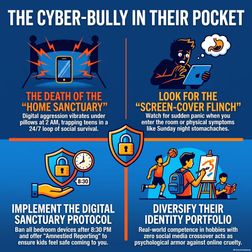
AI
When we were kids, bullying ended at 3:00 PM when the school bell rang. Today, it follows children through their front door, sits down at their dinner table, and slips directly under their pillows at 2 AM. Modern relational aggression has evolved from hallway confrontations into relentless, 24/7 digital assaults. Between disappearing Snapchat messages, toxic group chats, anonymous school poll apps, and deliberate digital exclusion, adolescents are constantly swimming in high-stakes social surveillance [2, 3]. When a child's bedroom is no longer a psychological sanctuary, their nervous system lives in a permanent state of fight-or-flight. In Episode 31 of The Unplugged Life, we deconstruct the architecture of digital bullying. Learn why online relational aggression hits girls and boys with different neurological intensities, the critical warning signs that your teen is being targeted online, and an engineering-grade "Digital Sanctuary Blueprint" that guarantees your home remains an impenetrable safe haven from online cruelty. ⏱️ TIMESTAMPS: 0:00 - The Bell No Longer Saves Them (The 3:00 PM Shift) 1:20 - The Illusion of "Harmless Banter": Relational Aggression Defined 2:45 - The Architectural Trap: Disappearing Messages & Group Chat Exclusion 4:15 - The Bedroom Breach: Why 2 AM Notifications Cause Clinical Despair 5:45 - Behavioral Warning Signs: How to Spot a Digitally Targeted Child 7:15 - What NOT to Do: The Fatal Mistake of the Immediate Phone Confiscation 8:40 - The Digital Sanctuary Blueprint (3 Core Household Defenses) 10:10 - The 24-Hour Experiment: The "No-Retaliation" Family Open Door 11:20 - Final Thoughts & Preview of Episode 32 🛡️ THE DIGITAL SANCTUARY PROTOCOL: 1. Bedroom Device Curfew: Zero internet-connected screens in the bedroom after 8:30 PM. 2. The Amnestied Reporting Rule: Never punish a child for coming forward with toxic online interactions. 3. Screenshot Documentation: Preserve forensic evidence of harassment before confronting administrators. 4. Curate an Offline Identity: Ensure at least two major extracurricular pursuits that feature zero social media crossover. 👥 CONNECT WITH THE UNPLUGGED LIFE: • Subscribe for weekly data-driven frameworks to protect childhood in an algorithmic age.
Why "Risky Play" Beats Educational Apps: The Science of Child Resilience
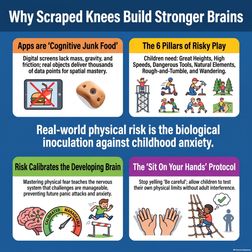
AI
Are "educational" apps actually educating our children, or are they simply sanitizing the essential physical struggle of childhood? Modern parenting culture has traded scraped knees, tree climbing, and mud for sanitized touchscreen games and gamified learning apps under the banner of safety and cognitive advancement [2]. Yet, developmental psychology reveals a startling truth: when you eliminate physical risk, three-dimensional spatial navigation, and tactile resistance from a child's play, you starve their developing vestibular and proprioceptive systems—increasing childhood anxiety and stunting physical resilience. In Episode 30 of The Unplugged Life, we evaluate the neurobiology of play [2]. Learn the six core categories of "Risky Play," why two-dimensional pixels can never stimulate spatial mastery or emotional risk assessment, and an engineering-grade framework to let your children take calculated physical risks outdoors so they grow into emotionally sturdy, confident adults. ⏱️ EPISODE TIMESTAMPS 0:00 - The Sanitized Playground: Why Scraped Knees Disappeared 1:20 - The Illusion of the "Educational App" 2:45 - The Two Hidden Senses: Vestibular & Proprioceptive Systems 4:20 - What is "Risky Play"? (The Ellen Sandseter 6-Category Model) 6:00 - How Screen Play Amplifies Childhood Anxiety 7:35 - Rebalancing the Ratio: Green Time vs. Screen Time 8:55 - The Parent's "Sit on Your Hands" Protocol 10:15 - The 24-Hour Experiment: The Outdoor Risk Challenge 11:20 - Final Thoughts & Preview of Episode 31 🌲 THE 6 FORMS OF BENEFICIAL RISKY PLAY: 1. Great heights: Climbing trees, boulders, or high structures to master fear. 2. Rapid speeds: Sledding, swinging, biking, or running down hills. 3. Dangerous tools: Using whittling knives, hammers, or scissors under guidance. 4. Dangerous elements: Interacting with water, fire, or rough terrain safely. 5. Rough-and-tumble: Wrestling, tumbling, and play fighting to learn physical boundaries. 6. Disappearing/Lost: Exploring hideouts and wandering just out of immediate adult gaze. 👥 CONNECT WITH THE UNPLUGGED LIFE: • Subscribe for weekly data-driven frameworks to protect childhood in the digital age. • Drop a comment below: What was your favorite "risky" outdoor activity when you were a kid?
Why Kids Can't Stop Gaming: How Compulsion Loops Trap Children
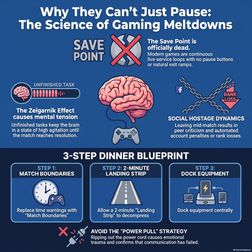
AI
"I can't pause it, I'm in a live match! Just five more minutes!" If this sentence triggers an immediate spike in your evening blood pressure, you are not alone. For millions of households, the dinner table call has become an exhausting battleground of screaming matches, confiscated controllers, and tearful meltdowns. But before you label your child as deliberately rebellious, you must understand the psychological architecture operating on the other side of that screen. In Episode 29 of The Unplugged Life, we deconstruct the hidden mechanics of modern multiplayer video games. From the extinction of the traditional "Save Point" to the deliberate psychological deployment of the Zeigarnik Effect and "near-miss" mechanics, discover why a child's developing brain finds it biologically agonising to disengage mid-loop. More importantly, learn an engineering-grade 3-step transition protocol that eliminates dinner table hostility without resorting to pulling the power plug. ⏱️ TIMESTAMPS 0:00 - The Dinner Table Standoff: Why Yelling Fails 1:15 - The Death of the "Save Point" (The Structural Shift in Gaming) 2:45 - The Zeigarnik Effect: Why Unfinished Tasks Cause Biological Agitation 4:15 - The "Near-Miss" Compulsion Loop: Engineered Frictionless Re-entry 5:50 - Social Hostage Dynamics: Ranked Penalties and Squad Pressure 7:15 - The Danger of the "Power Pull" (Why Ripping the Plug Causes Trauma) 8:35 - The 3-Step Dinner Transition Blueprint 10:05 - The 24-Hour Experiment: The Match-Boundary Shift 11:15 - Final Thoughts & Preview of Episode 30 🎮 THE GAMING TRANSITION ACTION PROTOCOL: 1. Replace time warnings ("Dinner in 10 minutes") with operational match boundaries ("This is your final match of the night"). 2. Build a 2-minute "Landing Strip" buffer after the console powers down to let adrenaline clear before conversation starts. 3. Ban in-room mobile gaming during meals: controllers and devices rest in a central kitchen dock. 4. Establish clear consequences in advance: quitting a designated final match late forfeits tomorrow's gaming window. 👥 CONNECT WITH THE UNPLUGGED LIFE: • Subscribe for data-backed frameworks to reclaim family connection from tech loops. • Drop a comment below: What specific video game causes the most friction during dinner in your home?
When Should Kids Get a Phone? The Safe Age & Stepped-Access System
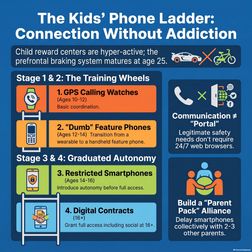
AI
"Everyone in my class has one, why can't I?" It is the single most common, guilt-inducing question parents face the moment their child enters middle school. Handing an 11- or 12-year-old an unrestricted, internet-connected smartphone isn't merely giving them a communication device—it is handing them an unmonitored portal to social media algorithms, adult content, peer comparison, and 24/7 social dynamics before their executive function has even begun to mature. In Episode 28 of The Unplugged Life, we dismantle the anxiety surrounding your child's first smartphone. We analyze the neurodevelopmental case for delaying connected smartphones until at least age 14 or 16, dismantle the fear of "social isolation," and present an engineering-grade "Stepped-Access System". Learn how to satisfy legitimate logistical safety needs without handing over the keys to the entire open internet. ⏱️ TIMESTAMPS 0:00 - The "Everyone Has One" Crisis 1:25 - The Frontal Lobe Gap: Why Kids Can't Self-Regulate 2:50 - What Are We Actually Handing Them? (Communication vs. Portal) 4:20 - The "Wait Until 8th" Movement & Collective Action 5:50 - The Stepped-Access Framework: 4 Stages from Age 10 to 18 6:40 - Stage 1: The Dumb Smartwatch / GPS Tracker 7:30 - Stage 2: The Brick Phone / Calling-Only Device 8:25 - Stage 3: The Restricted Smartphone (No Browser / No App Store) 9:30 - Stage 4: Full Autonomy with Digital Contracts 10:35 - The 24-Hour Experiment: The Parent Alliance Pact 11:45 - Final Thoughts & Preview of Episode 29 📱 THE STEPPED-ACCESS PHONE BLUEPRINT: Ages 10–12: GPS Calling Watches (Communication + Location; zero feeds, zero games). Ages 12–14: Basic Feature / "Dumb" Phones (Calls, SMS group chats; zero internet browser). Ages 14–16: Locked-down Smartphone (Maps, Music, School tools; social media strictly banned). Ages 16+: Graduated social media access tethered to real-world behavioral accountability. 👥 CONNECT WITH THE UNPLUGGED LIFE: Subscribe for data-driven frameworks to protect childhood in an algorithmic world.
Blue Light & Child Brain Development: What Screen Exposure Actually Does
AI
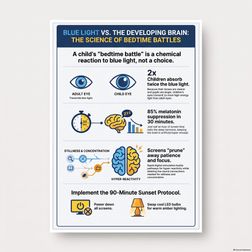
Why does turning off your child's tablet at bedtime consistently trigger an explosive meltdown? It isn't just behavioral defiance—it is a physiological collision between neurochemistry and circadian biology. Children's eyes feature larger pupils and clearer crystalline lenses than adults, allowing up to twice as much high-energy blue light to strike their retinas. When that blue-spectrum wavelength hits their photoreceptors, it halts melatonin synthesis by over 85%, surges cortisol, and disrupts the delicate architecture of the prefrontal cortex during its most critical developmental window. In Episode 27 of The Unplugged Life, we unpack the peer-reviewed neuroscience of developing brains under screen exposure. Learn the biological mechanisms of synaptic pruning, why screen-induced sleep loss mimics symptoms of ADHD, and how to implement the Sunset Protocol—a simple, engineering-grade lighting and device routine that protects your child's developing brain and restores calm bedtimes. Episode Timestamps 0:00 - The 8 PM Meltdown (Why Bedtime Tech Battles Are Biological) 1:20 - The Pediatric Eye: Why Children Absorb Twice the Blue Light 2:45 - The Prefrontal Cortex Under Construction (Ages 0 to 7) 4:15 - Synaptic Pruning: The "Use It or Lose It" Neurological Rule 5:45 - Sleep Fragmentation & The ADHD Diagnostic Overlap 7:15 - The Sunset Protocol: Step-by-Step Household Light Architecture 8:45 - What About Blue Light Glasses and "Night Shift" Mode? 9:55 - The 24-Hour Experiment: The 90-Minute Analog Sunset Challenge 11:05 - Final Thoughts & Preview of Episode 28
The iPad Kid Crisis: Why 5-Year-Olds Can't Hold Scissors
AI
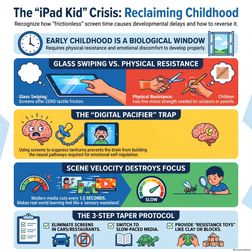
Classroom teachers, pediatricians, and occupational therapists are sounding the alarm: early childhood development has hit a critical turning point over the last decade. Kindergarten educators report five-year-olds walking into classrooms unable to hold safety scissors, grip pencils, or stack wooden blocks due to underdeveloped fine motor skills from swiping frictionless glass. Meanwhile, elementary teachers face rooms of children experiencing explosive tantrums when asked to sit through an eight-minute story. The "iPad Kid" is not an internet punchline—it is a documented neurodevelopmental crisis. In Episode 26 of The Unplugged Life (Series 2: The Safe Childhood), host examines front-line developmental data and offers a practical, low-friction roadmap for parents. In this episode, you will discover: • The Fine Motor Gap: How swiping glass bypasses muscle resistance and bilateral coordination. • The Emotional Regulation Collapse: Why using tablets as "digital pacifiers" prevents self-soothing. • Scene Velocity & Sensory Flooding: How 1.5-second fast cuts recalibrate focus and make real life feel boring. • The 3-Step Low-Friction Tablet Taper: An engineering approach to phase out screens without home warfare. • The 24-Hour Restaurant Challenge: A simple kit to reclaim family mealtimes. 🧸 THE SAFE CHILDHOOD AUDIT: 1. Physical Baseline: Prioritize clay, scissors, coloring, and blocks for hand strength. 2. Emotional Baseline: Allow tantrums and boredom to play out naturally without screen substitution. 3. Media Velocity: Eliminate hyper-stimulating cartoons with scene cuts under 4 seconds. 4. Boundary Protocol: Keep transitional zones (car rides, restaurants, family meals) strictly screen-free. ⏱️ EPISODE TIMESTAMPS: 0:00 - The Kindergarten Alarm: What Teachers Are Seeing Right Now 1:25 - Welcome to Series 2:00 The Safe Childhood 2:40 - The Motor Skill Deficit: Glass Swiping vs. Physical Resistance 4:15 - The Emotional Regulation Gap: Why Tablets Eliminate Resilience 6:00 - Fast Cuts and Sensory Flooding: How Early Media Rewires Focus 7:45 - The "Digital Pacifier" Trap (Empathy for Stressed Parents) 9:10 - The 3-Step Low-Friction Tablet Taper Protocol 10:35 - The 24-Hour Experiment: The Restaurant Survival Challenge 11:45 - Series 2 Roadmap & Preview of Episode 27 👥 CONNECT & SUBSCRIBE: • Subscribe to The Unplugged Life for weekly data-driven frameworks to protect childhood in a digital age. • Question for listeners: What behavioral changes have you noticed in kids who use tablets daily ?
What Will You Be Remembered For? How to Escape the Trap of Living Online
AI
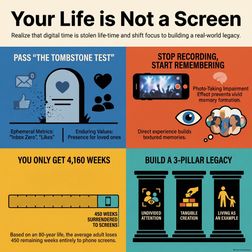
Nobody ever reached the end of their life, looked around at their loved ones, and whispered: "I wish I spent more time scrolling." Yet, if an outside observer evaluated your life purely by how you allocate your waking hours, what would they conclude mattered most to you? For millions of adults, the brutal mathematical reality is that our primary life activity has become staring into a glass rectangle. We document moments instead of experiencing them, optimize for algorithmic validation, and let real life quietly pass by in the background. In this milestone 25th episode of The Unplugged Life—the grand finale of our Adult Digital Reset Series—we confront the ultimate philosophical wake-up call: your finite mortality. Discover the cognitive science of memory formation, why constant documentation destroys real-world recall, the "Tombstone Test" for everyday decisions, and an engineering-grade framework to build an enduring legacy rooted in presence, action, and human connection. 🕊️ THE LEGACY AUDIT CHECKLIST: 1. The Tombstone Test: If it doesn't matter on your final day, don't give it your best hours today. 2. Put the camera down: Engage your senses directly so your brain forms deep, durable memories. 3. Track your "Life in Weeks": Treat each seven-day block as an unrecoverable non-renewable asset. 4. Shift from spectator to architect: Create relationships and physical projects that outlive your apps. Episode Timestamps: Ensure these are formatted with space-dash-space (as below) so major RSS directories and YouTube can automatically parse them into interactive chapters: 0:00 - The Uncomfortable Audit: Where Did Your Life Go? 1:20 - The Finale of the Adult Digital Reset Series 2:35 - The Tombstone Test: The Illusion of Digital Achievements 4:10 - The "Photo-Taking Impairment Effect" (Living vs. Performing) 5:50 - The Life In Weeks Framework: Staring at Your Finite Canvas 7:25 - The 3 Pillars of an Enduring Real-World Legacy 8:55 - How to Re-Enter the World as an "Unplugged" Human 10:15 - The 24-Hour Experiment: The Eulogy Exercise 11:30 - Series 1 Recap & What’s Next in Series 2 (The Safe Childhood) 👥 CONNECT WITH THE UNPLUGGED LIFE: • Subscribe for data-backed frameworks to reclaim your focus, family, and life from tech. • Drop a comment below: What is one real-world memory from this year that had nothing to do with a screen?
Stop Email Anxiety: The 4D System to Reach Inbox Zero Forever
AI
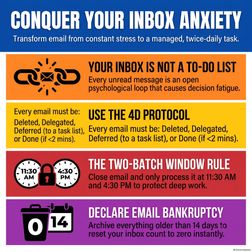
Do you feel an involuntary spike of anxiety every time you see a bold unread message or that dreaded red badge with '4,821' emails on your phone? Most knowledge workers and busy adults don't check email to accomplish work; they check email compulsively as an anxiety management ritual. We treat our inboxes like real-time communication systems, allowing anyone with an email address to dictate our priorities, derail our mornings, and fracture our mental focus. In Episode 24 of The Unplugged Life, we deconstruct the psychology of email dread and unread communication debt. Learn why treating an inbox as a to-do list guarantees permanent mental fatigue, the engineering-grade '4D Protocol' to process hundreds of emails in under 30 minutes, and how to establish hard boundaries around asynchronous communication so you can do your real life's work uninterrupted. What You'll Learn in This Episode: The Red Badge of Anxiety: Why unread messages drain your energy The Core Lie: Why treating email as a real-time chat room fractures your focus The 4D Inbox Processing Protocol: Your objective sorting system (Delete, Delegate, Defer, Do) The Two-Batch Window Rule: How to kill the constant check habit The Nuclear Option: How to safely declare email bankruptcy and wipe the slate clean" Episode Timestamps : 0:00 - The Red Badge of Anxiety: Why Unread Messages Drain Your Energy 1:15 - The Core Lie: Email as a Real-Time Chat System 2:40 - The Psychological Trap of the "Public To-Do List" 4:10 - The 4D Protocol: Delete, Delegate, Defer, Do 6:00 - The "Two Batch Windows" Rule (Killing the Constant Check) 7:30 - Establishing Asynchronous Expectations with Clients & Teams 8:55 - The Nuclear Option: Declaring Email Bankruptcy Safely 10:10 - The 24-Hour Experiment: The 48-Hour Unread Sweep 11:15 - Final Thoughts & Preview of Episode 25Subscribe: Sign up for weekly data-driven frameworks to reclaim cognitive clarity from modern tech.Join the Conversation: Drop a comment below: What is your current unread email count right now?
Should You Switch to a Dumbphone? An Honest Review of Minimalist Tech
AI
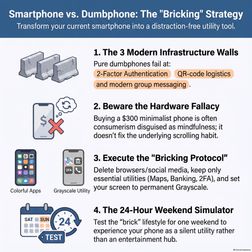
Could you actually survive modern life with a phone that only calls, texts, and has no internet browser? The "Dumbphone" movement has exploded as exhausted smartphone users search for an escape hatch from algorithmic feeds, constant notifications, and infinite scrolling. Devices like the Light Phone, Punkt, and nostalgic flip phones promise absolute peace of mind. But what happens when you actually try to navigate a modern city, board a flight with a digital boarding pass, or authenticate a work login using two-factor SMS? In Episode 23 of The Unplugged Life, we deliver an honest, engineering-grade audit of the "dumbphone lifestyle." Discover the hidden operational roadblocks nobody warns you about, why buying another gadget rarely fixes an undisciplined habit, and how to use the "Bricking Protocol" to convert the smartphone currently in your pocket into a zero-distraction minimalist phone without spending a single dollar. ⏱️ TIMESTAMPS 0:00 - The Nostalgic Trap: Why We Want to Throw Our Phones Away 1:10 - The Rise of the Minimalist Device (Light Phone, Punkt, Flip Phones) 2:30 - The 3 Hidden Friction Points of Living With a Dumbphone 4:15 - Point 1: Two-Factor Authentication & Modern Workplace Security 5:25 - Point 2: The Navigation & Public Transit Gap 6:30 - Point 3: The Group Chat Isolation (iMessage/WhatsApp Friction) 7:45 - The "Hardware Fallacy": Why Buying a Dumbphone Doesn't Fix Compulsion 8:55 - The Bricking Protocol: How to Turn Your Current Smartphone "Dumb" 10:15 - The 24-Hour Experiment: The Weekend Dumbphone Simulator 11:20 - Final Thoughts & Preview of Episode 24 🛠️ THE SMARTPHONE "BRICKING" PROTOCOL: 1. Delete all browsers (Safari/Chrome) or lock them with Screen Time passwords. 2. Remove all social media, news, and streaming video apps entirely. 3. Keep utility-only tools: Maps, WhatsApp/SMS, Banking, Rideshare, Camera. 4. Set display to permanent Grayscale with all notification badges turned off. 👥 CONNECT WITH THE UNPLUGGED LIFE: • Subscribe for weekly frameworks to master digital habits and cognitive focus. • Drop a comment below: Have you ever considered ditching your smartphone for a flip phone?
72 Hours Without a Phone: What Happens to Your Brain
AI
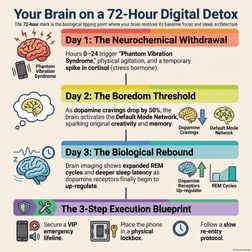
What actually happens inside your skull when you cut off digital stimulation for 72 consecutive hours? Most people imagine a digital detox as a serene weekend of sitting in nature with a cup of tea. The clinical reality is much messier: the first 24 hours trigger physical agitation, phantom vibrations, and genuine neurochemical withdrawal. But by hour 48, your baseline dopamine receptors start to recalibrate—leading to dramatic surges in working memory, deep sleep, and sustained focus. In Episode 22 of The Unplugged Life, we map out the exact hour-by-hour biological timeline of a 3-Day Digital Detox. Learn how your nervous system transitions from the initial "dopamine crash" to neurochemical equilibrium, the science behind lowered salivary cortisol levels, and an engineering-grade protocol to execute your own 72-hour reset without derailing your career or personal emergencies. ⏱️ TIMESTAMPS 0:00 - The Phantom Buzz: The Raw Reality of Day One 1:15 - Why Willpower Alone Feels Like Physical Agitation 2:30 - Hours 0 to 24: The Dopamine Deficit & Cortisol Spike 4:10 - Hours 24 to 48: The Fog Lifts & Boredom Emerges 5:45 - Hours 48 to 72: Deep Sleep Architecture & Sensory Clarity 7:15 - The Biochemical Markers: Cortisol, REM Sleep, and Prefrontal Blood Flow 8:30 - The Low-Risk 72-Hour Execution Blueprint (Emergency Contacts & Auto-Responders) 9:40 - The 24-Hour Experiment: The 6-Hour Micro-Detox 10:45 - Final Thoughts & Preview of Episode 23 🧪 THE 72-HOUR DETOX MILESTONES: • Hour 12: Peak phantom vibration syndrome; mild physical restlessness. • Hour 36: Dopamine receptors begin up-regulating; cravings drop by 50%. • Hour 60: Significant expansion of REM cycles and deeper sleep latency. • Hour 72: Restoration of linear attention; real-world colors and conversations feel richer. 👥 CONNECT WITH THE UNPLUGGED LIFE: • Subscribe for weekly data-driven frameworks to reclaim your mind from tech. • Connect with Raghvendra (CEng PMP) on LinkedIn for deep work frameworks & cognitive engineering. • Drop a comment below: Have you ever gone 24 full hours without checking a screen? ``` [2]
1 of 4