The Resilience Room

The Resilience Room

by Immersive
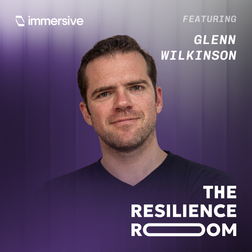
Hacking AI: The Jade Puffer Attack, Prompt Injection, and the Dead Internet Theory | Glenn Wilkinson

Explicit
In this episode, Sam sits down with Glenn Wilkinson, a long-time ethical hacker, keynote speaker, and CEO of Agger Labs. Glenn shares his journey from a curious teenager in Zimbabwe bypassing game demo protections to snooping on audience phones for a Daniel Radcliffe stage show. The conversation dives deep into the evolution of ransomware and how Agger Labs is combatting novel threats. Glenn explains their approach of using local, deterministic deception technology—laying traps in the file system for ransomware to trip over—alongside robust anti-tampering measures. They also break down the recent "Jade Puffer" attack, highlighting how AI is now being used to orchestrate the hacker tradecraft of reconnaissance and lateral movement by exploiting unpatched, year-old vulnerabilities. Addressing the anxiety around artificial intelligence, Glenn offers a grounded perspective: AI will replace tools, not necessarily people. He discusses why the future belongs to the "AI Wrangler" and provides a hacker's insight into prompt engineering. Glenn explains why bypassing AI guardrails is currently a game of "whack-a-mole," comparing it to early SQL injection because data and commands share the same channel. Finally, they debate the technical realities of banning social media for teenagers, with Glenn arguing that bans simply drive kids to unregulated, darker corners of the internet. The episode wraps up with Glenn's 2030 prediction: a societal pushback against big tech, driven by the "dead internet theory" and a desire for local, offline communities. Topics covered: the hacker mindset, ransomware defense and deception technology, the Jade Puffer AI attack, cybersecurity fundamentals, AI replacing tools vs. jobs, prompt injection and bypassing LLM guardrails, the proposed UK social media ban for minors, dumb phones, and the dead internet theory.
The Black Belt of Cyber Security | The Resilience Room ft. Mike Vetri
In this episode of The Resilience Room, Sam sits down with Mike Vetri, Senior Director of SecOps at Veeva Systems and a former Air Force Cyberspace Operations Officer. Mike shares his fascinating transition from training as a military pilot to finding his true calling in cyber defense during the early 2010s—a time when the industry was still widely misunderstood. Drawing from his extensive military background and his journey as a corporate security leader, Mike explains how emotional intelligence and empathy are not just "soft skills," but critical drivers that directly impact a company’s performance and revenue goals. He digs deep into the realities of cybersecurity burnout, sharing tactical leadership frameworks—like the four pillars of moderation (time, money, recognition, and development)—to keep high-performing teams thriving under pressure. The conversation also tackles the chaotic nature of incident response. Mike details how leaders can act as an "umbrella" during a crisis, using military principles like the OODA loop to manage resource allocation and maintain calm in the eye of the storm. He also gives a masterclass on the current AI threat landscape, discussing the terrifying rise of AI-generated phishing and highly polymorphic malware like Phantom Raven, while explaining why human judgment must remain the final line of defense. Finally, Mike reveals how his years as a Black Belt instructor in Krav Maga perfectly parallel the modern cyber battlefield. From weapon disarming to fighting nation-state threat actors, he explains why security teams must abandon complacency and constantly train at a "black belt level" to survive. Topics covered: Military to civilian cyber transitions, empathetic leadership and emotional intelligence, managing cybersecurity burnout, crisis and incident response management, the OODA loop in security, AI-powered phishing and polymorphic malware, the risks of AI automation in security stacks, insider threat risks, and applying Krav Maga principles to threat modeling.
It’s Software, Not Magic: Navigating the Vulnerability Speed Wave and Shadow AI | The Resilience Room ft. Lee Stephens
In this episode of The Resilience Room, Sam Dickison sits down with Lee Stephens, a 31-year veteran at BT. Lee shares his unique journey from sales into cyber security, detailing how the industry's variety and fast-paced environment have kept him engaged at BT across wildly different roles spanning research, marketing, and operations. The conversation dives deep into the realities of modern threat landscapes, reflecting on the simplicity behind major retail ransomware attacks and why mastering the "boring basics" remains the most critical line of defense for businesses of any size. They tackle the explosive progression of vulnerability exploitation speed, tracking how the average time to exploit a CVE plummeted from one year in 2021 to just over a week in 2026—effectively destroying traditional 90-day patch windows. Lee and Sam also strip away the hype surrounding artificial intelligence in the Security Operations Center (SOC). Lee offers a grounded perspective on "Shadow AI," the realistic limits of autonomous SOCs, and why AI should be treated as software rather than magic. Finally, they look over the horizon at the looming "Y2K moment" of quantum computing, discussing how post-quantum cryptography will fundamentally alter global encryption standards. Topics covered: Breaking into cyber security, building a long-term tech career, ransomware and the retail sector, vulnerability exploitation timelines, patch management at scale, autonomous SOCs and analyst burnout, Shadow AI and corporate data guardrails, and post-quantum cryptography readiness.
Gamification, Crisis Simulation, and the Fight Against AI Fatigue | The Resilience Room ft. Mahdi Raza
In this episode of The Resilience Room, host Sam Dickison and co-host Jamie Knobles sit down with Mahdi Raza, a lifelong tech enthusiast and cyber ecosystem activator. Mahdi shares his nostalgic journey into the digital world—from accidentally brute-forcing his way into AOL at age 12 to navigating today’s complex, fast-moving threat landscape. The conversation dives deep into why traditional security awareness training fails and how Mahdi’s company, SiberX, is turning the industry upside down. By leveraging the power of gamification, immersive physical escape rooms, and eSports principles, they are shifting the narrative from boring, repetitive checklists to hands-on, high-stakes defense learning. They also break down the mechanics of "Operation Defend the North"—a massive, real-world tabletop crisis simulation designed alongside partners like Immersive to test critical infrastructure against modern threats. With the rise of AI, deep fakes, and quantum computing, Mahdi explains why organizations can no longer rely on static playbooks or outdated fishing campaigns. Instead, he reveals how SiberX's "Now AI" war room workshops—featuring real-world crisis simulators from NATO and the Pentagon—are building genuine resilience for both enterprise leaders and the next generation of digital defenders. Topics covered: Breaking into cyber security, gamification of security training, eSports and cyber skills, building a cyber ecosystem, tabletop exercises and crisis simulation, deep fakes and AI threat management, human-in-the-loop decision-making, and the evolution of local LLMs.
Leading with Curiosity in the NHS | The Resilience Room ft. Nasser Arif
In this episode of The Resilience Room, Sam and James are joined by Nasser Arif, an award-winning cybersecurity leader in the NHS who journeyed from aeronautical engineering to finding his true "home" in cyber. Nasser shares his unique transition from a non-traditional background into a field engineer role, and the pivotal moment an observant manager invited him to join the security team. The trio dives deep into the mindset of curiosity required to survive a rapidly changing industry. Nasser provides a refreshingly human perspective on AI adoption, moving past the "doom and gloom" to discuss how LLMs can streamline tedious tasks—like meeting minutes—to make space for more creative, strategic work and genuine human connection. He also reveals his "secret" use for AI: visualizing his dreams and even predicting his award-winning fashion choices. Nasser reflects on winning the National Cyber Award for the NHS, battling imposter syndrome by staying authentic, and his new role as a judge for the upcoming awards. Whether you are a student looking for free resources or a professional feeling overwhelmed by the speed of tech, this episode is a masterclass in staying grounded while moving at a rapid pace. Topics covered: Non-traditional routes into cyber, transferable engineering skills, managing burnout and industry change, AI in healthcare and enterprise, the ethics of data ownership, overcoming imposter syndrome through authenticity, and the "butterfly effect" of mentorship. [The views and opinions expressed in this episode are those of the speakers and do not necessarily reflect the official policy or position of their employer.]
Find the Thing That Makes You Sparkle | The Resilience Room ft. Hazel McPherson
In this episode of The Resilience Room, Sam and James sit down with Hazel, a seasoned cyber security professional who spent 15 years in technical IT before discovering her true calling through an ISC2 pilot programme in the NHS. Hazel opens up about the moment a tutor changed her entire perspective on security — and why that hacker mindset still defines how she approaches the industry today. The conversation covers the very real challenge facing mid-career professionals who've outgrown entry-level resources but haven't yet reached the executive tier, and why Hazel believes the cyber security community is one of the most genuinely collaborative in tech. Hazel also discusses her work with Women in Cyber Security UK & Ireland and B-Sides Bristol, before introducing Seasides — her own initiative bringing cyber security education and opportunity to coastal communities in the South West, starting in Weston-super-Mare. They also tackle the AI question head-on: will it kill entry-level jobs? Hazel gives a grounded, refreshingly non-hysterical take on where AI genuinely helps, where it fails, and why the people doing hands-on work have far less to fear than the headlines suggest. Topics covered: breaking into cyber security, mentorship and community, women in tech, the mid-career gap, AI and the future of security roles, coastal community outreach, vibe coding, and knowing when to question your AI tools.
Why AI Won't Save Your SOC — And What Actually Will | The Resilience Room ft. Ben Bachmann
Explicit
In this episode of The Resilience Room, cybersecurity leader Ben Bachmann breaks down why AI-powered SOC tools are still overhyped, how security culture beats any technology investment, and what CISOs are really losing sleep over. From OT security on offshore rigs to the true cost of drowning in data, Ben shares candid insight from years leading security at global organisations. Whether you're a CISO, aspiring security professional, or just trying to keep your company safe, this conversation cuts through the noise. Our host is Sam Dickison and the co-host this time is Alex Kliemt, from Immersive. Topics covered: AI in cybersecurity, SOC automation, phishing & social engineering, OT/ICS security, CISO board communication, security culture, incident response, and building security awareness programmes.