The Melapress Show

The Melapress Show

by Robert Abela
Accessibility, Revenue, and the Mistakes Most Agencies Keep Making | Anne-Mieke Bovelett
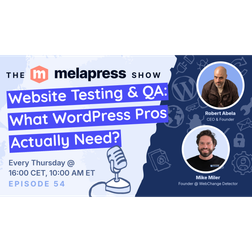
Most organizations only consider accessibility when faced with a legal deadline or a complaint. Anne-Mieke Bovelett's approach begins much earlier, at the stage of product decisions, design systems, and CMS workflows that ensure a site is accessible for everyone before any code is written. With 27 years of experience in web infrastructure across retail, academic, agency, and enterprise clients in the Netherlands, Germany, and beyond, she knows exactly where agencies often go wrong with accessibility, and the consequences of these mistakes. In this conversation, Anne and Robert unpack the gap between technical compliance and real-world usability, explain why accessibility, SEO, usability, and conversion optimization are increasingly the same discipline, and discuss how AI search and agents are raising the stakes for clear semantic structure. Key topics include: Why "WCAG compliant" doesn't guarantee a usable website The accessibility mistakes that show up on WordPress sites regardless of who built them How to reframe accessibility as an investment instead of a project cost Where accessibility debt gets introduced during discovery, design, and development What metrics actually demonstrate accessibility ROI to a client How AI-driven search and agents change the value of accessible, well-structured content 🎙️Guest: Anne-Mieke Bovelett, Accessibility Strategist 🎙️Host: Robert Abela, Melapress
Regression Testing, Visual Testing & QA: What WordPress Pros Need? | Mike Miler (WebChange Detector)
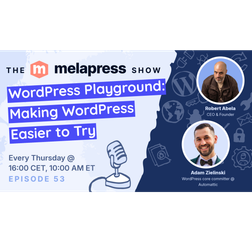
Agencies applying updates across dozens of client sites face a consistent challenge: the issues that matter most, such as broken forms, failed checkouts, and layout regressions, rarely surface on the homepage. Without a structured testing process, these issues surface only when a client notices. Mike Miler, Founder of WebChange Detector, works with agencies on exactly this problem and brings a grounded, tool-informed perspective on where testing effort actually pays off. Key topics include: The practical difference between testing, monitoring, and QA, and why each serves a different purpose in a maintenance workflow How regression testing and visual testing work, and the distinct failure types each one is designed to catch Which change types carry the highest risk: plugin and theme updates, design changes, third-party integrations, or configuration changes How to structure a QA checklist that's consistent and repeatable across multiple team members What to automate when managing websites at scale, and what still requires a human review step Practical uses of AI in generating test coverage and flagging anomalies 🎙 Guest: Mike Miler, Founder at WebChange Detector 🎙️Host: Robert Abela, Melapress
WordPress Playground Deep Dive: Making WordPress Easier to Try and Learn | Adam Zielinski (Automattic)
Getting started with WordPress, whether as a learner, a contributor, or an agency evaluating plugins for a client, has always required more setup than it should. WordPress Playground was built to address that friction directly, making it possible to run a full WordPress environment in the browser, instantly, with no installation required. In this live episode, Adam Zieliński shares how the project has evolved, the adoption patterns that surprised the team, and the common misconceptions that still follow Playground around. Key topics include: The original problem WordPress Playground was created to solve, and why instant access matters How agencies are using Playground for plugin and theme evaluation, product demos, and client onboarding Interactive learning approaches versus traditional tutorials, and how Playground is reshaping WordPress education Reducing setup friction for contributors and making it easier to reproduce, test, and share issues Where AI and experimentation intersect with Playground, and what unexpected use cases have emerged Adam's vision for where Playground fits in the next generation of WordPress workflows 🎙Guest: Adam Zieliński, WordPress Core Committer & Architect of WordPress Playground 🎙️Host: Robert Abela, Melapress
WordPress Plugin Supply Chain Attacks: Hunting for Backdoors with AI | Austin Ginder (Anchor Host, WP Beacon)
Supply chain attacks against WordPress plugins are difficult to spot because they often hide behind legitimate update processes that users trust every day. In this episode, Austin Ginder, Founder of Anchor Host and WPBeacon, shares how investigating compromised sites across a large managed WordPress environment led him to uncover multiple examples of plugin supply chain abuse. He explains the techniques involved, how AI accelerated the investigation process, and what the WordPress ecosystem can do to improve software integrity. Key topics discussed: • How plugin supply chain attacks operate through trusted update channels • The attack patterns Austin investigated, including expired domain takeovers, redirected update infrastructure, and version number manipulation • How Claude Code accelerated timeline reconstruction and forensic investigation • WPBeacon and its role in identifying indicators of supply chain compromise • WPRegistry and the vision for a community-driven plugin integrity database • The challenges surrounding abandoned plugins and ecosystem governance • The growing impact of AI on both attackers and defenders 🎙Guest: Austin Ginder, Anchor Host & WP Beacon 🎙️Host: Robert Abela, Melapress
AI in WordPress Core: Connectors, Abilities & How to Stay Secure | Jonathan Bossenger (Automattic)
In Episode 51 of the Melapress Show, Jonathan Bossenger, Developer Advocate at Automattic, joins Robert Abela to break down how WordPress is being rebuilt from the ground up to work with AI and what that means for the people who build and manage WordPress sites. The conversation covers the four Core AI building blocks that shipped with WordPress 7, why the Abilities API could change how developers structure their plugins, and the real security considerations involved in connecting your site to an AI provider. Whether you're a seasoned plugin developer or just getting started, this episode gives you a clear picture of what's happening now and where things are heading. Key topics include: The four WordPress Core AI building blocks: Abilities API, AI Client, MCP Adapter, and Connectors How the user-controlled model means site owners decide how AI is used on their site Why connecting to AI providers makes API key security more critical than ever, and what to do about it How to get a feature request or idea into the hands of the right WordPress Core contributors What the Abilities API does, why it matters for plugin developers, and how to start registering abilities What the WordPress AI plugin is, how it mirrors the Gutenberg/performance plugin model, and where it's heading How AI is reshaping the developer role and why experienced developers blogging and sharing more matters now more than ever 🎙 Guest: Jonathan Bossenger, Developer Advocate at Automattic 🎙️ Host: Robert Abela, Melapress
Building Modern WordPress Products in the AI Era | Vova Feldman (Freemius)
In this 50th episode of the Melapress Show, Vova Feldman, Founder & CEO of Freemius, joins Robert Abela to explore how AI is transforming the way WordPress products are built, maintained, and supported. While AI is making development faster than ever, many plugin vendors are discovering that speed alone doesn't solve the harder problems: technical debt, support at scale, product quality, and the growing complexity of modern SaaS-connected WordPress products. This conversation goes beyond the hype, offering a grounded look at where the ecosystem is heading and which skills and processes still matter in an AI-assisted world. Key topics include: - How AI is accelerating WordPress plugin and product development, and where the risks are emerging - Why technical debt is a growing problem as building speed outpaces engineering discipline - The evolution from standalone plugins to modern, SaaS-connected WordPress products - How to maintain product quality and reliability as operational complexity increases - Scaling support effectively without sacrificing the user experience - What engineering skills and development practices remain essential in the AI era 🎙️ Guest: Vova Feldman, Founder & CEO at Freemius 🎙️ Host: Robert Abela, Melapress
REGEXSS Demo: How Hackers Exploit Regular Expressions in WordPress | Matthew Rollings (Stealthcopter)
In Episode 49 of the Melapress Show, Matthew Rollings, application security professional and bug bounty hunter, joins Robert Abela to break down RegexXSS: a vulnerability class hiding in the regex code of WordPress plugins. Mat explains how post-sanitization regex manipulation can reintroduce cross-site scripting even after WordPress has done its job, and demonstrates how an attacker can leverage it to take over a full admin account. Many developers are unaware that using regex to parse or modify HTML, even after WordPress's built-in KSES sanitization, can introduce fresh XSS vectors. With over 70,000 WordPress plugins in existence, and regex used heavily throughout PHP development, this vulnerability class is both widespread and chronically under-reported. Mat has earned £20–30k in bug bounties from this single class alone. Key topics include: The definition of RegexXSS and why it's distinct from conventional cross-site scripting How WordPress sanitizes input by default and exactly where that protection ends Why regex is fundamentally context-unaware and therefore unsafe for HTML manipulation A step-by-step demo of abusing a regex deletion to smuggle a JavaScript payload How XSS can be escalated to silent admin account creation in WordPress 🎙 Guest: Matthew Rollings, Application Security Professional 🎙️ Host: Robert Abela, Melapress
Developer Advocacy, Enterprise WordPress & The WP Community Collective | Chris Reynolds (Pantheon)
WordPress powers nearly half the web, but the people doing the actual core work are often underfunded, under-supported, and contributing on their own time. Chris Reynolds has seen this firsthand as a long-time contributor, hosting team lead, and now as president of the WP Community Collective, an organization building a new model for independent, community-funded contributions to WordPress. In this conversation, Chris breaks down how the contribution pipeline actually works, why it's so hard to get started, and what WordPress could learn from Drupal's approach to community, governance, and funding. He also explains the three models the WP Community Collective uses: fellowships, projects, and individual sponsorships, and how businesses can support core work without taking on the overhead of hiring. Key topics include: The WP Community Collective: what it is, how it works, and why it was founded Why most WordPress core contributions come from a small number of companies The real experience of trying to break into WordPress core development How DrupalCon's governance model and mentored contributor days compare to WordPress Commercial competition vs open source collaboration: where WordPress struggles How businesses can sponsor contributors through the WP Community Collective 🎙 Guest: Chris Reynolds, Senior Developer Advocate at Pantheon & President at WP Community Collective 🎙️ Host: Robert Abela, Melapress
How Enterprises & Businesses Approach WordPress Security | Dan Knauss
In Episode 47 of the Melapress Show, Dan Knauss, Solutions Architect (worked with Multidots and Solid Security), joins Robert Abela to break down the gap between how enterprises perceive WordPress security and what's actually driving risk in real production environments. Enterprise teams often enter WordPress security conversations shaped by headlines, vendor narratives, and secondhand assumptions rather than evidence, and the decisions that follow reflect that. Dan brings a practitioner's perspective on where this goes wrong, what it costs, and how to fix it. Key topics include: How "WordPress is insecure" narratives form at the enterprise level, and who reinforces them What actually happens inside an organization when a high-profile vulnerability report drops The difference between the risks enterprises fixate on and the vulnerabilities that cause real incidents Why security tooling often outpaces process, and why that makes environments harder to manage, not safer How to evaluate WordPress security properly: plugins, vendors, hosting, and access control Practical frameworks for communicating risk clearly to non-technical stakeholders and leadership 🎙 Guest: Dan Knauss, Solutions Architect and Technical Generalist 🎙️ Host: Robert Abela, Melapress
WordPress Product Growth, Strategy, and What Actually Works | Matt Cromwell (Roots & Fruit)
In Episode 46 of the Melapress Show, Matt Cromwell, co-founder of GiveWP (acquired by StellarWP) and founder of Roots & Fruit, joins Bram Vergouwen to talk through what the GiveWP journey really looked like from the inside. A lot of WordPress product founders focus on building but underinvest in understanding their market, and that gap can make a big difference to how things turn out. Matt draws on his own experience to share what he's learned and what he focuses on when working with product companies today. Key topics include: What the GiveWP growth story looked like and how the acquisition came together Common strategic mistakes WordPress product founders make How to use customer feedback and market signals to shape product decisions Why chasing trends rarely works and what to pay attention to instead How AI is changing the WordPress product landscape and what stays the same What Roots & Fruit does and the kinds of WordPress companies Matt works with today 🎙 Guest: Matt Cromwell, founder of Roots & Fruit 🎙️ Host: Bram Vergouwen, Melapress
1 of 6