
The Foot Detective

The Foot Detective

by Sole Trace
Season 3
Epilogue
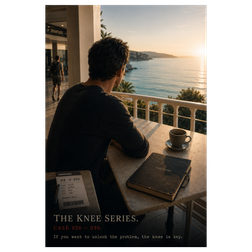
He closed the notebook on the last morning and looked out at the sea. Ten cases. Ten knees. One week on the coast that had not, in any meaningful sense, constituted a holiday. He was already thinking about the flight home — whether the man in the aisle seat had been limping slightly when he boarded. If you want to unlock the problem, the knee is key.
Case 030: The Loaded Spring — Patellar Tendinopathy
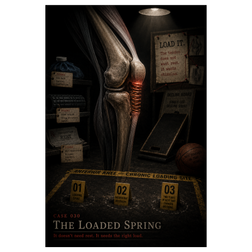
Case 030: The Loaded Spring — Patellar Tendinopathy Two years. The same tendon, the same clinicians, the same advice: rest it, ice it, let the inflammation settle. And every time he returned to the court, it came back within a week. In this final case of the knee series, Sole Trace closes the file on one of sport's most mismanaged tendons — and explains why rest is not the answer. Patellar tendinopathy is not an inflammation problem. It is a loading problem. The tendon that has been rested and stretched for two years has been given everything except the one thing it actually responds to. It's time to load the spring. If you want to unlock the problem, the knee is key.
Case 029: The Friction Line Iliotibial Band Syndrome
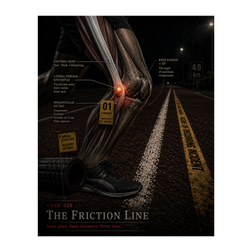
Case 029: The Friction Line — Iliotibial Band Syndrome Kilometre four. Every run, without fail, for six weeks. The lateral knee pain was so consistent it had started to feel like a scheduled appointment. In this case, Sole Trace unpacks one of running's most mismanaged injuries — and why the foam roller and the crossed-leg stretch, however satisfying, are solving the wrong problem. ITB syndrome isn't a tightness issue. It's a compression problem at a specific knee angle, driven by a hip that isn't doing its job. The band isn't the culprit. It's just where the crime scene is. If you want to unlock the problem, the knee is key.
Case 028: The Empty Frame The Phantom X-Ray — When Normal Imaging Hides the Real Story
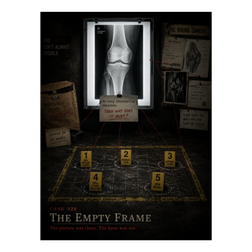
Case 028: The Empty Frame — The Phantom X-Ray She had carried the X-ray for six weeks, convinced someone would eventually see what three clinicians had missed. The report was clean. The knee was not. In this case, Sole Trace investigates the phantom X-ray — the normal imaging result that closes the file on a runner who is still very much injured. From tibial plateau stress reactions to bone bruises, meniscal tears, and chondral lesions, the suspects here are united by one thing: X-ray cannot see them. Knowing what your investigation can and cannot show isn't a technicality. It's the difference between a diagnosis and a dismissal. If you want to unlock the problem, the knee is key.
Case 027: The Inside Job Medial Collateral Ligament Injury
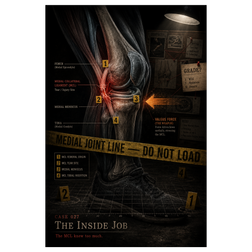
Case 027: The Inside Job — Medial Collateral Ligament Injury A valgus force on a planted knee. Three days of strapping and a transatlantic flight later, he wants to run a half marathon by the weekend. Sole Trace has seen this before — and knows that the real danger isn't the injury itself, it's the grading. A misclassified MCL sprain returns to sport too early, loads an unstable knee, and ends up worse than if it had never been assessed at all. In this case, Sole Trace lines up the suspects — from contact mechanics and chronic valgus collapse to missed meniscal co-injury and the calcium deposit nobody thought to X-ray — and works through the clinical framework that separates a fortnight off from a surgical referral. The MCL usually heals. The question is whether you know what grade you're dealing with before you make that call.
Case 026: The Crossed Pattern Lower Crossed Syndrome
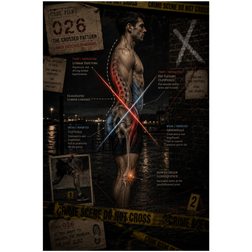
Case 026: The Crossed Pattern Lower Crossed Syndrome Is Lower Crossed Syndrome a genuine clinical phenomenon, or simply a convenient label for a common movement pattern? In this episode of The Foot Detective, Sole Trace investigates one of the most debated concepts in running biomechanics. A runner presents with anterior knee pain, tight hip flexors, an exaggerated lumbar curve, and glutes that seem to have quietly left the conversation. One practitioner calls it Lower Crossed Syndrome. Another dismisses it completely. So who is right? Follow the clues as we examine the relationship between prolonged sitting, anterior pelvic tilt, hip extension deficits, gluteal underperformance, and the downstream effects that often show up at the knee. Inside this case file: The origins of Lower Crossed Syndrome Why hip flexors and glutes matter to runners The link between posture and performance How movement patterns influence knee loading When the problem is the knee—and when it isn't Practical strategies for addressing the pattern rather than chasing symptoms Part biomechanics investigation, part detective story, this episode explores how a seemingly simple postural pattern can influence everything from running efficiency to recurring injury. Because sometimes the pain is just the messenger. The real clues are hidden elsewhere. If you want to unlock the problem, the knee is key. 🎙️ The Foot Detective Takes on the Knee A series of running injury mysteries, solved one clue at a time.
Case 025: The Front Line — Quadriceps Strain & Tear
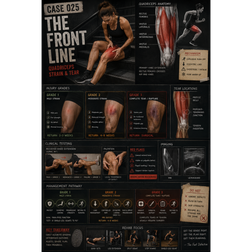
This one happens in a moment. A step, a push, a burst of effort — and then a sharp pain across the front of the thigh. The runner can still move, but something isn’t right. The leg doesn’t want to straighten with the same confidence. There’s hesitation where there used to be power. They’ll call it a quad strain. Ice it. Rest it. Give it a week. Sometimes that’s enough. Sometimes it isn’t. In this episode of The Foot Detective, we open the file on Quadriceps Strain & Tear — where the front line of the thigh fails under load, and the difference between mild strain and serious injury matters more than most realise. We follow the clues through eccentric loading, poor preparation, previous injury sites, and the unique vulnerability of rectus femoris — the muscle caught between hip and knee. This is not just about pain. It’s about function. Can the runner extend the knee against resistance? Is there weakness? A defect? A loss of control? These are the details that separate a two-week recovery from a two-month rebuild — or a surgical referral. We break down how to grade the injury, what each level means for return to running, and why early assessment is the most important decision in the entire process. Because a quadriceps strain isn’t one condition. It’s a spectrum — and getting it wrong at the start changes everything that follows. If you want to unlock the problem, the knee is key.
Case 024: The Long Pull — Hamstring Strain & Proximal Hamstring Tendinopathy
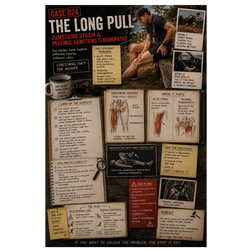
This case looks like one injury, but it isn’t. A sharp pull during sprinting and a deep ache at the sitting bone may both be called “hamstring pain” — but they behave very differently. In this episode of The Foot Detective, we separate acute hamstring strain from proximal hamstring tendinopathy, unpack why stretching can make both worse, and explore how to manage load, rebuild strength, and return to running without repeating the same mistake. Because not every hamstring needs length. Some need better loading. If you want to unlock the problem, the knee is key.
Case 023: The Unravelling — Anterior Cruciate Ligament Injury
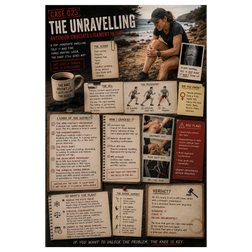
This one starts with a moment the runner remembers clearly: a planted foot, a descent, a pop, and a knee that suddenly no longer feels like it belongs to them. The X-ray was normal. The swelling settled. But three months later, the knee still gives way on uneven ground. In this episode of The Foot Detective, we open the file on the Anterior Cruciate Ligament Injury — the ligament injury too often dismissed as a simple sprain when the early clues are missed. We follow the evidence through rapid swelling, non-contact twisting mechanisms, instability on descents, and the clinical tests that reveal what an X-ray never can. This is not just a dramatic knee episode. It is a structural failure with long-term consequences if it is underdiagnosed, poorly staged, or rushed back too soon. We look at when MRI matters, when surgery becomes part of the conversation, and why ACL rehab is not a quick return — but a nine-to-twelve-month rebuild. Because a knee that gives way is not asking for reassurance. It is asking to be properly understood. If you want to unlock the problem, the knee is key.
Case 022: The Torn Witness — Medial Meniscus Injury
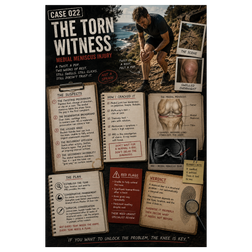
This one comes with a moment the runner can replay clearly. A planted foot. A twist. A pop — felt more than heard. The knee swells overnight, settles with rest, then swells again the moment running resumes. Now it clicks. Sometimes it catches. Occasionally, it gives way just enough to raise doubt. They’ll call it a sprain. They’ll ice it, rest it, and wait. But a knee that keeps swelling, clicking, and refusing to fully trust itself isn’t asking for more time. It’s asking for a proper diagnosis. In this episode of The Foot Detective, we open the file on the Medial Meniscus Injury — the cartilage structure that quietly stabilises the knee until a twist, a load, or time itself exposes its limits. We follow the clues through joint line pain, recurrent swelling, mechanical symptoms, and the tell-tale history of rotation under load. This is not just about a tear. It’s about what that tear does to the knee — how it alters load distribution, disrupts stability, and creates a joint that can no longer move cleanly through its range. We break down the difference between stable and unstable tears, acute and degenerative presentations, and why some runners return with rehab while others require surgical input. Because not every meniscal tear needs the knife. But every meniscal tear needs to be understood. We explore how to identify it clinically, when imaging matters, and why a knee that locks, swells repeatedly, or gives way is telling you something that shouldn’t be ignored. Because sometimes the problem isn’t the pain. It’s the piece of the joint that’s no longer playing its role. If you want to unlock the problem, the knee is key.
1 of 4