The Books Breakdown

The Books Breakdown

by Jay Fincher
Season 1
Reading your P & L like a pro,...

Episode Summary Most business owners receive a Profit and Loss statement every month and never really look at it. In this episode, we break down what a P&L actually tells you, why it matters more than you think, and how to start using it as a real decision-making tool — not just a document your accountant sends you. What You'll Learn The difference between a P&L (a "movie" over time) and a balance sheet (a "snapshot" in time) How to read revenue trends instead of just single-month numbers What COGS (Cost of Goods Sold) is and why gross profit is one of the most important numbers on the page How operating expenses can quietly creep up and erode profitability Why operating income is often the truest measure of business health A simple monthly habit for spotting problems before they become crises The critical difference between profit and cash (and why they're not the same thing) Key Takeaway Your P&L isn't just paperwork — it's a diagnostic tool. Five minutes a month comparing your top line, gross profit, expenses, and bottom line can help you catch problems early and understand your business's real trajectory. Homework From This Episode Pull up last month's P&L and review four numbers: revenue, gross profit, operating expenses, and net/operating income. That's it. Mentioned in This Episode Cherokee Bookkeeping Co. — flat-rate, no-surprises bookkeeping for small businesses nationwide 🔗 cherokeebookkeeping.com
Cash Flow Management
EPISODE RECAP — KEY TAKEAWAYS 1. Cash flow is the timing of money moving in and out — not the same as profit. 2. You can be profitable on paper and still have a cash crisis if the timing doesn't line up. 3. A 13-week rolling cash flow forecast lets you spot gaps before they become emergencies. 4. Invoice immediately and shorten payment terms to accelerate cash coming in. 5. Negotiate extended terms with vendors to slow cash going out. 6. Build a cash reserve of 1–3 months of operating expenses as a safety buffer.
Accounts Receivabe
In this episode, Jay breaks down Accounts Receivable — the money owed to your business for goods or services already delivered but not yet paid for. Jay explains where AR sits on the Balance Sheet, why it's classified as a current asset, and how a high AR balance can create serious cash flow problems even when business looks good on paper. The episode also covers the AR Aging Report — a key tool for tracking overdue invoices and staying ahead of collection issues. Presented by Cherokee Bookkeeping. Co.
Debits, Credits, and the Magic of Double-Entry
Ever stared at your books and thought — wait, why does this debit go here and the credit go... there? You're not alone. On this episode of The Books Breakdown, we're cutting through the confusion around one of the most misunderstood concepts in small business finance — debits and credits — and the 600-year-old system that holds your entire financial picture together. We'll break it down with real examples, plain language, and a cheat sheet you'll actually remember. No accounting degree required.
Depreciation & Accumulated Depreciation
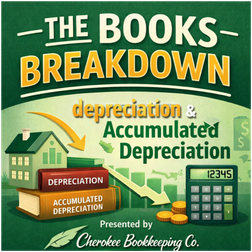
Ever wondered why you can't just write off a big equipment purchase all at once? In this episode, we break down two of the most misunderstood concepts in small business accounting — depreciation and accumulated depreciation. Using a simple, real-world example, we explain how depreciation spreads the cost of a long-term asset over its useful life, and how accumulated depreciation tracks the total wear and tear on your balance sheet. We also cover why all of this matters for your taxes, your financial statements, and your long-term business planning. Short, clear, and practical — just the way we like it at Cherokee Bookkeeping Co.
Tax deductions for small businesses
Money back in your pocket....