The Bill Board, a Numismatic Journey with Banknotes

The Bill Board, a Numismatic Journey with Banknotes

by Tim Baker
Season 2026
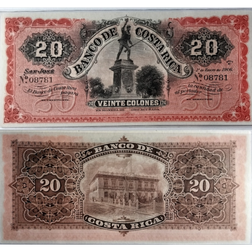
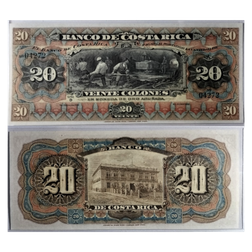
Costa Rica: Banco de Costa Rica 20 Colones Series D (1901)
The turn of the 20th century marked a definitive inflection point for the Republic of Costa Rica, a period characterized by the ascendancy of the "Liberal State" and the aggressive modernization of its economic infrastructure. The banknote we are looking at—the Banco de Costa Rica 20 Colones, Series D, dated 1901 encapsulates the nation’s aspirations toward industrial progress, financial stability, and architectural grandeur. The specific specimen under analysis, identified by Serial Number 04272, belongs to a series of banknotes produced by the American Bank Note Company (ABNC) of New York. By deconstructing its physical composition, iconographic narratives, and institutional origins, we reveal the broader economic tapestry of the "Generation of Olympus" (Generación del Olimpo)—the liberal elite that governed Costa Rica and sought to integrate its coffee-based economy into the gold-standard global markets of Europe and North America.1 This report asserts that the Series D 20 Colones note was designed to function as a "monument in paper." At a time when the Costa Rican Colón (introduced in 1896) was solidifying its value against gold, the Banco de Costa Rica—the nation's premier financial institution—commissioned a currency that visually equated the extraction of mineral wealth (the obverse mining scene) with the solidity of banking institutions (the reverse architectural portrait). The survival of Serial 04272 as a high-grade remainder allows for a pristine view into the engraving mastery of the late Victorian era, offering numismatists and historians alike a tangible link to the zenith of private bank issuance in Central America.
Costa Rica: Banco de Costa Rica 20 Colones Series C (1906) Banknote
A review of the history of the bank, the iconongraphy on the banknote, the Series C, and the market and technical specs. Did you know there was an American who wanted to establish English speaking colonies and slave states in Latin America and who was celebrated in the U.S>? Listen and find out where he fits in to the story.
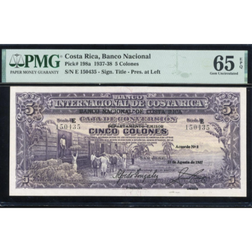
Costa Rica: PMG 65 EPQ Banco National De Costa Rica 5 Colones 1937-1938 (Pick 198a)
The study of Latin American currency provides a unique lens through which to view the economic and political evolution of the region. We are looking at the Costa Rica 5 Colones note of 1937-1938, cataloged in the Standard Catalog of World Paper Money as Pick 198a. This banknote is not merely a medium of exchange; it is a transitional artifact that bridges two distinct eras of Costa Rican banking history: the period of the Banco Internacional de Costa Rica and the subsequent establishment of the Banco Nacional de Costa Rica. This report focuses on a specific, high-grade specimen of this issue: a 5 Colones note graded PMG 65 EPQ (Gem Uncirculated), identified as a "Top Pop" (Top Population) rarity. The existence of such a pristine example is a statistical anomaly given the tropical climate of Costa Rica and the heavy circulation these low-denomination notes typically endured. The note is characterized by its provisional nature—a revalidation of an earlier issue via a typographic overprint—and its striking obverse vignette, familiarly known to collectors as the "Banana Train." The visual narrative of the note, depicting the loading of bananas onto a railway car, encapsulates the "Green Gold" era of Costa Rica, dominated by the United Fruit Company and the Atlantic Railroad. This report will dissect the historical context, technical specifications, security features, and market dynamics surrounding this numismatic treasure, providing a definitive reference for the advanced collector.
Mexico: Mexican Currency History from Cacao to Polymer
Great overview to start with Mexican currency, from pre-Hispanic, to colonial to pre-revolution to revolution to independence to the latest issues, the Series G
Mexico: La Tresoria General del Estado de Oaxaco 5 Pesos (1916)
AI
The study of regional Mexican currency during the decade-long civil conflict of 1910 to 1920 provides an unparalleled lens through which to view the macroeconomic collapse and political fragmentation of a modernizing nation. Among the most historically significant numismatic issues of this era are those originating from the State of Oaxaca. In 1915, to insulate itself from the factional violence tearing through the republic, the Oaxacan government declared state sovereignty.1 This political maneuver necessitated immediate financial independence. The 5 Pesos banknote issued by the Tesorería General del Estado de Oaxaca serves as a prime example of emergency fiat currency. This monetary instrument functioned simultaneously as a medium of daily exchange, a mechanism for state-building, a tool for military funding, and a physical declaration of regional autonomy. This analytical report provides an examination of the 1916 Oaxaca 5 Pesos banknote, focusing specifically on the Series Z specimen dated February 28, 1916. The analysis synthesizes the historical context of its issuance, the political economy of the State of Oaxaca during the revolution, the technical and physical specifications of the series, the biographical contexts of its imagery, and a precise valuation based on current market metrics and third-party grading standards.
Mexico: The Presidential Succession of 1910 by Franciso Madero
AI
The 2012 publication by the Instituto Electoral y de Participación Ciudadana del Estado de Jalisco serves as both a historical preservation of Francisco I. Madero’s seminal work, The Presidential Succession of 1910, and a pedagogical tool for modern civic education. The text honors the legacy of Mexican democratic thinkers who challenged absolute power and militarism, arguing that their stoic defense of republican values laid the necessary groundwork for the country's current institutional legitimacy. Within the excerpts, Madero reflects on his own transition from an indifferent businessman to a revolutionary leader, fueled by a conviction that the Mexican people were ready for representative democracy and an end to the Porfirian dictatorship. Ultimately, the source frames the effective suffrage and no re-election movement as an ongoing moral obligation, emphasizing that public instruction and active citizenship are the primary defenses against despotism.
Mexico: Banco Nacional de Mexico 5 Pesos Banknote (1910)
AI
The 5 Pesos banknote issued by El Banco Nacional de México, dated March 1, 1910 (Pick number P-S257c), is a critical artifact of financial history that encapsulates the economic maturation, political centralization, and societal complexities of late 19th and early 20th-century Mexico. The issuance of this specific banknote was not an isolated event but rather the culmination of decades of legislative maneuvering designed to modernize a fractured and highly localized agrarian economy into a unified, capital-driven state capable of attracting foreign investment. The legal framework authorizing the creation and continued circulation of these banknotes was firmly rooted in the financial policies of the Porfiriato—the era of President Porfirio Díaz's rule. Prior to the late 19th century, Mexico suffered from a severe lack of standardized currency. Various states and private entities issued their own notes, leading to a chaotic system of exchange rates and widespread mistrust of paper money. To remedy this, the Mexican government, largely under the guidance of Finance Minister José Yves Limantour, sought to implement a cohesive national banking structure.1 This effort culminated in the General Institutions of Credit Law (Ley General de Instituciones de Crédito) of 1897. This sweeping legislation formalized the rules for banks of issue (bancos de emisión), requiring them to hold specific metallic reserves—usually gold and silver—to back their circulating notes.1 Under this model, the government permitted a plural issuance system where each state in the Republic was allowed at least one private banknote issuance bank.2 However, the law was structured to heavily favor established monopolies. While the 1897 law restricted most provincial and state banks to issuing notes with a minimum denomination of 5 pesos, El Banco Nacional de México was granted a highly lucrative and unique exemption allowing it to issue notes in denominations of 1 and 2 pesos.1 The thought process behind the design and creation of this series was deeply entwined with the desire to project an image of European-style stability and modernization. The Mexican banking elite contracted the American Bank Note Company (ABNC) of New York to design, engrave, and print the currency.3 The ABNC was the premier security printing firm of the era, known for its intricate geometric lathe work and high-quality intaglio printing. By utilizing the ABNC, the Mexican government and the directors of El Banco Nacional de México ensured that their currency would be visually imposing, practically difficult to counterfeit, and aesthetically aligned with the currencies of global superpowers. The decision to employ classical allegories and standardized portraiture was a deliberate ideological choice, reflecting the prevailing philosophy of Positivism embraced by the Díaz regime, which valued order, progress, and scientific rationalism.
Bermuda: Bermuda Monetary Authority 5 Dollar Polymer Banknote (2024)
The Bermuda 5 Dollars banknote, formally introduced into circulation in the fall of 2024, represents a pivotal technological evolution for the territory's currency system. Operating under the legal framework of the Bermuda Monetary Authority Act 1969, the Bermuda Monetary Authority (BMA) retains the exclusive mandate to issue and redeem the island’s national currency. Under this legislative authorization, the BMA periodically updates the physical medium of exchange to ensure structural integrity and public confidence.4 The 2024 issuance is a direct exercise of this authority, shifting the physical currency from traditional cotton-paper substrates to modern SAFEGUARD® polymer. The decision to redesign and issue this specific banknote was driven by the BMA's strategic goal to modernize the island's cash infrastructure.3 Polymer banknotes are manufactured from a thin, flexible synthetic plastic, typically biaxially oriented polypropylene (BOPP).2 The primary reason for this transition was economic and practical: polymer notes are estimated to last up to two and a half times longer than their cotton counterparts because they are highly resistant to moisture, dirt, and mechanical tearing. The thought process behind the specific design was heavily influenced by a desire to maintain public familiarity while upgrading the underlying technology. To achieve this, the BMA launched the "Same look, Smarter design" campaign, explicitly communicating that while the notes would feel different and contain advanced security protocols, the vibrant color palettes and vertical reverse orientations of the beloved 2009 series would remain largely intact. The note subsequently garnered international acclaim, winning the International Bank Note Society’s (IBNS) “Bank Note of the Year Award” for 2024, as well as the Best New Banknote award at the High Security Printing (HSP) Latin America conference.
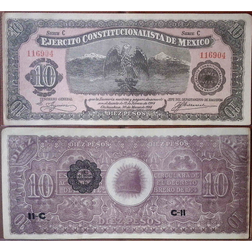
Mexico: Carranza and Pancho Villa, A Review of the Relationship
Exploring the relationship and history of the two men during the Revolution including the numismatic impact
Mexico: Govierno Constitutionalista de Mexico Monclova 1 Peso Banknote (1913)
The introduction of the 1913 Monclova 1 Peso banknote represents a pivotal inflection point in the monetary and political evolution of modern Mexico. The creation of this currency was not born from an orderly macroeconomic policy, but rather from the desperate financial requirements of a burgeoning revolution. In February 1913, a period known as the "Ten Tragic Days" (La Decena Trágica) culminated in the assassination of the democratically elected President Francisco I. Madero and Vice President José María Pino Suárez. Following this, General Victoriano Huerta seized control of the federal government in Mexico City, establishing a military dictatorship. Venustiano Carranza, who was serving as the Governor of the northern State of Coahuila at the time, steadfastly refused to recognize the legitimacy of the Huerta administration. On March 26, 1913, Carranza and a coalition of northern military leaders promulgated the Plan of Guadalupe. This political manifesto formally declared their rebellion against Huerta, established the Constitutionalist Army, and designated Carranza as the "First Chief" (Primer Jefe) of the movement. The primary obstacle immediately facing Carranza's Constitutionalist forces was the acquisition of capital. A military campaign spanning the vast geography of Mexico required immense funding for munitions, provisions, transportation, and troop salaries. The traditional financial infrastructure of the country, including the federal treasury and the established banking monopoly of the Banco Nacional de México, remained firmly under the control of the Huerta regime in the capital. Furthermore, as political instability swept the nation, hard currency—specifically gold coins and the standard silver pesos—rapidly vanished from circulation as citizens and foreign businesses hoarded precious metals to protect their wealth. Faced with a complete lack of specie and cut off from the capital markets of Mexico City, Carranza turned to the issuance of unbacked fiat paper currency. On April 26, 1913, operating out of his initial stronghold in Monclova, Coahuila, Carranza issued a decree authorizing the creation of the first official paper money of the Constitutionalist Government. This legal decree formed the foundation for the "Monclova Issue". The decree mandated that the new banknotes be recognized as legal tender within all territories subdued by the Constitutionalist Army. The initial authorization permitted the issuance of five million pesos, an amount that would be repeatedly expanded via subsequent decrees as the conflict escalated.
1 of 10