Scottish Centre for Global History

Scottish Centre for Global History

by University of Dundee
Season 1
Graduate Research: Diana Mendez Rojas on Agricultural Knowledge in Mexico (1940-1980)
Diana Mendez Rojas shares her doctoral research on the growth agricultural knowledge in Mexico between 1940-1980. She focuses on fellowship winners, from the Rockefeller Foundation, and how their graduate experiences across the world influenced Mexico's knowledge and agricultural practice. Diana also talks about how this history links to the Green Revolution and Mexico's role in this development.
Graduate Research: Niels Boender on Post-Colonial Kenya
PhD student Niels Boender discusses his project on reconciliation in post-colonial Kenya, the Migrated Archives and his work on the recent documentary A Very British Way of Torture.
Graduate Research: Chilean Rural History in the Late Nineteenth Century with Amie Campos
Amie Campos discusses her doctoral research on rural history in Chile in the 19th century. She elaborates on the state relationship with indigenous communities in the south of the country. Amie also tells us about her research experience in Chile. Finally, she shares her move out of academia and reflects on the PhD process.
Graduate Research: British Radio Propaganda in East Africa during Decolonisation
Alex White talks about his doctoral research on British radio propaganda in East Africa during the decolonisation process.
Benjamin Smith on "The Dope" and Doing Latin American History in the UK
Benjamin summarises his book by highlighting his main arguments and sources for the project. He also discusses the reasons for writing a popular history. Thereafter, Benjamin talks about the experience of doing Latin American history in the UK. He shares his personal journey through the PhD in the UK, contrasts the UK and US system and elaborates on the importance of Latin American history in Britain.
Veronica Ehrenreich-Risner on "Bantu Authorities: Apartheid's System of Race and Ethnicity"
Veronica Ehrenreich-Risner discusses her book on Apartheid South Africa. She explains the Bantu Authorities System before discussing why the Apartheid state created it, how it operated, and how it adapted during the regime. Aran MacKinnon also joins the discussion to share his views on Veronica's work and discuss the topic of the Bantu Authorities System.
Graduate Research: Cassie Osei on Social Mobility in Twentieth Century Brazil
Cassie Osei discusses doctoral research on social mobility among Black communities in relation to their experience of housing, labour and education. She begins by sharing with us her academic journey before sharing with us an overview of her doctoral research and her experience of conducting that research. Additionally, she discusses education practice within tertiary education.
Graduate Research: Material Culture in Warri Kingdom, Nigeria during the 19th Century with Allegra Ayida
Allegra Ayida discusses her research on the Warri Kingdom in relation to material culture and imperialism. She also talks about de-centring Europe in her research, oral history and the Benin Bronze debate in the context of museum collections. Link to Allegra's webpage: Home | Allegra Ayida. Books suggested: The Brutish Museums The Benin Bronzes, Colonial Violence and Cultural Restitution by Dan Hicks The Whole Picture: The Colonial Story of the Art in Our Museums & Why We Need to Talk About It” (2020) by Alice Procter
Mark Blyth on Anger, Climate Change, Global Economy and Dundee
Mark Blyth of Brown University talks growing up in Dundee, the role of public anger in the Global Economy, how realistic solutions for climate change and inequality are, and what the two most 'arrogant' disciplines (History and Economics) can learn from one another"
Interview: Reflections on a U.S. Foreign Service Career in Latin America and the Middle East with Stephen McFarland
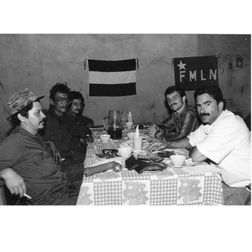
In this interview, Stephen McFarland shares his experiences and reflections on his life in diplomacy. We discuss his experiences in Peru, El Salvador, Guatemala, Nicaragua, Venezuela, Afghanistan, and Iraq among other places. Stephen McFarland is a retired ambassador who served in the U.S. Foreign Service for over 37 years, largely in countries engaged in or emerging from conflict. He had 10 posts in Central and South America, and he also served in Iraq, where he led a provincial reconstruction team in a Marine regiment conducting counterinsurgency operations in Al Anbar during the 2007 surge. Later he headed Embassy Kabul’s law enforcement and rule of law efforts in 2012-2013. After retirement, in 2015-17 he led a USAID justice project in Colombia’s conflict zones, accompanying local officials as they returned to areas the guerrillas had dominated; between 2018 and 2021 he was a consultant on Guatemala for Millicom LLC. The son of Foreign Service officer George McFarland, Stephen grew up in central Texas, Latin America, and the Middle East. He is a graduate of Yale University, the Air War College, and Georgetown University’s School of Foreign Service (Security Studies). He and his wife have four sons. He enjoys playing soccer, hiking, diving, and reading history. Image: Stephen McFarland with FMLN/ERP leadership and U.S. journalist Phil Bronstein in Perquin, El Salvador, April 1990. Copyright © Donna De Cesare, 1990. All rights by permission of photographer only; https://moody.utexas.edu/faculty/donna-decesare
1 of 4