Scaling Intelligence

Scaling Intelligence

by HPC-AI Leadership Organization
Beyond the Benchmark: Sagar Dolas, SURF, on Exascale Scientific Productivity
Sagar Dolas, Program Manager at SURF — the Dutch national organization for digital infrastructure in research and higher education — joins Kevin Jackson to challenge one of HPC's most enduring assumptions: that bigger machines produce more science. Sagar argues that raw compute capacity and scientific productivity are not the same thing, and that the gap between them is growing. At SURF, he and his colleagues have tracked that classical simulation and modeling workflows can lose as much as 25 to 30 percent of their compute time to manual data movement between storage tiers — a problem rooted not in hardware limits but in orchestration, legacy software, and workflow design. He makes the case that if the HPC community had designed systems from the application side outward, a convergent infrastructure meeting the needs of astronomy, high-energy physics, and classical simulation workflows would have emerged a decade earlier. Sagar goes further: the cultural and funding architecture of the field — CapEx for hardware, incidental OpEx for people — structurally underinvests in the expertise that makes machines useful. He proposes replacing the FLOP-count-focused Top500 with a new international ranking that celebrates whole-system scientific productivity, and calls on policymakers to shift from hardware-first to capabilities-first investment, measuring success by time to science, end-to-end workflow throughput, and communities served.
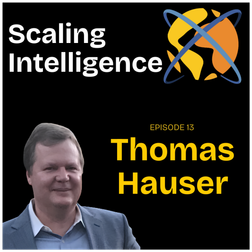
From Cheyenne to Derecho: Thomas Hauser on GPUs, Data, and Global Climate Science
Thomas Hauser is the former director of the Computational and Information Systems Lab (CISL) at the National Center for Atmospheric Research (NCAR) and a HALO member — one of the most consequential HPC facilities in Earth system science. In this episode, he traces his career from computational fluid dynamics and Cray-era supercomputing to leading the team behind Derecho — NCAR's newest system, deployed in 2023 with nearly 4x the throughput of its predecessor, Cheyenne, and with 20% of its capacity built on GPUs. Hauser explains how CISL tackled the challenge of migrating million-line Fortran-heavy atmospheric codes to GPU architectures — not by mandate, but by showing scientists the energy savings. He describes the integration of NCAR's fragmented data silos into GDEX, a modernized data infrastructure now connected to the Open Science Data Federation, where analysis workflows that previously took weeks can complete in minutes. He discusses NCAR's international collaborations with EPCC in Edinburgh and HLRS in Stuttgart, and why sharing codes, I/O improvements, and datasets globally makes the entire atmospheric science community stronger. The episode closes with Hauser reflecting on a career-long commitment to democratizing HPC access — from small institutions in the Rocky Mountain region to university researchers running AI workflows on national infrastructure.
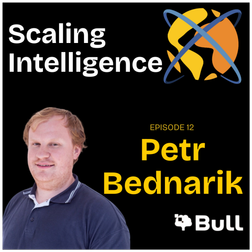
From POC to Production at 30% of Cloud Cost: Petr Bednarik on Bull’s Sovereign AI Stack
Petr Bednarik is Enterprise AI Global Lead at Bull, the newly independent French sovereign AI company carved out of Atos and backed by the French sovereign fund. In this episode, Kevin Jackson talks with Petr about Bull's strategic transformation — from HPC hardware vendor to a full-stack AI provider covering infrastructure, data platforms, and end-to-end use case delivery. Petr brings a rare vantage point: he founded DataSentics, the 300-person AI consultancy Bull acquired four years ago, and now leads the use-case side of the combined business. Petr explains Bull's four-challenge framework — impact, regional control, openness, and sustainability — and why Bull insists on starting every client engagement with use-case value before touching infrastructure. He walks through a concrete case from a major Asian financial institution where Bull deployed AI-powered speech-to-text and LLMs to automate call-centre compliance monitoring across thousands of agents. Scaling the validated cloud pilot to full production would have been prohibitively expensive; Bull's ability to match dedicated, AI-optimised on-prem hardware to the specific workload brought total cost to roughly 30% of a naïve cloud scale-out, while preserving the regulatory control the client required. The conversation then turns to AI factories — national and institution-scale clusters where Bull goes beyond selling GPUs to helping governments drive real utilisation across ministries, railways, and public agencies. Petr also unpacks Bull's hybrid sovereignty model, the Bull Sequana AI open-source platform, and why BXI interconnect is Bull's near-term regional sovereignty win while European GPU alternatives remain years away.
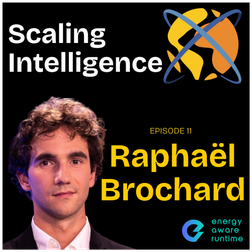
Cutting GPU Energy Use by 20%: Raphaël Brochard on How EAR Makes HPC and AI Data Centers Energy-Aware
In this episode of Scaling Intelligence, Kevin Jackson speaks with Raphaël Brochard, General Manager of Energy Aware Runtime (EAR) — a spin-off from Barcelona Supercomputing Center — about why energy efficiency is becoming a hard constraint for AI and HPC data centers. EAR delivers real-time, vendor-agnostic energy optimization across CPUs, GPUs, and I/O — automatically reducing GPU energy use by ~20% on AI workloads, with up to ~50% possible through deeper tuning. Raphaël explains how the system works, where it sits in the stack, and what operators at sites like LRZ, EDF, and SuperMUC-NG have learned from deploying it. The conversation also explores how energy visibility often reveals hidden inefficiencies, and why topics like smart power capping, peak demand penalties, grid constraints, and carbon-aware scheduling are becoming increasingly important. Finally, they discuss where energy management in large-scale compute is heading — and why energy is quickly becoming a first-class constraint in AI and HPC operations.
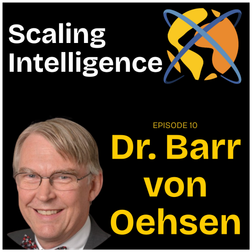
Inside Pittsburgh Supercomputing Center: Barr von Oehsen on AI Infrastructure, Quantum, and the Keystone Research Factory
In this episode of Scaling Intelligence, Kevin Jackson speaks with Dr. Barr von Oehsen, Director of the Pittsburgh Supercomputing Center (PSC), about how PSC is helping shape the future of AI infrastructure, quantum computing, and advanced research computing. Barr shares his path from pure mathematics to leading one of the nation’s premier supercomputing centers, then explains why PSC is pushing beyond traditional HPC to support a new era of AI-driven research, shared statewide infrastructure, and quantum readiness. A major focus of the conversation is PSC’s Keystone AI and Quantum Factory initiative, an effort to bring together universities, government, startups, and industry across Pennsylvania to build a more connected and competitive innovation ecosystem. Barr discusses the need for shared compute infrastructure, secure multi-tenant environments, workforce development, edge-to-cloud architectures, and new models for supporting researchers and startups as AI adoption accelerates. The discussion also explores the practical barriers organizations face today, from power and cooling limits to fragmented resources, cloud cost challenges, and the shortage of people who know how to deploy and operate modern AI infrastructure at scale. What you’ll hear in this episode Barr von Oehsen’s journey from pure mathematics into supercomputing leadership How PSC is expanding from traditional HPC into AI and quantum computing What the Keystone AI and Quantum Factory is and why it matters Why Pennsylvania is building a statewide approach to AI infrastructure and workforce development The infrastructure challenges behind modern AI, including power, cooling, data centers, and secure environments How PSC supports researchers, startups, and institutions with advanced computing resources Why workforce development for AI infrastructure is now a strategic priority How state-level initiatives may shape the future of U.S. AI competitiveness
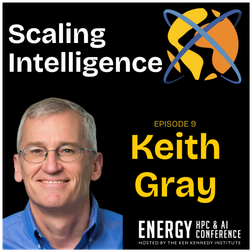
Why Energy Leads HPC and AI Growth—A conversation with Keith Gray of TotalEnergies
In this episode of Scaling Intelligence, Addison Snell speaks with Keith Gray, VP of Computational Science and Engineering at TotalEnergies, about why the energy sector is now the fastest-growing market for HPC and AI. They discuss how AI is being integrated into physics-based workflows, why HPC remains essential for seismic imaging and reservoir simulation, and how advanced computing is accelerating research across oil and gas, carbon capture, wind, solar, and hydrogen. The conversation also previews the Rice Energy HPC and AI Conference (Feb 24–26, 2026), covering its role in industry collaboration, talent development, and real-world HPC use cases. Event details mentioned in the episode: Rice Energy HPC & AI Conference 📍 Rice University, Houston, Texas 📅 February 24–26, 2026 🌐 https://energyhpc.rice.edu Recordings from the event are published via the Ken Kennedy Institute YouTube channel.
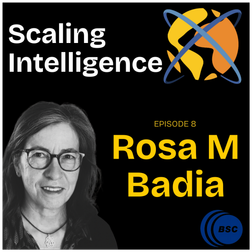
How AI Is Reshaping HPC Software and Supercomputing | Rosa Badia (BSC)
In this episode of Scaling Intelligence, we speak with Rosa Badia, Director of the HPC Software Research Area at the Barcelona Supercomputing Center (BSC), live from SC25. Rosa discusses her new leadership role overseeing BSC’s HPC software research, how the center is organizing work across HPC, AI, and hardware, and what she’s seeing as AI rapidly reshapes supercomputing. We explore BSC’s efforts in large language models, AI-driven digital twins, and hybrid HPC–AI and HPC–quantum workflows, as well as its role as a host for European AI Factories. We also talk about why SC remains such a critical meeting point for the community, the challenges ahead as new technologies scale, and BSC’s strategic work on open RISC-V–based architectures and the software stack behind future systems like MareNostrum 6. Links & Resources Learn more about HALO / Join for free → hpcaileadership.org/apply Follow Scaling Intelligence on LinkedIn → linkedin.com/showcase/scaling-intelligence-halo
Inside Alice Recoque: Europe’s New Exascale-Class AI Factory
In this episode, recorded live at SC25, we talk to the CEA and GENCI team behind Alice Recoque, Europe’s newest exascale-class AI Factory. We cover why the system honors AI pioneer Alice Recoque, how AI + HPC + quantum converge in this architecture, what makes the access model so SME-friendly, and why this system matters for Europe’s sovereignty agenda. A concise, insider look at the team building one of Europe’s most significant research infrastructures. Links & Resources Learn more about HALO / Join for free → hpcaileadership.org/apply Follow Scaling Intelligence on LinkedIn → linkedin.com/showcase/scaling-intelligence-halo
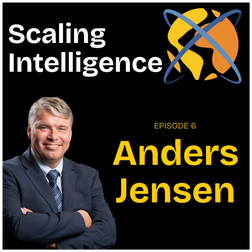
Anders Jensen on Europe’s Exascale Moment: JUPITER, Digital Sovereignty, and AI Factories
Host Kevin Jackson talks with Anders Jensen, Executive Director of Executive Director of the European High Performance Computing Joint Undertaking (EuroHPC JU), about Europe’s first exascale system JUPITER, AI factories, digital sovereignty, RISC-V innovation, and quantum ambitions—revealing how EuroHPC is shaping the future of Europe’s high-performance and energy-efficient computing.
The Sweet Side of HPC: Jay Lofstead on Mentorship, Inclusion, and Gelato
Discover the human side of high-performance computing (HPC). In this episode of Scaling Intelligence, host Antonia Maar talks with Jay Lofstead, Principal Member of Technical Staff at Sandia National Laboratories, about mentorship, inclusion, and community building — with a side of gelato. 🍦 Jay shares his unconventional journey into HPC and AI research, the story behind the now-global HPC Gelato Group, and his insights on fostering inclusive networks through Women in HPC and beyond. Together, they explore what authentic mentorship means, how to empower new talent in technical fields, and why curiosity — like ice cream — is best shared. Links & Resources Join the HPC Gelato Group → linkedin.com/groups/14316155 Learn more about HALO / Join for free → hpcaileadership.org/apply Explore Women in HPC → womeninhpc.org Follow Scaling Intelligence on LinkedIn → linkedin.com/showcase/scaling-intelligence-halo
1 of 2