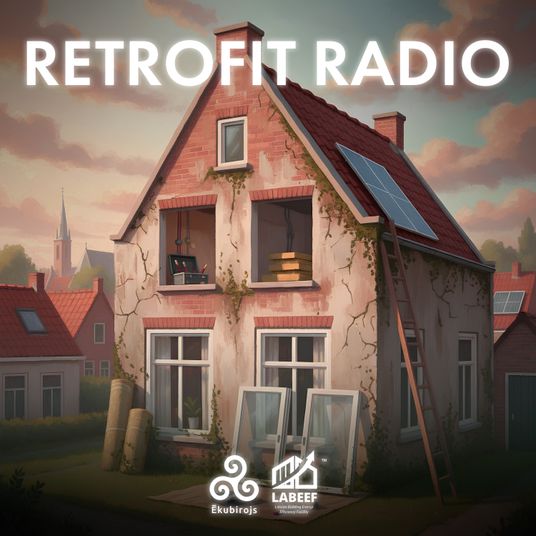
Retrofit Radio
by Nicholas StancioffSeason 1
Nicholas kicks things off by pulling back the curtain on what he calls "invisible energy poverty" — the 34 million Europeans who can't afford to heat their homes, except the real number is almost certainly much higher, because most people suffering won't even admit it. He takes you inside a freezing apartment in Besançon, France, where a mum is choosing between turning on the heat and buying groceries — and from there, unpacks how energy poverty isn't one thing, it's nine distinct profiles, each with different causes and different solutions that most policies completely ignore. The episode ends on a genuinely exciting note: the RENEW-IT project, which asks the completely radical question — what if the people living in these buildings just fixed them themselves? Not with a manual and a pat on the back, but with real training, side-by-side with professionals. And it's working: costs down 15%, people gaining skills, neighbors becoming friends, and — maybe most importantly — the shame of invisible poverty replaced by something that actually looks like pride. 
The Numbers Behind Europe's Energy Crisis
This one starts with a scenario that feels almost comically unfair once you see it clearly: you're a landlord with a broken heating system, but your tenants pay the bills. You're a tenant in a freezing apartment, but you don't own the building. So neither of you does anything — and the cold just... continues. That's the split incentive, and Nicholas lays out just how structurally maddening it is: in the US alone it wastes between $4 and $11 billion a year, and renters use 2.7% more energy overall than homeowners simply because landlords haven't invested in efficiency. It gets worse. Even when landlords could charge higher rent for an efficient building, tenants in Berlin studies only valued each euro of energy savings at 23 cents more in rent. A balcony? Worth more than insulation. Partly because Energy Performance Certificates are unreliable (up to 62% are wrong in the UK), and partly because markets just can't value what they can't accurately measure. But Nicholas ends with real hope: Denmark's tenant-governed social housing cut energy consumption 45% since the 1970s, and better EPC standards are already doubling how much tenants value efficiency. 
Here's the uncomfortable truth Nicholas lays out in this episode: even when retrofits do happen, they often don't work the way anyone promised. In the UK's flagship Retrofit for the Future programme, the majority of homes used 50% more energy than predicted post-retrofit. The reasons layer on top of each other — the "pre-bound effect" (fuel-poor households were already under-heating, so the baseline was always a fiction), shoddy construction, bad handovers where nobody explained how to use the new systems, and then the "rebound effect," where people finally warm up their homes properly and the promised carbon savings evaporate. And then there's the middle-income retrofit trap, where programs end up serving neither the fuel-poor (who get grants) nor the wealthy (who can self-fund), but completely miss the majority in between. Nicholas is genuinely exasperated by this — and rightfully so. The UK's Green Deal had a conversion rate of 0.6%. Not because people didn't care, but because complexity, distrust, and financial risk made saying no the rational choice. The fix, he argues, isn't more money — it's smarter design, honest timelines, and treating energy efficiency like the infrastructure it actually is. 
If there's a single theme running under everything in this series, it's trust — or the lack of it. This episode opens with a tower block in Leicester where residents turned down a genuinely good retrofit because they'd been lied to too many times before. Nicholas makes the case that the trust deficit isn't just a soft problem on the side — it's the reason retrofits fail even when the technology is right. In Milan, 500 tenants in comprehensively upgraded social housing used 80% more energy than predicted, largely because they didn't trust the new systems enough to actually use them as intended. The flip side is just as striking: a community solar project in Boston, run through local faith communities with real cooperative governance, achieved higher enrollment in low-income neighborhoods than wealthier ones — because the messenger was trusted. Nicholas outlines what trust actually looks like in practice: consistency, transparency, responsiveness, and real personal relationships — not form letters, but someone who shows up, learns your name, and keeps their promises. A Colorado programme that spent 18 months just building relationships before touching a single piece of equipment ended up far exceeding its retrofit targets. Not more funding. More trust. 
The finale pulls it all together and lands on something genuinely hopeful. Nicholas introduces the RENEW-IT project in full — an EU-funded initiative running right now across France, Germany, and Spain that's testing a simple but radical idea: what if energy-poor residents didn't just benefit from retrofits, but actually did the work themselves? With residents handling roughly 30% of tasks under professional supervision, the project cuts labor costs by around 15% — which on a €50,000 retrofit translates to €7,500 per home, often the difference between impossible and possible. But the deeper story is about what happens to people. RENEW-IT is designed to create career pathways out of energy poverty: 600 former energy-poor residents are expected to transition into retrofit sector jobs, and the goal is 6,000 residents affected and 120 buildings retrofitted within five years. Nicholas ends the series where he started — with those 34 million people — but reframes them completely. They're not a problem to be solved. They're the solution waiting to be activated. And if RENEW-IT gets it right in those four pilot buildings in Besançon, Berlin, Getafe, and Centelles, the model is entirely open-source and free for anyone, anywhere, to replicate.