Rethink Your Understanding

Rethink Your Understanding

by Phil Clark
Season 3
The Flat Org That Still Had Managers
AI
In this episode, the AI hosts explore my article, which argues that a flat organization is not defined by fewer managers, but by where authority and decision-making reside. The conversation examines a model where self-managed teams own delivery while managers focus on coaching, development, and creating the conditions for autonomy to work. Link to the article: The Flat Org That Still Had Managers, originally published May 31, 2026. Connect with me on LinkedIn
AI Can Shrink Your Team. It Cannot Shrink the Work
AI
AI can make teams faster, leaner, and more capable, but it does not make judgment, ownership, and accountability disappear. In this episode, the AI host explores my recent article on the leadership risk of mistaking reduced task effort for reduced responsibility. As teams become more AI-enabled, leaders must think carefully about technical depth, feedback loops, quality, cognitive load, and where accountability actually lives. The goal is not simply to create the smallest team. The goal is to design the smallest sustainable system. Link to the article: AI Can Shrink Your Team. It Cannot Shrink the Work, originally published May 22, 2026. Connect with me on LinkedIn
More Code Is Not More Value
AI
In this episode, the AI hosts discuss my post on how AI is becoming an operating model test for modern organizations. AI is producing more code, more activity, and more visible output, but that does not automatically mean more business value. Drawing from recent IBM, CircleCI, and DORA insights, I explain how AI can expose weak systems, increase productivity debt, and overwhelm teams when speed is not matched with flow, accountability, and outcome discipline. AI is a multiplier, but what it multiplies depends on the strength of the system around it. Link to the article: More Code Is Not More Value: Why AI Is an Operating Model Test, originally published May 17, 2026. Connect with me on LinkedIn
The Real Definition of Done
AI
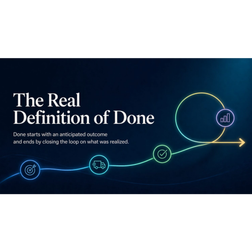
This episode explores a needed shift in how software teams define when work is actually complete. Traditionally, “the definition of done” has meant that a feature was coded, tested, and released to production. The AI hosts discuss my perspective that this definition is incomplete because it focuses on delivery activity rather than customer or business impact. A more mature approach starts with anticipated outcomes and closes the loop after delivery to understand whether the work achieved its intended result. By connecting workflow with realization, organizations can move beyond output and turn delivery into learning, evidence, and strategic value. Link to the article: The Real Definition of Done, originally published April 14, 2026. Connect with me on LinkedIn
AI Is a Multiplier
AI
Today’s conversation explores why enterprise AI adoption should be treated as a system-wide transformation rather than simply a tool for faster coding. The AI host discusses how AI acts as a multiplier, strengthening organizations with mature delivery systems while exposing risk, defects, and fragility in weaker ones. The episode highlights the importance of AI literacy, strong DevOps practices, human accountability, and a full value stream mindset. At its core, this conversation challenges leaders to look beyond coding productivity and ask a bigger question: Is their operating model strong enough to amplify AI? AI will not fix a broken delivery system. It will reveal the truth of how an organization actually delivers value. Link to the article: AI Is a Multiplier, originally published April 09, 2026. Connect with me on LinkedIn
Software for Humans, Systems for Agents
AI
In this episode, the AI hosts explore why the agentic era is shaping up to be more than another AI feature wave. As software begins to act on behalf of users, engineering and product leaders may need to rethink the systems beneath the interface, from data quality and secure APIs to durable state, long-running workflows, and human approval checkpoints. They discuss why trust will likely build gradually, starting with lower-risk tasks before expanding into higher-stakes transactions. The bigger idea is simple: this looks more like a major systems shift, similar to cloud or continuous delivery, than a surface-level product enhancement. Link to the article: Software for Humans, Systems for Agents, originally published April 06, 2026. Connect with me on LinkedIn
Staying Was the Hard Move
In this episode, the AI hosts unpack my recent career reflection article, Staying Was the Hard Move, and the counterintuitive truth that long tenure doesn’t have to mean stagnation. They explore what it actually takes to lead through the “hard middle” of digital transformation: modernizing legacy architecture without breaking customer trust, scaling engineering practices through years of growth, and evolving from tactical management into executive leadership focused on team outcomes. It’s a story about compounding impact, how resilience, culture, and sustained reinvention can become the real advantage. Link to the article: Staying Was the Hard Move, originally published February 28, 2026. Connect with me on LinkedIn
Agile Isn’t Dead and AI Isn’t Killing It Either
I keep seeing “Agile is dead” headlines, now repackaged for the AI era. My take: AI isn’t killing Agile. AI is illuminating constraints that were already in the value stream. AI can do market research, write documentation, write code fast - it can’t take accountability. As AI compresses execution time, rebundles responsibilities, and enables smaller teams with faster release cycles, the real work shifts to human judgment: decision-making, validation, security, governance, and operating safely in production. This episode reframes Agile and agility as an enduring capability, and explores what must evolve when software delivery accelerates dramatically with AI. Link to the article: Agile Isn’t Dead and AI Isn’t Killing It Either, originally published January 24, 2026. Connect with me on LinkedIn
Season 2
AI Fluent, Fundamentally Lost
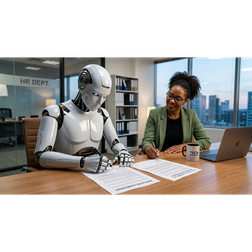
AI is now table stakes in software engineering hiring, but it is also warping the signals we used to trust. In this episode, the AI hosts cover my article about a growing pattern I call “AI-fluent, fundamentally lost”: candidates who can produce impressive output with prompts, yet struggle to explain the logic, constraints, and architectural trade-offs behind what they ship. The result is a new kind of risk: “glass cannons” that look productive fast, but can drive long-term maintenance cost and technical debt when fundamentals and judgment are missing. They cover the arguments for a more durable hiring approach that evaluates both system-level reasoning and AI-assisted execution, treating AI as a productivity accelerator, not a replacement for critical thinking. Link to the article: AI Fluent, Fundamentally Lost, originally published December 07, 2025. Connect with me on LinkedIn
When AI Isn't Enough
In this episode, we unpack a new challenge in software hiring: AI is boosting productivity while also creating an illusion of mastery. Candidates can generate impressive AI-assisted code, yet struggle when the conversation moves to fundamentals like composition vs. inheritance, tradeoffs, and architectural decision-making. The result is a distortion of traditional hiring signals, where output can mask gaps in understanding. The AI hosts dig into why fundamentals still matter most in enterprise systems, where reliability, durability, and accountability matter more than raw speed. Great engineers don’t just produce code, they can debug it, validate it, and challenge AI-generated work with sound judgment. We close with what hiring practices must evolve to measure next: architectural reasoning and system-level decision-making, the areas where AI can assist, but not substitute. Link to the article: When AI Isn’t Enough, originally published November 29, 2025. Connect with me on LinkedIn
1 of 7