Owlcast

Owlcast

by M Warrick
Season 1
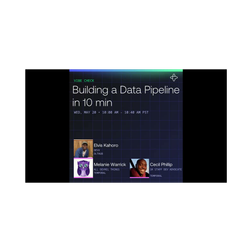
Vibe Check: Zero to Data Pipeline — Building with AI & dlt in 10 Minutes
Watch the video version for the demos and screen shares: https://www.youtube.com/live/GMsIhP3RIHgElvis Kaharu (Developer Advocate at dltHub) joined Melanie and co-host Cecil Phillip for a Vibe Check on building data pipelines in 10 minutes with dlt, the open source Python SDK for moving data from anywhere it lives. Elvis walked through how dlt fits between custom Python scripts and managed platforms, and showed how an agent can one-shot a pipeline when the SDK gives it strongly typed, declarative primitives to fill in. Topics covered: Why data pipelines are more than copying from point A to point B (schema normalization, incremental loads, schema evolution as a SEV) Scaffolding a project with uvx dlthub start and what gets generated for Claude (skills, roles, starter pipeline) Installing dlt toolkits for REST APIs, data quality, and file systems One-shotting a GitHub issues pipeline with Claude and the REST API skill Switching destinations with a single line of code (DuckDB, Snowflake, Iceberg, S3, Hugging Face) Schema contracts with Pydantic and the gatekeeper pattern for handling bad rows Attaching to a pipeline with Marimo notebooks to inspect data, schemas, and run data quality checks Failure introspection via checks.get_failures() and feeding failed rows into another dlt pipeline Exporting dlt transformations as dbt models for regulated industries (health, finance) Where Ibis fits in (Python expressions that compile to SQL in Snowflake) Snowflake Cortex AI operators through Ibis as a way to shift left on AI workloads Skills vs. MCP in the dlt setup, and how skills get tuned differently for Claude, Codex, and Copilot dltHub Pro for hosted pipelines, monitoring, and deploying Marimo notebooks as dashboards If you have ever wired up a brittle ingestion script, fought with a managed connector that did not quite fit, or wondered how agents should actually pull data into your warehouse, this episode is for you. Resources: dltHub: https://dlthub.com/ dltHub on GitHub: https://github.com/dlt-hub Introducing dltHub Pro: https://dlthub.com/blog/introducing-dlthub-pro Hugging Face + dlt for ML: https://dlthub.com/blog/hugging-face-dlt-ml Elvis on GitHub: https://github.com/elviskahoro Temporal on GitHub: https://github.com/temporalio
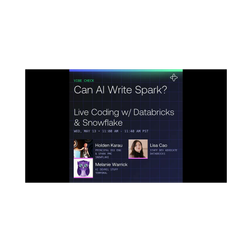
Vibe Check: Can AI Actually Write Spark? Live Coding w/ Databricks & Snowflake
Watch the video version for the demos and screen shares: https://www.youtube.com/live/jCQx4XvrEUk Holden Karau (Snowflake, formerly Databricks) and Lisa Cao (Databricks DevRel) joined us to dig into what it actually looks like to write Spark code with AI agents in 2026. We worked through a real example from Holden's High Performance Spark Second Edition — a Goldilocks-style exact percentiles problem across hundreds of columns — and watched Claude Code handle it from a cold-start repo, then again with proper context and a reference solution. Lisa walked through using a skill file to get Claude to write declarative pipelines the right way instead of hallucinating the syntax, and we talked about why local mode, Arrow UDFs, and the upcoming Python UDF transpilation work in Spark 4.3 matter for AI-assisted Spark development. We also covered: why the "agents trying to shut you up" failure mode shows up in code generation, the case for property-based testing as a guardrail for agentic coding, Spark 3 to Spark 4 porting as a more reliable path than one-shotting Spark 4, and where agents still struggle (dependency management, Spark internals, real stack trace debugging vs. pattern matching from Stack Overflow). Resources: Apache Spark: https://spark.apache.org & https://github.com/apache/spark High Performance Spark (O'Reilly): https://www.oreilly.com Spark testing base: https://github.com/holdenk/spark-testing-base Databricks Spark: https://www.databricks.com/spark/about Data + AI Summit (June 15–18, San Francisco): https://www.databricks.com/dataaisummit Snowflake Summit (June 1–4, San Francisco): https://www.snowflake.com/summit PySpark Data Sources: https://github.com/allisonwang-db/pyspark-data-sources PySpark SDP: https://github.com/lisancao/pyspark-sdp Distributed Computing 4 Kids: https://distributedcomputing4kids.com/ What's working for you when you write Spark with agents? Drop your patterns and gotchas below. And let us know what you want to see on future episodes. Originally streamed May 13, 2026 on Vibe Check Temporal YouTube channel and you can watch the full episode at: https://www.youtube.com/live/jCQx4XvrEUk
Vibe Check at Replay '26: Day 2 w/ Shabnam Emdadi, Francesc Campoy, Melissa Herrera, & Shy
Day two of Vibe Check live from Replay 2026. Shabnam Emdadi, staff software engineer at Shopify and Temporal Constellation member, on what AI frameworks are rediscovering from distributed systems, why retries are more expensive in an LLM world, and the case for judgment over one-more-prompt addiction. Francesc Campoy, Go expert and JustForFunc creator, on his first take on Temporal after the Go workshop, the cognitive offloading vs cognitive surrender distinction, and why software engineering still matters in production. Vibe Check co-hosts Melissa and Shy on the Replay keynote: Melissa's robot arm demo and agents workshop, and Shy's marathon to ship 2,300 hackable conference badges, including how Codex and Claude got the firmware over the line. Resources: Shopify: https://www.shopify.com JustForFunc: https://www.youtube.com/c/justforfunc Replay badge project: https://badge.temporal.io Temporal AI: https://temporal.io/ai Originally published May 7, 2026 on Vibe Check Temporal YouTube channel and you can watch the full episode at: https://www.youtube.com/watch?v=WXAIQxAKW4o
Vibe Check at Replay '26: w/ Ritika Shrivastava, Brian Douglas, Beverly Lu, & Johann Schleier-Smith
Ritika Shrivastava from Ember Robotics talks about what the AI agent world is rediscovering that robotics has known for years, and where companies trip up scaling from one robot to a hundred. Brian Douglas from Paper Compute breaks down their work on agent runtime and durable session recording, and where context engineering is heading post-MCP. Beverly Lu from Chime walks through what it actually takes to ship AI in a regulated fintech: evals as a discipline, domain experts in the loop, and per-model harnesses. We close with Johann Schleier-Smith from Temporal on the AI announcements from the keynote: priority and fairness, large payload storage, workflow streams, serverless workers, and where the harness conversation is heading. Resources: Ember Robotics: https://emberrobotics.com Paper Compute: https://papercompute.com Chime: https://www.chime.com Temporal AI: https://temporal.io/ai Originally published May 6, 2026 on Vibe Check Temporal YouTube channel and you can watch the full episode at: https://www.youtube.com/watch?v=GHHc4rDn8yY&t
Vibe Check: Claude Code Unpacked — How to Actually Ship with AI Tooling
Watch the video version for the demos and screen shares: https://www.youtube.com/live/fQGcbND0Uas Sarah Deaton, Technical Content Engineer at Anthropic and the person who owns the Claude Code docs, joined myself and my co-host Angela Zhou (Sr Technical Curriculum Dev @ Temporal) to walk through what's new and what's underused in Claude Code. We covered Claude Design for non-designers, the difference between CLAUDE.md, skills, hooks, and subagents (and when to reach for each), routines that run on schedules or GitHub events, the new rewind feature, auto mode, forked subagents, and the layers of sandboxing available for safer execution. Topics covered: Claude Design for visual work, mockups, and slide decks (and the handoff into Claude Code) When to use CLAUDE.md vs skills vs hooks vs subagents Why hooks are the deterministic layer underneath the model and where teams misuse CLAUDE.md Slash init for scaffolding a new repo with Claude Code Routines: scheduled tasks plus GitHub events and API triggers Rewind: pulling failed attempts out of the context window without polluting the next try Auto mode and the classifier that gates risky actions Forked subagents: subagents that inherit the full conversation but keep their work isolated Sandboxing tiers: slash sandbox, dev containers, VMs, and Claude Code on the web Resources: Claude: https://claude.ai/new Claude Code docs: https://code.claude.com/docs Claude Design: https://claude.ai/design Code with Claude events: https://claude.com/code-with-claude Session management and 1M context blog post: https://claude.com/blog/using-claude-code-session-management-and-1m-context Temporal AI: https://temporal.io/solutions/ai Note: This is the audio version of a video livestream that included live coding, screen shares, and on-screen demos. For the visual content, watch the full episode on YouTube. Originally streamed April 24, 2026 on Vibe Check Temporal YouTube channel and you can watch the full episode at: https://www.youtube.com/live/fQGcbND0Uas
Vibe Check: Planning a Sailing Trip with AI Agents — ADK Go in Action
Watch the video version for the demos and screen shares: https://youtu.be/rAY1ERVJLY4 Terry Ryan from Google walks us through Naval Plan, a real app he built (and actually uses) to plan sailing trips using ADK Go. The app combines agentic research — pulling from old sailing forums and local knowledge — with deterministic API calls for tides, weather, and sunrise/sunset data. We dig into how the agents are architected, the quirks of working with Google Search as a tool in ADK, and Terry's dev workflow using Gemini CLI. Topics covered: Building Naval Plan: an agentic sailing trip planner with ADK Go Mixing agentic research with deterministic API tools (tides, weather, sunrise/sunset) ADK agent architecture: subagents, tool composition, and the Google Search tool workaround Structured JSON output from agents and how to make it reliable Dev workflow: Gemini CLI in YOLO mode, git-based rollback, and prompt management Using LiteLLM for multi-model support in ADK Tool count limits and context window considerations Upcoming Temporal + ADK integration Links mentioned: ADK: https://adk.dev Naval Plan walkthrough video: https://www.youtube.com/watch?v=kwSVtQ7dziU Charm (Go terminal UI libraries): https://charm.sh Google Cloud Next (Las Vegas): https://www.googlecloudevents.com/next-vegas Originally published April 6, 2026 on Vibe Check Temporal YouTube channel and you can watch the full episode at: https://youtu.be/rAY1ERVJLY4
Vibe Check: New Skill Unlocked with Vercel & Temporal
Watch the video version for the demos and screen shares: https://www.youtube.com/live/CXSHANydwig In this livestream, Donald (AI Foundations engineer at Temporal) and Mark Biza (DX engineer at Vercel) join us for a Vibe Check on skills — what they are, how to build them, and what they unlock for AI-assisted development. Donald previews the upcoming Temporal Agent Skill and live-demos it in Claude Code, while Mark walks through skills.sh, the distribution platform Vercel built to share skills across agents and teams. We go beyond the surface and explore: What Claude Code skills actually are — markdown files with YAML frontmatter that give coding agents structured, domain-specific context Why skills matter: how they guide agents past incomplete or inaccurate training data toward real best practices How the Temporal Agent Skill is structured — a shared core for cross-language concepts plus language-specific folders for Python, TypeScript, Go, and more A live demo: Claude Code building a durable payment workflow using the Saga pattern — unprompted — because it was encoded in the skill Why being able to run and iterate on workflow code (not just write it) is the key unlock for agents debugging Temporal apps How skills.sh works — installation via npx skills add owner/repo, the leaderboard, auditing, and community contributions Vercel's Chat SDK skill and how it scaffolds agents for Slack, Discord, Teams, and WhatsApp Using skills outside of code — marketing, SEO, copywriting, and motion graphics with Remotion Skills vs. MCP: why the future likely uses both together, and where each fits The case for skill cross-dependencies and skill bundles — a feature Donald and Mark noodle on live If you're building on Temporal, experimenting with Claude Code, or trying to understand how to give your coding agents better guardrails and domain knowledge, this episode is for you. The Temporal Agent Skill is launching next week — look for it on skills.sh. Resources: Temporal Agent Skills repo: https://github.com/temporalio/skill-temporal-developer/tree/dev skills.sh: https://skills.sh/ Vercel Agent Resources & Skills: https://vercel.com/docs/agent-resources/skills Temporal with AI: https://docs.temporal.io/with-ai Temporal for AI: https://temporal.io/solutions/ai Temporal Community Slack (share your skill feedback here): https://temporal.io/slack Originally streamed March 13, 2026 on Vibe Check Temporal YouTube channel and you can watch the full episode at: https://www.youtube.com/live/CXSHANydwig