Redacted intelligence

Redacted intelligence

by Quantum
Season 1
A Master of Planetary Defense
AI
Season finale: Michael David Hicks was a 59-year-old NASA JPL physicist and a world-renowned expert on the physical properties of comets and asteroids. He didn't just study space rocks; he worked on the groundbreaking DART Project (Double Asteroid Redirection Test)—the first mission in history to successfully shift the orbit of an asteroid. Michael was literally a pioneer of planetary defense.
The Inventory of Shadows
AI
Steven Garcia was a man of lists. At the Kansas City National Security Campus in Albuquerque, his job was to ensure that every bolt, every circuit, and every firing mechanism was exactly where it was supposed to be. But on August 28th, 2025, Steven himself was no longer where he was supposed to be. He walked into the Albuquerque sun with a handgun and a head full of inventory logs. No car. No phone pings. Just a vacancy in the chain of custody for some of the most sensitive electronics in the American arsenal.
"THE LOS ALAMOS RESET: THE VANISHING GATEKEEPER."
AI
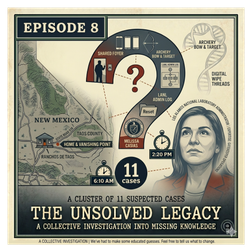
The mystery of Melissa Casias is unique because, on paper, she wasn't a "scientist." She was an administrative assistant at Los Alamos National Laboratory (LANL). Her niece and family have even stated that she didn't have high-level security clearance. However, in the context of the "List of 11," her role is seen by many investigators as a "Gatekeeper" position—someone who might not hold the secrets themselves, but who manages the schedules, emails, and physical access for those who do.
Episode 7: The Fusion Flashpoint
AI
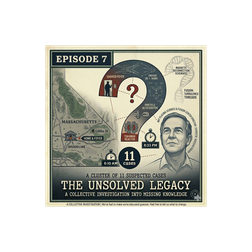
As the head of one of MIT’s largest laboratories, he oversaw more than 250 researchers working across seven buildings. His goal was simple but world-changing: to harness the power of the stars here on Earth. But on a quiet Monday night in Brookline, Massachusetts, the man who spent his life studying magnetic reconnection and fusion turbulence was stepped into a shadow he couldn't see coming. At 8:33 p.m., the doorbell rang repeatedly at Loureiro’s apartment. His twelve-year-old daughter went to check the door. Her father, sensing something was wrong, intervened and told her to stay back. As he stepped into the shared foyer, the silence of the building was shattered by three to six gunshots.
Episode 6: The Dark Matter of Llano
AI
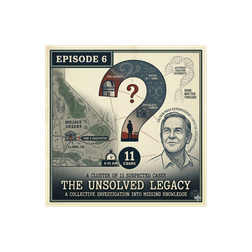
Episode 6: The Dark Matter of Llano – The Death of Carl Grillmair In this episode, we investigate the brutal February 2026 murder of Carl Grillmair, a world-renowned Caltech astrophysicist and NASA veteran. Known as a "detective of the deep," Grillmair’s life was cut short on the front porch of his remote desert home in Llano, California—just eleven days before the disappearance of Major General Neil McCasland. A Mind of Cosmic Scale Working out of Caltech’s Infrared Processing and Analysis Center (IPAC), Grillmair was a pioneer in the study of dark matter and the discovery of stellar streams—ghostly trails of stars that reveal the violent history of our galaxy's formation. His work was so foundational that it was used in the very same aerospace tracking and missile defense systems managed by the Pentagon's high-level officials.
The Thirty-Second Window
AI
The Incident In the summer of 2025, Monica Reza—a 60-year-old elite aerospace engineer—went for a routine Sunday morning hike on the Mount Waterman Trail in the Angeles National Forest. She was an experienced hiker in peak physical condition. At 9:10 AM, she was trailing about 30 feet behind her companion. He turned back, they made eye contact, and Monica smiled and waved. When he turned around again less than a minute later, the trail was empty. Despite a massive multi-agency search involving helicopters, infrared radar, and rappelling teams, not a single piece of her gear or clothing was ever found. The "Mondaloy" Connection Monica wasn't just a NASA JPL employee; she was a materials scientist who held the patent for Mondaloy. This specialized metal alloy is critical for modern rocket engines because it can withstand extreme heat and pressure without corroding. The McCasland Link: The U.S. government project that funded Monica’s revolutionary metal research was overseen by none other than Maj. Gen. William "Neil" McCasland during his time at the Air Force Research Laboratory.
Episode 4: The Vanishing General
AI
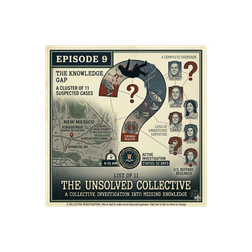
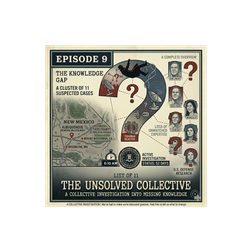
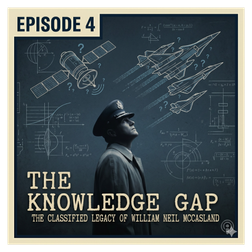
On February 27, 2026, a man who held the keys to America’s most sensitive aerospace secrets walked out of his front door and vanished. Major General William "Neil" McCasland (Ret.), former commander of the Air Force Research Laboratory, left behind his phone and glasses, taking only a revolver into the New Mexico desert. In this episode, we dive into the search that has mobilized the FBI and sparked a firestorm of speculation. Was it a voluntary disappearance, a medical crisis, or does it tie into his legendary work with "Special Programs" and UAP research? We examine the "Knowledge Gap" left behind when a mind of this caliber goes off the grid.
The Ice Trap – The Unsolved Death of Rodney Marks
AI
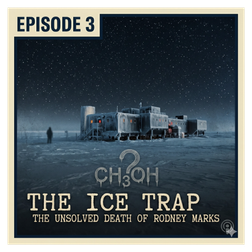
In this episode, we venture to the most isolated laboratory on the planet: the Amundsen-Scott South Pole Station. We investigate the chilling 2000 cold case of Rodney Marks, a 32-year-old Australian astrophysicist who died under mysterious circumstances during the peak of the Antarctic winter. The Mystery at the Bottom of the World Working at the edge of the known universe, Marks was part of an elite team studying deep-space galaxies. But as the "winter-over" period began—a time when the station is completely inaccessible to the outside world—Marks fell violently ill. With no hope of evacuation and limited medical resources, he passed away within 36 hours. Key Investigation Points: The Methanol Revelation: Months later, an autopsy performed in New Zealand revealed a lethal dose of methanol poisoning, turning a tragic "natural death" into a potential homicide investigation. A "Closed-Room" Mystery: With only 49 people on station and no way in or out, the case presents a real-life locked-room scenario. Was it accidental contamination, or something more sinister? Jurisdictional Hurdles: Explore the complex legal challenges of investigating a crime in Antarctica, where international treaties and remote environments make finding justice nearly impossible. The Science of Survival: We look at the psychological toll of extreme isolation and the high-stakes world of polar research. Why This Case Still Haunts Investigators Two decades later, the death of Rodney Marks remains one of the only suspected murders in Antarctic history. We piece together the final hours of the brilliant scientist and explore why the truth remains frozen in time.
The CIA Scientist Who Fell from a Window
AI
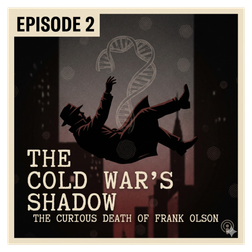
November, 1953. A scientist checks into a hotel in New York City. Days later, he falls from a tenth-floor window. The official ruling is suicide. But the full story would take decades to surface. And even then, it wouldn’t fully explain what happened. Frank Olson was not an ordinary researcher. He was a bacteriologist working for the U.S. Army, specializing in biological warfare. His work existed at the intersection of science, intelligence, and national security. The kind of work that few people fully understood, and even fewer were allowed to discuss. In November of 1953, Olson attended a meeting with colleagues. During that meeting, he was unknowingly given LSD. At the time, the substance was being studied by intelligence agencies. The goal was to explore its potential use in interrogation and psychological control. Olson had no idea he had been dosed. In the days that followed, something changed. Colleagues described him as anxious. Unstable. Deeply disturbed. He began to question his work. He questioned his role. And according to some accounts, he considered leaving his position entirely. For someone involved in sensitive programs, that kind of shift raised concern. Days later, Olson was taken to New York City. He checked into a hotel. In the early hours of November 28th, he fell from a tenth-floor window. His death was ruled a suicide. For more than twenty years, that explanation stood. Then, in the 1970s, new information emerged. The CIA revealed that Olson had been part of an experiment involving LSD. His family learned the truth decades after his death. The U.S. government later issued an apology. But the revelation raised new questions, not fewer. Was his death truly the result of psychological distress? Or was there more to the story? Some investigators pointed to inconsistencies. Details that didn’t fully align. The official record changed, but uncertainty remained. Frank Olson’s story sits at the intersection of science, secrecy, and unanswered questions. A researcher working in sensitive fields. A sudden and unexplained death. And information that surfaced only years later. Some stories are explained. Others are revised. And some remain unresolved.
Flight MH370 and the Scientist on board
AI
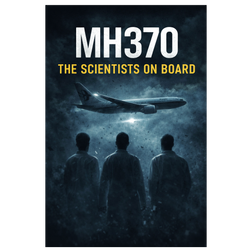
Malaysia Airlines Flight 370 disappearance remains one of the greatest unsolved aviation mysteries in history. But beyond the disappearance of the aircraft itself… were the people on board. In this episode, we examine the professionals, engineers, and specialists aboard Flight 370, including employees connected to Freescale Semiconductor, and explore the role knowledge plays in modern systems—and what is lost when it vanishes. This is not speculation. This is a breakdown of who was there… and why it matters.