Meteorology Matters

Meteorology Matters

by Rob Jones
Season 3
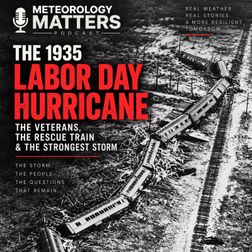
The 1935 Labor Day Hurricane: The Veterans, the Rescue Train & the Strongest Storm
On Labor Day 1935, one of the most powerful hurricanes ever to strike the United States exploded into a Category 5 storm and slammed into the Florida Keys with estimated sustained winds of 185 mph and a central pressure of 892 mb, the lowest pressure assigned to a U.S. hurricane landfall. But this disaster is about much more than the storm itself. Hundreds of World War I veterans were living in federal work camps along the Keys, and an evacuation train sent from Miami reached Islamorada just as catastrophic winds and storm surge arrived. In this episode of Meteorology Matters, we reconstruct the extraordinary meteorology, the primitive forecasting network that struggled to locate the hurricane, Leonard Povey’s historic reconnaissance flight, the desperate rescue-train mission, survivor accounts, and the controversial aftermath that led Ernest Hemingway to ask, “Who Murdered the Vets?” More than 400 people died, including roughly 250–260 World War I veterans. Nearly a century later, the disaster still raises a difficult question: how much responsibility does government have to protect vulnerable people when the forecast itself remains uncertain?
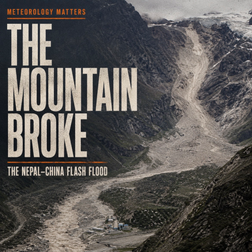
The Mountain Broke: What Caused the Nepal–China Flash Flood?
The seismic signal initially looked like an earthquake. It was the mountain itself collapsing. On August 26, bedrock and glacier ice tore loose high above the Nepal–China border, transforming into a rock–ice avalanche, debris flow, and devastating flood. Meteorology Matters reconstructs that cascading disaster, explains why the evidence points away from a conventional glacial-lake outburst flood, and examines how retreating glaciers and warming mountain permafrost may have destabilized the slope without pretending science has identified one definitive trigger. We follow the human toll, rescue and reconstruction efforts, continuing secondary hazards, and the flood of mislabeled, staged, and AI-generated videos that followed. Then we turn to a very different flash flood in the Grand Canyon to show why a locally catastrophic torrent can destroy critical infrastructure while doing almost nothing to relieve the Colorado River’s long-term water shortage. Two floods, two entirely different mechanisms, and one larger lesson: the condition of the landscape can be just as important as the event that sets a disaster in motion.
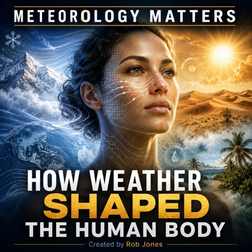
How Weather Shaped the Human Body
What if some of the features you see every time you look in the mirror were partly shaped by weather experienced thousands of years before you were born? In this episode of Meteorology Matters, we explore the extraordinary evidence connecting human evolution with temperature, humidity, sunlight, drought, atmospheric pressure and other environmental conditions. From the shape of the human nose and differences in skin pigmentation to curly scalp hair, body proportions and our remarkable ability to sweat, generations of exposure to very different climates appear to have left biological fingerprints on populations around the world. We also look beneath the surface. Research is revealing genetic differences associated with cold-weather thermogenesis, kidney function and dehydration tolerance in extremely arid environments, and the remarkable physiological solutions developed independently by Tibetan, Andean and Ethiopian high-altitude populations living with reduced oxygen. But climate does not always change humans gradually. Major droughts, cold periods and other environmental disruptions can alter migration, isolate populations, create genetic bottlenecks and change which inherited traits become more common. Finally, we look forward. In today’s interconnected world of international migration, intermarriage, air conditioning, medicine and modern infrastructure, can regional climate still shape human evolution? And as extreme heat, drought and disease environments change, could future generations experience selection involving heat tolerance, sweating efficiency, water conservation, metabolism or entirely different traits we have not yet recognized? Meteorology Matters was created by meteorologist Rob Jones. TikTok: @TVmeteorologist Instagram: @meteorologist Facebook: Hurricane Rob Jones Bluesky: @meteorologist.bsky.social Mastodon: @meteorologist@mstdn.social
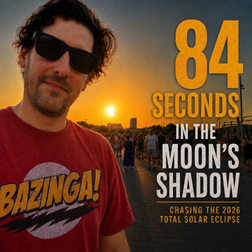
84 Seconds in the Moon’s Shadow: Chasing the 2026 Total Solar Eclipse
Meteorologist Rob Jones traveled to Zaragoza, Spain, with only hours of planning to chase the August 12, 2026 total solar eclipse — all for about 84 seconds inside the Moon’s shadow. What followed was part science experiment, part logistical scramble: sold-out trains and buses, basic hotel rooms approaching €600, rental cars over €800, extreme heat, thousands gathering along the Ebro River, and a first experience of totality powerful enough to explain why eclipse chasers keep coming back. In this episode of Meteorology Matters, we explore what Rob saw and felt during totality including a vivid red solar prominence and compare his first eclipse with veteran eclipse chaser and meteorologist Matthew Cappucci’s description of the same extraordinary event. Then we follow the science far beyond the eclipse itself. Why does the Moon perfectly cover the Sun? Why is it moving away from Earth by about 1.5 inches per year? How do tides, the Bay of Fundy, shifting continents, ocean resonance, Earth’s rotation, melting ice and rising seas influence the Earth-Moon system? Can lunar tides affect earthquakes? And why will total solar eclipses eventually disappear altogether? We also look ahead to August 2, 2027, when totality can last an astonishing 6 minutes 23 seconds. From hurricane chasing to eclipse chasing, this is a story about what happens when science becomes something you don’t just understand… but experience. Follow meteorologist Rob Jones on Instagram, TikTok, YouTube and Facebook, and like, follow, comment and rate Meteorology Matters wherever you listen.
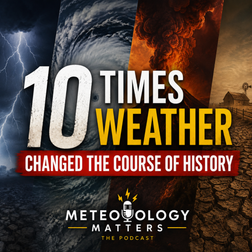
10 Times Weather Changed the Course of History
History is often told through kings, presidents, generals, and revolutions—but what if the atmosphere was quietly shaping those decisions all along? In this episode of Meteorology Matters, we explore ten remarkable moments when weather altered the course of history. From the forecast that helped launch D-Day to the typhoons that confronted the Mongol invasions of Japan, the Bhola Cyclone that accelerated the birth of Bangladesh, Napoleon's disastrous retreat from Russia, the Year Without a Summer after Mount Tambora, the Dust Bowl, the Great Mississippi Flood, Galveston, the Spanish Armada, and the weather-related food crises that intensified the French Revolution, we examine how storms, droughts, floods, volcanic eruptions, and harsh seasons influenced some of history's biggest turning points. Rather than asking whether weather alone changed history, we explore a more compelling question: How did weather reshape the choices leaders and ordinary people were forced to make? Join us as Meteorology Matters uncovers the science, uncertainty, and unforgettable stories behind the weather that helped change the course of history.
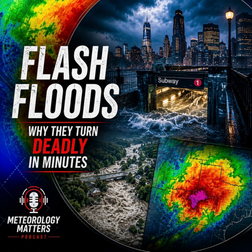
Flash Floods: Why They Turn Deadly in Minutes
Flash floods can happen almost anywhere from New York City subways and the rivers of Central Texas to mountain villages in Italy, the streets of China, and communities across Europe, Asia, and Africa. Why do they become deadly so quickly, even when people know heavy rain is coming? In this episode of Meteorology Matters, we explore the science behind one of the world’s fastest and most misunderstood weather hazards. Through unforgettable disasters and the lessons they taught, we explain how rainfall, terrain, infrastructure, forecasting, and human behavior combine to create life-threatening situations in just minutes. You’ll learn why some storms produce catastrophic flooding, how meteorologists detect these events, what today’s warning systems can and cannot do, and the decisions that often determine who survives. Whether you live in a major city, a mountain valley, or near a small creek, understanding flash floods could one day save your life. Follow meteorologist Rob Jones on Instagram, TikTok, YouTube, and Facebook for more weather insights, and subscribe to Meteorology Matters wherever you listen to podcasts.
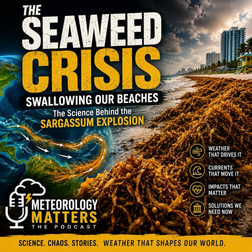
The Seaweed Crisis Swallowing Our Beaches | The Science Behind the Sargassum Explosion
Why are beaches across Florida, the Caribbean, Mexico, and parts of the Gulf Coast being buried under mountains of seaweed and why has it become one of the fastest-growing environmental and economic challenges facing coastal communities? In this episode of Meteorology Matters, we explore the remarkable story of sargassum, a floating seaweed that serves as a vital offshore ecosystem but becomes a costly problem once it reaches shore. We examine the science behind the Great Atlantic Sargassum Belt, how weather patterns and ocean currents control where it accumulates, and why forecasting its arrival remains so challenging. Along the way, we discuss the impacts on tourism, marine life, public health, local governments, and coastal economies, while exploring the latest research into cleanup efforts, forecasting technology, and potential long-term solutions. Whether you’ve encountered sargassum on vacation or simply want to understand one of the Atlantic’s most fascinating environmental stories, this episode explains why the seaweed crisis is about much more than what’s washing up on the beach.
The Hurricane Forecast Is Only Half the Story
A hurricane forecast is only valuable if people understand it, trust it, and know how to act on it. In this episode of Meteorology Matters, meteorologist Rob Jones’ production explores why effective hurricane communication can be just as important as the forecast itself. Using lessons inspired by the career of hurricane specialist Bryan Norcross, we discuss how meteorologists communicate uncertainty, why public trust is earned over time, and how clear messaging can help people make better decisions before, during, and after a storm. We also examine the latest outlook for the 2026 Atlantic hurricane season, why a quieter season does not reduce your risk, and how even an unnamed tropical disturbance can produce dangerous flooding and life-threatening impacts. Along the way, we break down some of the biggest misconceptions in hurricane forecasting, including what the forecast cone really means, why hurricane categories don’t tell the whole story, and why impacts, not names or wind speeds alone, should drive preparedness. Whether you’re a weather enthusiast, emergency manager, fellow meteorologist, or someone who simply wants to better understand hurricanes, this episode offers practical insight into the science, psychology, and communication behind today’s forecasts. Follow Rob Jones on Instagram, TikTok, YouTube, and Facebook for more weather insights, and if you enjoyed this episode, please like, follow, share, and leave a rating or review. Your support helps more people discover Meteorology Matters.
The Great Hackensack & New York City Tornado Disaster of 1895
In July 1895, one of the most remarkable and least remembered tornado disasters in the history of the New York metropolitan area struck without warning. Historic Cherry Hill near modern day Hackensack and River Edge, New Jersey, was devastated as homes, businesses, farms, churches, and the railroad community were torn apart. The same day, another destructive tornado ripped through Woodhaven in what is now Queens, New York City. In this episode of Meteorology Matters, meteorologist Rob Jones reconstructs the disaster property by property, following the storm’s path through Cherry Hill while telling the stories of the people who lived through it. Along the way, we examine the deaths, rescues, destruction, and recovery, while exploring one of the biggest unanswered questions in American weather history: Was this one extraordinary tornado that crossed from New Jersey into New York City, or two separate tornadoes produced by the same storm system? Join us as we revisit one of the forgotten weather disasters that helped shape the history of the New York region.
The Heat Wave That Changed America: How Weather Reshaped Modern Life
What if one weather event quietly transformed an entire nation? The deadly heat wave of 1936 was far more than a record-breaking summer. It changed how Americans dressed, where they lived, how buildings were designed, and accelerated the adoption of air conditioning that would reshape cities, businesses, and everyday life for generations. In this episode of Meteorology Matters, we explore how extreme weather can leave lasting marks on society, not just through disasters, but through the ways people adapt. From sleeping porches and blocks of ice to modern heat domes, urban heat islands, and the future of cooling technology, this is the story of how weather quietly helped build the modern world. Whether you’re fascinated by meteorology, history, engineering, or simply curious about how our daily lives came to look the way they do, this episode reveals why some of the most important weather stories continue long after the forecast has ended. Follow meteorologist Rob Jones for more weather insights, hurricane coverage, and new episodes of Meteorology Matters.
1 of 26