COMM 1035 Listening

COMM 1035 Listening

by Sunny Skye Hughes
Season 1
Unit 7 Lecture: Adaptive and Resilient Listening

Unit 7 focuses on adaptive and resilient listening, emphasizing how to remain effective when communication becomes difficult due to emotional reactions, cognitive overload, or environmental distractions. The lecture explains that listening breakdowns often result from internal triggers, limited processing capacity, emotional intensity, and external stressors, and it highlights that effective listening requires intentional adjustment rather than passive understanding. Drawing on research from cognitive science, emotional intelligence, and communication theory, the unit introduces strategies such as narrowing focus, regulating emotions, asking clarifying questions, using reflective listening, reducing cognitive load, and maintaining an adaptive mindset. Together, these skills build resilient listening—the ability to stay engaged, recover from breakdowns, and maintain accuracy under pressure—reinforcing that strong communication depends not on perfect conditions, but on the ability to adapt and respond effectively in real-world situations
Unit 6 Lecture: Evaluating Information Quality
In this lecture, you will learn how to move beyond simply understanding messages to actively evaluating their credibility. You will explore how listeners often rely on fast, automatic thinking, and how this can lead you to accept information too quickly based on confidence, emotion, or familiarity. You will learn how to slow down and evaluate messages using the EERB framework—expertise, evidence, reasoning, and bias—by asking key questions about who is speaking, what supports the claim, whether the message makes sense, and what perspectives may be influencing it. You will examine different types of expertise, learn how to identify strong and weak evidence, recognize logical fallacies and flawed reasoning, and detect bias and missing information. You will also learn to distinguish between what is persuasive and what is actually credible, as well as how emotional appeals and tone can influence your interpretation. By the end of the lecture, you will be able to evaluate information more intentionally, helping you become a more critical listener, stronger thinker, and more informed decision-maker.
Unit 5 Lecture: Response Styles and Personal Biases
In this episode, we take a deeper look at what really shapes communication—not just what is said, but how it is interpreted and how we respond. While earlier units focused on external factors like context and environment, this lecture shifts inward to explore the role of the listener. Why can two people hear the same message and walk away with completely different reactions? The answer lies in personal biases and response styles. You’ll learn how meaning is constructed internally, how your past experiences and emotions influence interpretation, and how automatic reactions can lead to misunderstanding or conflict. We break down common response styles—like defensive, aggressive, avoidant, passive, assertive, and empathic responses—and examine how each one impacts communication outcomes. This episode also introduces key communication theories and shows how biases, interpretation, emotion, and response all work together in a continuous process that shapes every interaction. Most importantly, you’ll begin to understand how to shift from reacting automatically to responding intentionally—leading to clearer, more effective, and more meaningful communication. Because communication isn’t just about what others say. It’s about what you hear—and what you do next.
Unit 4 Lecture: Listening with Contextual Intelligence
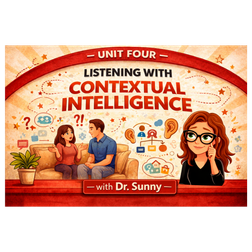
In this episode, we focus on how to listen with contextual awareness in real time—especially in personal, face-to-face conversations. Using a relatable relationship scenario, you’ll learn a practical step-by-step method for pausing before reacting, separating content from interpretation, and quickly scanning relational, situational, cultural, power, and nonverbal cues. Rather than responding defensively, you’ll practice clarifying and reflecting to increase listening fidelity and reduce unnecessary conflict. This lecture emphasizes emotional regulation, interpretive flexibility, and intentional response. By learning to assess context before assigning meaning, you become a calmer, more accurate, and more mature communicator in your personal and professional relationships.
Unit 4 Lecture: Speaking with Contextual Intelligence
In this episode, we shift from analyzing how context shapes listening to learning how to speak with contextual awareness. Communication doesn’t fail only because people mishear us — it often breaks down because we ignore the relational, situational, cultural, power, and channel contexts surrounding our message. This lecture explores how anticipating those five layers can dramatically reduce misinterpretation in academic, professional, and personal conversations. You’ll learn practical strategies for clarifying intent, adjusting for stress and hierarchy, adapting to cultural norms, and choosing the right communication medium. By speaking with contextual intelligence, you make it easier for others to listen accurately — reducing defensiveness, confusion, and unnecessary conflict.
Unit 4 Lecture: Listening and Communication Contexts
In this episode, we explore how meaning is shaped not just by words, but by the contexts surrounding them. Using the recurring example, “Can we talk about your last report?”, we examine how relational context, situational context, cultural norms, organizational power structures, and communication channels influence interpretation. Drawing from major communication and social psychology theories — including Social Penetration Theory, Attribution Theory, High- and Low-Context Communication, Power Distance, Media Richness Theory, and Social Presence Theory — this lecture helps you develop a critical listening skill: the ability to assess how context shapes meaning before reacting. By the end, you’ll be able to pause, identify contextual influences, and interpret messages with greater accuracy and emotional intelligence.
Unit 3 Lecture: Theories and Principles of Listening
This Unit 3 lecture shifts from the “what” of listening to the “why” and “how” by introducing the major theories scholars use to explain listening. The unit’s main goal is to analyze and evaluate listening models—not just define them—so students can diagnose breakdowns and choose better responses in real conversations. The lecture traces how listening became a formal area of study in the mid-20th century, grew into a structured subfield in the 1980s with models like Brownell’s HURIER, and later expanded to include emotion, empathy, identity, culture, and relational dynamics. To make theory practical, the lecture uses one scenario throughout: a coworker, Maya, says, “I feel like I’m carrying most of the weight on this project. I need you to take more initiative.” The HURIER Model breaks listening into six stages—hearing, understanding, remembering, interpreting, evaluating, and responding—helping pinpoint where internal breakdowns occur, often at interpreting and evaluating when negative intent is assigned. The Transactional Model explains meaning as co-created through simultaneous verbal and nonverbal feedback, context, relational history, and noise, showing how tension escalates between people. Listening fidelity adds a measurement lens by asking whether the listener’s constructed meaning matches the speaker’s intent. Mindful and empathic listening introduce the emotional layer, emphasizing attention regulation, emotional awareness, and perspective-taking to reduce defensiveness and build trust. Constructivist listening explains how schemas and lived experience shape interpretation, so the same message can produce different realities. The key takeaway is that no single theory explains everything; each highlights a different layer of listening—cognitive, relational, emotional, and interpretive—so effective analysis requires using multiple lenses.
Unit 2 Recap on Barriers and Challenges in Listening
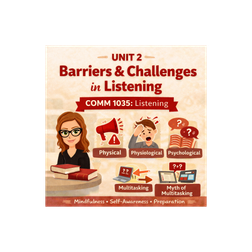
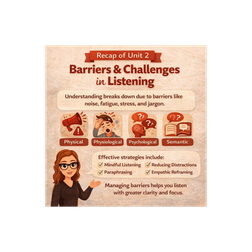
In Unit 2, we examined why listening often breaks down—not because people don’t care, but because barriers interfere with attention and understanding. We explored four major types of listening barriers: physical barriers like noise and technology issues; physiological barriers such as fatigue, illness, or hunger; psychological barriers including stress, emotions, defensiveness, and preoccupation; and semantic barriers that arise from language differences, jargon, or missing context. We also challenged the myth of multitasking, learning that divided attention increases cognitive load and lowers comprehension. The key takeaway is that while barriers can’t always be eliminated, they can be recognized and managed through strategies like mindful listening, reducing distractions, empathic reframing, and paraphrasing—helping you listen with greater clarity, focus, and intention in real-life situations.
Unit 2 Lecture: Barriers and Challenges in Listening
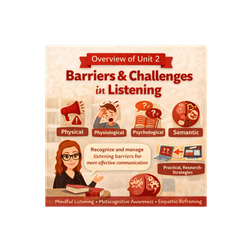
This episode explores the barriers and challenges that interfere with effective listening, emphasizing that listening is an active skill influenced by both internal and external factors. It introduces four main types of listening barriers—physical, physiological, psychological, and semantic—and explains how each can disrupt comprehension, from environmental noise and fatigue to emotional reactions, bias, and language differences. Drawing on research from communication, psychology, and neuroscience, the lecture highlights why multitasking is a myth, how cognitive load limits attention, and how emotions and perceptual filters shape what we hear and understand. It also presents practical, research-based strategies such as mindful listening, metacognitive awareness, environmental control, empathic reframing, and paraphrasing to help listeners manage barriers and improve focus, understanding, and connection in academic, professional, and personal settings.
Unit 2 Overview of Barriers and Challenges in Listening
Unit 2 focuses on the barriers and challenges that interfere with effective listening, emphasizing that even strong listeners encounter obstacles that affect understanding. This unit introduces four main types of listening barriers—physical, physiological, psychological, and semantic—and explains how environmental conditions, physical states, emotions, cognitive overload, bias, and language differences can disrupt comprehension. Students learn how internal and external distractions, multitasking, and emotional reactions limit attention and increase listening effort, while research shows that focus and attention are finite resources. The unit also highlights practical, research-based strategies—such as mindful listening, metacognitive awareness, environmental control, and empathic reframing—to help recognize and manage barriers, leading to more effective communication in academic, professional, and personal contexts.
1 of 3